
Tech
How to Properly Package Perfume for Shipping: Expert Guide


During shipping, most of the products can get damaged because of the harmful physical and environmental damages. Perfume is filled in delicate glass or metallic containers or bottles, which can also crack and scatter during delivery to customer addresses. Because every shipment carries a real risk that can lose the reputation of a perfume brand.
Thus, it’s vital for fragrance businesses to get packaging that ensures the complete protection of perfumes during transit and secures brand trust. In this blog, you will learn how to properly package a perfume for shipping to prevent product loss and damage.
Why Packaging Is Important for Perfumes?
Perfume packaging is not just used for branding and presentation at the shelves. It ensures product safety and brand trust during shipping. Most perfume bottles are made of fragile glass. They break easily during transit without proper protection. Many fragrances also contain alcohol-based compounds. These are classified as flammable liquids by carriers. This means strict shipping regulations apply. Ignoring them can result in fines or rejected shipments.
Poor packaging can cause damage to products and costly returns and repairs. It also destroys customer trust quickly. High-quality packaging plays an important role to keep the fragile glass bottles safe and sound and help brands to enhance the experience of customers. In today’s market, the unboxing moment drives social sharing. If you offer the best Arabian perfumes or French fragrances, packaging is both a protection tool and a marketing asset.
How to Pack Perfume Safely for Shipping?
In this section, you will learn the step by step guide to know how to pack perfumes safely for secure shipment.
Understand the Fragile Nature of the Product
All perfume bottles are made of delicate glass, which can break, leak, or crack when subjected to pressure. To start with, check the form and weight of your perfume bottle. Tall and narrow bottles tend to break more easily compared to wide bottles. It is crucial that you never miss this assessment phase.
Additionally, look at the cap and atomizer because they tend to come off when subjected to transport pressures. They should be wrapped separately using bubble wrapping and foam sleeves. By knowing how delicate perfumes are, you will be in a position to pack them better.
Use Durable Packaging
The outer box should be your first line of protection. The choice of material used to make the box depends on the weight of the perfume bottles. Lighter perfume bottles need to be packed in single-wall boxes while heavy or multi-bottles need double wall boxes.
The size of the box matters as much as its sturdiness. Ensure that there is at least two inches of cushioning around all sides of the bottle. If you use a bigger box, the bottle can move around inside while being transported. Avoid using old boxes or boxes with damage for transporting perfume bottles.
Add Inserts in Your Perfume Boxes
The inserts ensure that the bottle doesn’t move when inside the perfume boxes. Inserts absorb the shock and ensure that nothing moves when transported. Decide on what kind of insert to use depending on your budget and position in the market.
Foam inserts that are cut to match the contours of the bottle provide ultimate protection. These inserts guarantee that there will be no movement and that shock absorption will be efficient. Bubble wraps can be used but with at least two layers and taped down. Cardboard dividers and molded pulp trays can be used if more than one bottle needs to be transported.
EVA foam dies are the best choice for luxury products. These inserts ensure that the product is safe and also make an excellent first impression upon unboxing.
Apply Labels and Take Care of Branding
There are two main reasons for labeling: compliance and communication. All deliveries of perfumes should be labeled as Fragile outside the boxes. The message warns that the delivery requires care when transported. Hazard labels will be needed if there is alcohol in your fragrance. Attach all carrier documents to make sure that there will not be rejections.
The label and box itself reflect the image of your company straight away. Print everything in good quality using appropriate typefaces and fonts. Follow the colors from your brand’s palette. Your packaging must include the product name, logo, and any other safety information.
Small touches can make the difference, too. Branded tissue paper, thank-you cards, and stickers are easy ways to provide customers with a more memorable experience.
Ensure the Convenience of Customers with Packaging
Premium packaging is protective and provides ease during unboxing. Customers will get frustrated by too much tape right from the start. Confusing layers will make their experience unpleasant even before getting to their purchase. Create your packaging always keeping the customer in mind.
Create pull tabs for removing foam insert packaging. Consider adding perforated tear strips or ribbon handles to your outer packaging. Such minor details will ensure that opening the box feels effortless. Always include a return instruction card in the packaging of perfumes. Accessibility is overlooked by many brands. Thus, right packaging solutions can consider it.
Go Eco-Smart
Sustainable packaging is not just a trend but a necessity due to the demands of modern eco-conscious consumers. Being eco-friendly is beneficial both from the ethical and business perspective.
The use of recycled or FSC certified corrugated cardboard boxes or premium rigid boxes are highly recommended. Instead of polystyrene packing peanuts, biodegradable foam may be applied. Soy ink or water-based ink can be utilized during printing. Additional information regarding the right disposal of the packaging via recycling can be provided on the outer side of the box. Small boxes will save money and reduce your environmental footprint significantly.
Conclusion
Care must be taken while packaging perfumes for delivery. From the kind of packaging boxes to inserts, to labels used on these products, everything is important. Creative packaging boxes will not only help to protect the product but also portray the uniqueness of the brand. Smart packaging should be selected, one that will impress the customers.



Today, healthcare organizations are being asked to do more than ever before. For example, to improve patient outcomes, minimize unnecessary costs, and deliver high-quality care at scale.
Even though many providers are still dependent heavily on technology that was built for a completely different healthcare landscape, the challenge here is significant.
Even the Centers for Medicare & Medicaid Services (CMS) stated that value-based care models now account for an increasing share of healthcare payments. This highlights the industry’s ongoing shift away from traditional fee-for-service reimbursement.
Rather than rewarding the volume of services delivered, now providers are increasingly being evaluated on the basis of quality, efficiency, and outcomes of the care they provide. This shift changes the rules of the game.
Now, success is not measured by the number of patient visits or procedures they completed. Healthcare organizations should track quality metrics, manage patient populations more proactively, coordinate care across multiple providers, and identify risks before they become costly complications.
Providers cannot achieve all these goals with generic systems. And this is exactly where technology becomes a critical component.
Organizations need solutions that support data-driven decision-making, seamless care coordination, and real-time performance tracking to thrive in a value-driven ecosystem. This is why many providers are investing in EHR and EMR software development, including custom EHR development, to build systems that align with their unique workflows, reporting requirements, and value-based care goals.
Let’s explore how custom EHR solutions help healthcare organizations align with value-based care objectives, improve operational efficiency, and create better outcomes for both patients and providers.
Why Traditional EHR Systems Often Fall Short
As healthcare organizations continue to move towards value-based care, many have discovered that their existing EHR systems were not built for this new approach of delivering care. Many traditional EHRs were specifically designed for a fee-for-service model in which the primary goal was to document patient visits, generate billing codes, and support reimbursement processes.
As these systems handle documentation well, value-based care needs a much broader view. Providers are expected to track patient outcomes, close care gaps, manage chronic conditions, and improve quality measures over time. Even so, many standard EHRs struggle to support these goals.
Instead of the overall health journey of a patient, traditional systems focus only on individual visits. For example, recording that a patient attended an appointment is straightforward. Identifying which patients are overdue for preventive screenings or whose conditions are worsening often requires extra effort and manual tracking.
When managing larger patient populations, the limitations become even more apparent. As many off-the-shelf EHRs provide only basic reporting capabilities, this makes it difficult to monitor quality metrics or identify high-risk patients across an entire organization. As a result, staff members can spend hours just pulling data from different sources, creating spreadsheets, and generating reports manually.
These inefficiencies can quickly become an obstacle when reimbursement is increasingly tied to outcomes instead of services provided. Healthcare organizations need technology that goes beyond documentation and actively supports better decision making, care coordination, and population health management to succeed in a value-based environment.
How Custom EHR Supports Value-Based Care Organizations
All of these challenges are not impossible to solve. Instead of simply documenting visits and processing claims, a custom EHR value-based care organization is specifically designed to support outcome-driven care.
Proactive patient management is one of the key advantages of it. Patient risk stratification software for healthcare organizations helps care teams to quickly identify high-risk patients and intervene early before minor issues turn into major complications. With this, providers can stay one step ahead, rather than reacting to problems.
Furthermore, by bringing the right information together in one place, custom EHRs also support better care coordination. They can also capture social determinants of health (SDOH) like transportation or housing challenges. This can further help providers to understand and address factors that may affect patient outcomes.
Organizations can track performance measures as part of their everyday workflow, rather than spending hours collecting data for programs like MIPS, MACRA, and HEDIS. This can save time, minimize administrative burden, and provide a clearer view of progress.
For example, if a patient with hypertension misses follow-up appointments and has uncontrolled blood pressure, the system can flag the patient for outreach and notify the appropriate care team. Small actions like these can improve outcomes while helping organizations meet value-based care goals.
The Role of Interoperability and Analytics
If providers are working with incomplete information, even the best care plans can fall short. That is why interoperability in value-based healthcare is so important. Patients often receive care from multiple providers, labs, pharmacies, and specialists. When these systems can share data seamlessly, care teams get a more complete view of each patient’s health.
But collecting data is only half the battle. Organizations also need a way to make sense of it. A population health management dashboard brings key information together in one place, helping providers track care gaps, monitor high-risk patients, and measure progress toward quality goals without digging through countless records.
Analytics takes this a step further. By analyzing both historical and real-time data, healthcare organizations can spot trends and identify patients who may need attention before a problem becomes more serious. In other words, they can catch issues early rather than playing catch-up later.
Together, interoperability and analytics turn scattered data into actionable insights. Instead of simply storing information, healthcare organizations can use it to make smarter decisions, improve patient outcomes, and control costs—core goals of every value-based care program.
Financial and Operational Benefits
The benefits of getting this right show up on both the clinical and financial ledgers. The clearest is reducing avoidable readmissions and care costs. When the system flags high-risk patients and prompts timely intervention, organizations prevent the expensive admissions and complications that value-based contracts penalize — protecting both patients and margins.
That performance translates into stronger reimbursement. By tracking and hitting quality measures and shared-savings targets, organizations improve their reimbursement opportunities under value-based contracts rather than leaving incentive dollars on the table. For decision-makers, that is the direct return on the technology investment.
There are operational gains too. By automating the manual tracking and reporting that drain staff time, a custom EHR enhances provider efficiency and frees teams to focus on patient engagement, which itself improves adherence and outcomes. Many value-based activities, from chronic care management to annual wellness visits, are also separately reimbursable when properly documented, so a system that captures this work helps a practice both deliver and bill for proactive care. And because the system is purpose-built, it supports long-term scalability and growth: as the organization takes on more patients, more contracts, and more risk, the platform can grow with it rather than becoming a bottleneck.
Key Considerations When Building a Custom EHR
Building a custom EHR is a significant undertaking, and a few considerations determine whether it succeeds. The first is non-negotiable: compliance, security, and data governance. The system must meet HIPAA requirements with encryption, access controls, and audit trails, and it needs clear rules for how data is owned, managed, and kept accurate because flawed data produces flawed quality scores.
The second is fit with what already exists. Few organizations start from a blank slate, so integration with existing healthcare technologies — billing systems, labs, patient engagement tools, and other platforms has to be planned carefully, ideally on interoperability standards like FHIR.
The third is human. The most sophisticated system delivers nothing if clinicians won’t use it, so user adoption and workflow optimization deserve as much attention as the technology itself, involving staff early, fitting the tool to real workflows, and rolling out in phases. Finally, value-based care is still evolving, so it pays to plan for future requirements, building flexibility to adapt as programs, measures, and risk models change.
Conclusion
Value-based care has changed the rules, and the organizations that thrive under it will be those that can see, measure, and act on the health of their whole population. Generic EHRs built for fee-for-service billing simply were not designed for that work, which is why custom EHRs are becoming essential for value-based care organizations rather than a luxury.
The throughline is simple: better data leads to better outcomes, and better outcomes lead to better reimbursement. A custom-built EHR solution, supported by strategic EHR software development, is what connects those dots — turning scattered clinical information into proactive care, measurable quality, and sustainable financial performance.
For providers, administrators, and decision-makers navigating the shift to value, that connection is no longer optional; it is the foundation of doing this work well.
Frequently Asked Questions
- What makes a custom EHR better suited for value-based care organizations?
It is built around outcomes rather than billing with tailored workflows, patient risk stratification, SDOH capture, and automated quality reporting baked in. That lets organizations track and improve population health and hit value-based targets without bolting on workarounds.
- How can a custom EHR support MIPS and MACRA reporting requirements?
It can capture the required quality and performance data during normal care and generate the measures automatically, rather than through manual year-end exports. This makes reporting for the Quality Payment Program more accurate, less labor-intensive, and far easier to sustain.
- What role does patient risk stratification play in value-based care?
It sorts the population by risk level so care teams can focus on high-risk patients before problems escalate. This proactive targeting prevents costly admissions and complications — the core of improving outcomes while controlling cost under value-based contracts.
- How does SDOH integration improve patient outcomes?
Capturing social determinants like housing, transportation, and food access reveals the real-world barriers behind poor health. With that insight, care teams can connect patients to the right resources and address root causes, not just clinical symptoms, improving outcomes and reducing avoidable utilization.
- Why is interoperability important in value-based healthcare?
Value-based care requires a complete view of each patient, but data is scattered across providers, labs, and pharmacies. Interoperability connects it into one current record, so risk scores, quality measures, and care decisions are based on the full picture rather than fragments.
- How do population health management dashboards support care teams?
They turn raw data into a clear, real-time view of the whole panel — risk levels, open care gaps, and performance against quality targets. Instead of combing through charts, teams instantly see where to focus, making outreach and quality improvement far more efficient.
- Can predictive analytics help reduce healthcare costs?
Yes. By flagging patients likely to be readmitted or to decline, predictive models let teams intervene early, preventing expensive emergencies. Catching problems before they escalate is one of the most reliable ways to lower cost while improving outcomes.
- What should healthcare organizations consider before implementing a custom EHR for value-based care?
Key factors are HIPAA compliance and data governance, integration with existing systems, clinician adoption and workflow fit, and flexibility to adapt as value-based programs evolve. Planning for these up front determines whether the system delivers lasting value.
Evidence:



Cloud storage rarely stays simple for long. A personal Google Drive grows beside a work OneDrive, photos land in another service, and an old Dropbox account still holds folders nobody wants to download again. The result is not a shortage of storage; it is a coordination problem. MultCloud approaches that problem through a browser-based dashboard that connects separate cloud accounts and moves, syncs, or backs up data between them.
What Is MultCloud?
At its core, MultCloud’s web dashboard is a multi-cloud manager. After authorizing supported services, users can browse connected storage and create automated tasks without repeatedly downloading files to a computer and uploading them elsewhere. The product currently presents Cloud Transfer, Cloud Sync, Cloud Backup, and cloud-file management as distinct tools, which is helpful because a one-time migration is not the same job as keeping two folders aligned.
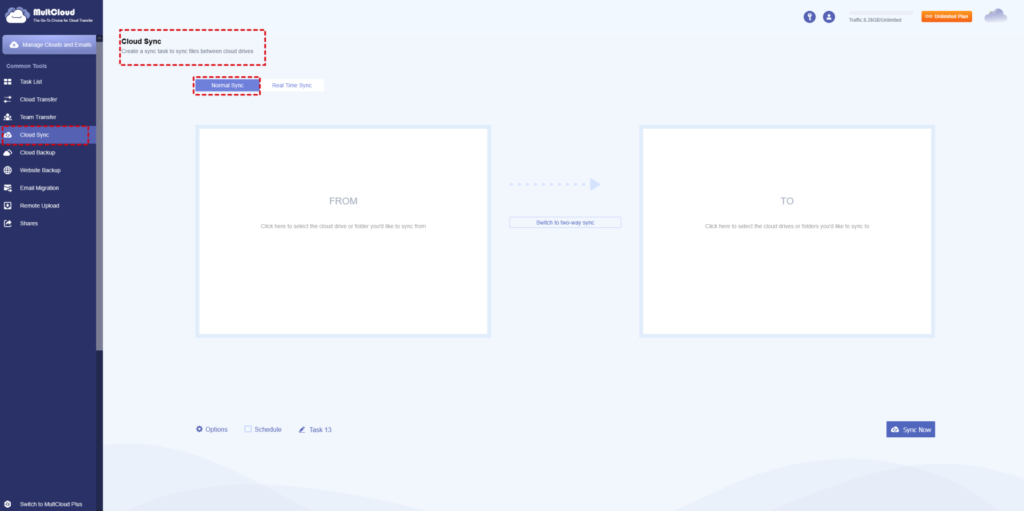
Cloud Sync is the feature that matters here. It can connect a source folder in one service with a destination in another, using one-way or two-way behavior. The interface also exposes Normal Sync and Real Time Sync, plus options for schedules and task management. That makes it useful for recurring workflows such as mirroring a project archive, keeping a second service updated, or maintaining an off-platform copy of frequently changed folders.
What Makes Cloud Sync Useful?
The strongest practical benefit is separation from the local computer. Once a sync task is configured, MultCloud handles the cloud-to-cloud work online, so the user does not have to keep a browser open for every file. That is more convenient than staging a large folder on a laptop, particularly when local disk space is limited.
The second advantage is control. A simple one-way task suits an archive or publishing workflow, while two-way sync is better when both locations should reflect changes. Real-time and scheduled choices reduce the need to remember a manual copy. MultCloud’s options can also narrow the job by file type, and email notifications can report completion. For a focused example, the company’s online tool for users who need to migrate Google Drive to OneDrive shows how a specific route can be handled without the traditional download-and-upload cycle.
Hands-On Review: Where It Works Well—and Where to Pause
The Cloud Sync screen is easier to understand than many automation tools: the source is on the left, the destination is on the right, and the direction of travel is visible between them. Options, Schedule, the task name, and Sync Now remain on the same working canvas. This reduces the chance of configuring a task in one screen and forgetting an important setting in another.
There is still a learning curve. One-way sync can behave differently depending on the selected mode, and some advanced modes are tied to paid access. Two-way sync also deserves care because changes can travel in both directions. Before syncing a large production folder, use a small test directory, confirm which side is the source of truth, and review the permissions granted to each connected cloud. MultCloud is most useful when automation is paired with a clear retention plan—not when it becomes a reason to stop thinking about file ownership.
How to Sync One Cloud to Another Easily with MultCloud
1. Create an account and open the dashboard
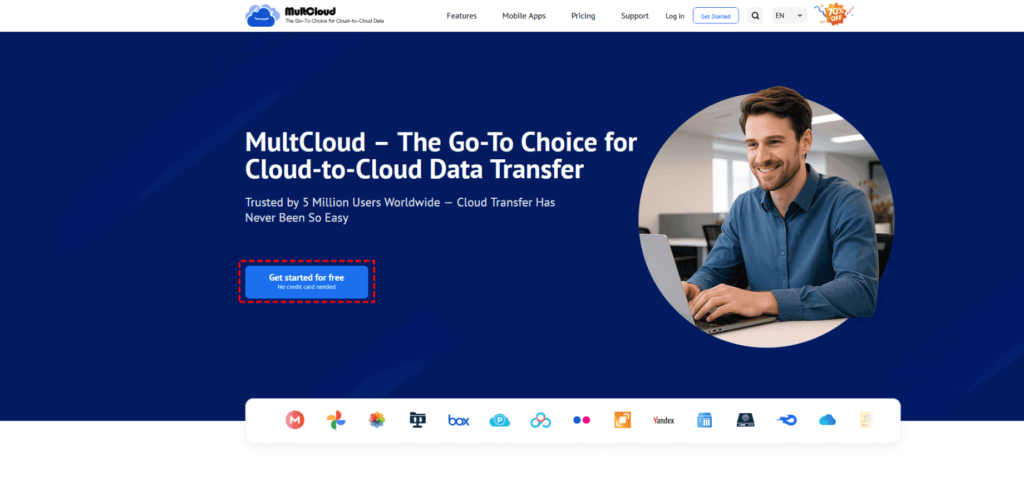
Open MultCloud, choose Get Started, and create or sign in to an account. No cloud data is moved at this stage. The first objective is simply to reach the dashboard where services and tasks are managed.
2. Add the cloud services you plan to use
Choose Manage Clouds and Emails, then Add Clouds and Emails. Select the source cloud and complete its authorization flow; repeat for the destination cloud. Read each permission screen before approving it. If you connect two accounts from the same cloud, give them clear display names so they are not confused later.
3. Open Cloud Sync and choose the sync type
Select Cloud Sync from Common Tools. Normal Sync covers scheduled or manually launched tasks; Real Time Sync watches for changes after setup. The screen also offers a switch for two-way sync. Leave the task as one-way unless you genuinely need updates to travel in both directions.
4. Select the source and destination
Click the FROM panel and choose the cloud, folder, or files to sync. Then click TO and choose the destination location. Check the direction arrow before continuing. A reversed task can place data in the wrong account or apply a mode to the wrong side.
5. Review options, schedule the task, and start syncing
Open Options to confirm the sync method and any filters or notifications. Use Schedule if the job should run daily, weekly, or monthly, and rename the task so it will be recognizable in Task List. Finally, select Sync Now. Monitor the first run and inspect a few destination files before treating the setup as complete.
Who Is MultCloud Best For?
MultCloud fits people who actively use more than one storage provider: freelancers separating client work from personal files, small teams maintaining a secondary copy, photographers distributing libraries, and administrators consolidating legacy accounts. It is less compelling for someone whose files already live comfortably in one ecosystem or whose organization prohibits third-party cloud connectors.
Final Verdict
MultCloud turns an awkward manual routine into a readable, reusable task. Its main strength is not simply connecting many services; it is giving transfer, synchronization, and backup separate workflows while keeping them in one dashboard. Cloud Sync is especially practical when the same folder needs to stay available across providers. Start with a test folder, choose the direction carefully, and the platform can remove a surprising amount of repetitive file handling.
Frequently Asked Questions
Does MultCloud require files to be downloaded first?
No. Its official Cloud Sync workflow is designed to process tasks between connected cloud services online rather than staging every file on the user’s computer.
What is the difference between one-way and two-way sync?
One-way sync sends changes from a defined source toward a destination. Two-way sync is intended to keep both selected locations aligned, so changes may be reflected in either direction.
Can a Cloud Sync task run on a schedule?
Yes. The Cloud Sync workspace includes a Schedule control for recurring tasks, alongside Options and task naming.
Should I test the task before syncing an entire account?
Yes. A small, non-critical folder helps confirm direction, mode, permissions, and destination behavior before a broader rollout.


Introduction
Editing images has become an essential part of digital content creation. Whether you’re refreshing product photos, redesigning social media graphics, or experimenting with artistic concepts, traditional photo editing can take considerable time and effort. Many users also find professional editing software difficult to learn.
EzMaker AI Image to Image simplifies this process by using artificial intelligence to transform one image into another while preserving the core subject. Instead of creating an image from scratch, the tool takes an existing photo and applies new styles, effects, or visual enhancements based on your instructions.
This makes it an excellent solution for creators, marketers, businesses, and designers who want to produce fresh visuals quickly without spending hours on manual editing.
What Is AI Image-to-Image Technology?
Unlike text-to-image generation, image-to-image AI starts with an existing picture. The original image acts as a reference while artificial intelligence modifies its appearance according to the user’s prompt or selected style.
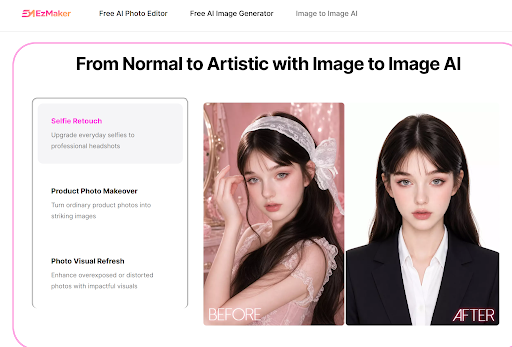
For example, a simple portrait can become a digital painting, an anime character, a cinematic scene, or a futuristic illustration while maintaining recognizable facial features and composition. This technology combines creativity with automation, allowing users to explore countless visual possibilities.
Reimagine Your Existing Images
Many people already have photos they like but want them to look more creative or professional. Instead of taking new pictures, EzMaker AI allows users to reinvent their existing images.
Common transformations include:
- Realistic to digital art
- Photo to watercolor painting
- Portrait to anime
- Sketch to colored artwork
- Daytime scene to night view
- Simple background to cinematic environment
- Casual photo to professional artwork
These transformations give old images a completely new appearance while keeping their original identity.
Why Image-to-Image AI Is Becoming Popular
Modern content creators constantly need fresh visuals. Reusing the same photos repeatedly can make content feel repetitive. Image-to-image AI provides an easy solution by generating multiple creative versions of a single image.
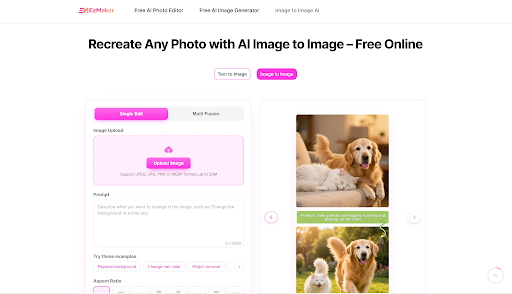
Instead of organizing another photo shoot or redesigning graphics from scratch, creators can refresh existing visuals in minutes. This flexibility has made AI-powered image editing increasingly valuable across many industries.
Creative Possibilities Without Complex Editing
Traditional editing often involves masking, layers, filters, brushes, and advanced software knowledge. EzMaker AI removes much of this complexity.
Users simply upload an image, describe the desired transformation, and allow the AI to handle the creative process. This enables beginners to achieve impressive visual results without requiring professional editing skills.
Ideal for Content Creators
Content creators frequently need original visuals to keep their audiences engaged. With EzMaker Image to Image AI, they can quickly transform existing photos into unique graphics for:
- YouTube thumbnails
- Instagram posts
- Facebook advertisements
- Pinterest graphics
- Blog illustrations
- Personal branding
- Digital portfolios
Creating multiple variations from a single image also provides greater flexibility when testing different content styles.
Helping Businesses Refresh Marketing Assets
Marketing materials often become outdated after repeated use. Instead of replacing every visual entirely, businesses can transform existing assets into fresh designs while maintaining brand consistency.
Examples include:
- Seasonal campaign graphics
- Product promotion updates
- Website banners
- Email marketing visuals
- Social media advertisements
- Event promotions
This approach helps companies save time while keeping their marketing materials visually engaging.
Popular Image Transformation Styles
EzMaker AI supports many artistic directions depending on the user’s creative goals.
Some popular styles include:
Digital Illustration
Convert ordinary photographs into polished digital artwork suitable for websites and presentations.
Oil Painting
Apply classic painting textures and artistic brush strokes to modern images.
Anime Style
Transform portraits into colorful anime-inspired characters.
Fantasy Art
Create magical environments filled with imaginative lighting, creatures, and dramatic scenery.
Cinematic Look
Give photos a movie-inspired atmosphere using professional lighting and color grading effects.
Vintage Style
Apply nostalgic colors and classic photography aesthetics for timeless visuals.
Tips for Better Transformations
Although AI performs most of the editing, thoughtful instructions improve the final outcome.
For stronger results:
- Use clear, high-quality source images.
- Describe the desired artistic style.
- Mention lighting preferences.
- Specify background changes.
- Include color themes.
- Keep prompts detailed but easy to understand.
Experimenting with different prompts can produce surprisingly creative variations from the same image.
Saving Time Across Creative Projects
Image editing often slows down production schedules, especially when multiple versions of the same graphic are required. EzMaker AI helps simplify this process by producing new variations quickly.
Creative professionals can spend less time editing and more time focusing on strategy, storytelling, and audience engagement. For agencies handling multiple clients, this efficiency can significantly improve productivity.
The Future of AI-Powered Image Editing
Artificial intelligence continues to improve its understanding of images, textures, lighting, and artistic styles. Future developments are expected to provide:
- More realistic transformations
- Better preservation of facial details
- Greater customization options
- Faster image processing
- Improved consistency across multiple edits
- Smarter style adaptation
As these technologies evolve, AI-powered editing will become an increasingly valuable companion for creative professionals.
Conclusion
EzMaker AI Image to Image offers a simple yet powerful way to reinvent existing visuals through artificial intelligence. By transforming ordinary photos into unique artistic creations, it helps creators, businesses, and marketers produce fresh content without starting from scratch.
Whether you’re refreshing marketing materials, enhancing personal photos, or exploring creative concepts, the platform provides a faster and more accessible approach to image editing. As visual storytelling continues to grow in importance, AI image-to-image technology is becoming an essential tool for modern digital creativity.

Custom EHR for Value-Based Care Organizations

How Much Does Car Storage Cost in Rochester, NY? A Complete 2025 Pricing Guide

Top 5 Benefits of Choosing Contract to Hire Solutions

Cost Breakdown: Hiring an IPO Consultant in India

Does Overdesign Reduce Garden Functionality?

What Is MultCloud? The Smarter Way to Manage Multiple Cloud Storage Accounts

The 15 Highest-Paid Rugby Players in the World

Christopher Dare: The Untold Story of Engineer and Former Husband of Angela Rippon

How to Ensure Your Home is Valued Correctly for a Quick Sale

Nancy Hallam: The Inspiring Life, Career, and Success Story Behind Ian Wright’s Wife

Who Is Maisie Mae Roffey? The Private Life, Family Story, and Quiet Success of Julie Walters’ Daughter

Simon Dixon Biography: Lifestyle, Net Worth, Family, Career and Success Story
The 15 Highest-Paid Rugby Players in the World
Christopher Dare: The Untold Story of Engineer and Former Husband of Angela Rippon
How to Ensure Your Home is Valued Correctly for a Quick Sale
Nancy Hallam: The Inspiring Life, Career, and Success Story Behind Ian Wright’s Wife
Who Is Maisie Mae Roffey? The Private Life, Family Story, and Quiet Success of Julie Walters’ Daughter
Simon Dixon Biography: Lifestyle, Net Worth, Family, Career and Success Story
-
 Sports2 months ago
The 15 Highest-Paid Rugby Players in the World
-
Celebrity8 months ago
Christopher Dare: The Untold Story of Engineer and Former Husband of Angela Rippon
-
 Real Estate6 months ago
How to Ensure Your Home is Valued Correctly for a Quick Sale
-
Celebrity9 months ago
Nancy Hallam: The Inspiring Life, Career, and Success Story Behind Ian Wright’s Wife
-
Celebrity8 months ago
Who Is Maisie Mae Roffey? The Private Life, Family Story, and Quiet Success of Julie Walters’ Daughter
-
Business8 months ago
Simon Dixon Biography: Lifestyle, Net Worth, Family, Career and Success Story
-
 Celebrity9 months ago
Johnny Carell: Inside the Life, Family, and Rising Success of Steve Carell’s Son
-

 Health6 months ago
Enclomimed 25 (Enclomiphene) – Effective PCT Protocol