
Tech
What Is MultCloud? The Smarter Way to Manage Multiple Cloud Storage Accounts


Cloud storage rarely stays simple for long. A personal Google Drive grows beside a work OneDrive, photos land in another service, and an old Dropbox account still holds folders nobody wants to download again. The result is not a shortage of storage; it is a coordination problem. MultCloud approaches that problem through a browser-based dashboard that connects separate cloud accounts and moves, syncs, or backs up data between them.
What Is MultCloud?
At its core, MultCloud’s web dashboard is a multi-cloud manager. After authorizing supported services, users can browse connected storage and create automated tasks without repeatedly downloading files to a computer and uploading them elsewhere. The product currently presents Cloud Transfer, Cloud Sync, Cloud Backup, and cloud-file management as distinct tools, which is helpful because a one-time migration is not the same job as keeping two folders aligned.
Cloud Sync is the feature that matters here. It can connect a source folder in one service with a destination in another, using one-way or two-way behavior. The interface also exposes Normal Sync and Real Time Sync, plus options for schedules and task management. That makes it useful for recurring workflows such as mirroring a project archive, keeping a second service updated, or maintaining an off-platform copy of frequently changed folders.
What Makes Cloud Sync Useful?
The strongest practical benefit is separation from the local computer. Once a sync task is configured, MultCloud handles the cloud-to-cloud work online, so the user does not have to keep a browser open for every file. That is more convenient than staging a large folder on a laptop, particularly when local disk space is limited.
The second advantage is control. A simple one-way task suits an archive or publishing workflow, while two-way sync is better when both locations should reflect changes. Real-time and scheduled choices reduce the need to remember a manual copy. MultCloud’s options can also narrow the job by file type, and email notifications can report completion. For a focused example, the company’s online tool for users who need to migrate Google Drive to OneDrive shows how a specific route can be handled without the traditional download-and-upload cycle.
Hands-On Review: Where It Works Well—and Where to Pause
The Cloud Sync screen is easier to understand than many automation tools: the source is on the left, the destination is on the right, and the direction of travel is visible between them. Options, Schedule, the task name, and Sync Now remain on the same working canvas. This reduces the chance of configuring a task in one screen and forgetting an important setting in another.
There is still a learning curve. One-way sync can behave differently depending on the selected mode, and some advanced modes are tied to paid access. Two-way sync also deserves care because changes can travel in both directions. Before syncing a large production folder, use a small test directory, confirm which side is the source of truth, and review the permissions granted to each connected cloud. MultCloud is most useful when automation is paired with a clear retention plan—not when it becomes a reason to stop thinking about file ownership.
How to Sync One Cloud to Another Easily with MultCloud
1. Create an account and open the dashboard
Open MultCloud, choose Get Started, and create or sign in to an account. No cloud data is moved at this stage. The first objective is simply to reach the dashboard where services and tasks are managed.

2. Add the cloud services you plan to use
Choose Manage Clouds and Emails, then Add Clouds and Emails. Select the source cloud and complete its authorization flow; repeat for the destination cloud. Read each permission screen before approving it. If you connect two accounts from the same cloud, give them clear display names so they are not confused later.
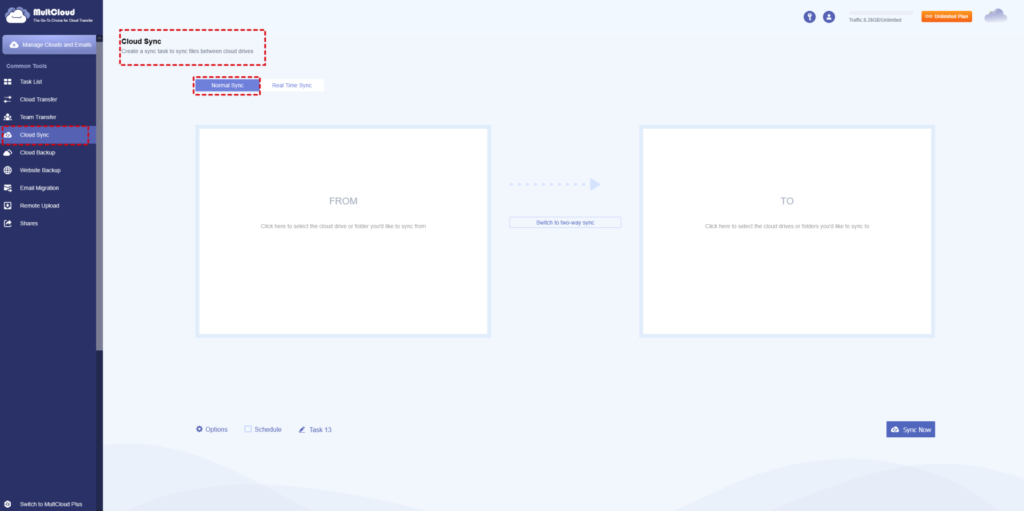
3. Open Cloud Sync and choose the sync type
Select Cloud Sync from Common Tools. Normal Sync covers scheduled or manually launched tasks; Real Time Sync watches for changes after setup. The screen also offers a switch for two-way sync. Leave the task as one-way unless you genuinely need updates to travel in both directions.
4. Select the source and destination
Click the FROM panel and choose the cloud, folder, or files to sync. Then click TO and choose the destination location. Check the direction arrow before continuing. A reversed task can place data in the wrong account or apply a mode to the wrong side.
5. Review options, schedule the task, and start syncing
Open Options to confirm the sync method and any filters or notifications. Use Schedule if the job should run daily, weekly, or monthly, and rename the task so it will be recognizable in Task List. Finally, select Sync Now. Monitor the first run and inspect a few destination files before treating the setup as complete.
Who Is MultCloud Best For?
MultCloud fits people who actively use more than one storage provider: freelancers separating client work from personal files, small teams maintaining a secondary copy, photographers distributing libraries, and administrators consolidating legacy accounts. It is less compelling for someone whose files already live comfortably in one ecosystem or whose organization prohibits third-party cloud connectors.
Final Verdict
MultCloud turns an awkward manual routine into a readable, reusable task. Its main strength is not simply connecting many services; it is giving transfer, synchronization, and backup separate workflows while keeping them in one dashboard. Cloud Sync is especially practical when the same folder needs to stay available across providers. Start with a test folder, choose the direction carefully, and the platform can remove a surprising amount of repetitive file handling.
Frequently Asked Questions
Does MultCloud require files to be downloaded first?
No. Its official Cloud Sync workflow is designed to process tasks between connected cloud services online rather than staging every file on the user’s computer.
What is the difference between one-way and two-way sync?
One-way sync sends changes from a defined source toward a destination. Two-way sync is intended to keep both selected locations aligned, so changes may be reflected in either direction.
Can a Cloud Sync task run on a schedule?
Yes. The Cloud Sync workspace includes a Schedule control for recurring tasks, alongside Options and task naming.
Should I test the task before syncing an entire account?
Yes. A small, non-critical folder helps confirm direction, mode, permissions, and destination behavior before a broader rollout.



Welding puts more stress on protective gear than almost any other trade. Molten spatter, radiant heat, sparks that arc in unpredictable directions, and hours of friction against a bench all add up fast. Yet a lot of welders are wearing an apron that looks the part but quietly fails the moment it matters.
The problem is that apron damage is rarely obvious until it’s too late. A weak spot doesn’t announce itself — it just lets a spark through at the worst possible moment. Below are five warning signs that your current apron may not be doing its job, and what to look for in a replacement.
It Scorches, Chars, or Melts Instead of Resisting Heat
Run your hand over the apron after a session. If you find small burn marks, hardened or glazed patches, or areas where the surface has gone stiff and brittle, the material is absorbing damage it shouldn’t be.
This is usually a sign the apron isn’t made from real leather at all — or that it’s a lower grade that can’t take sustained heat exposure. A proper leather apron for welding should shrug off short contact with sparks and spatter without scorching through. If yours is showing char marks after every use, the material is degrading faster than it should, and each burn mark is a thinner spot the next spark can pass straight through.

You Can See or Feel Layers Peeling Apart
Pick up the edge of the apron and flex it slightly. If you notice separation — a top layer starting to lift, flake, or peel away from a backing material underneath — you’re dealing with bonded or reconstituted leather, not a single piece of hide.
Bonded leather is made from scraps of leather fiber glued together with a polyurethane coating. It looks convincing on a store shelf, but heat and constant flexing break down that adhesive layer quickly. Once it starts peeling, it only gets worse, and the protective barrier becomes inconsistent across the apron. A genuine full grain leather apron, by contrast, is cut from a single hide with the natural grain intact — there’s no glue layer to fail, so it doesn’t delaminate under heat and repeated bending.
The Stitching Is Single-Row, Uneven, or Already Fraying
Stitching takes as much abuse as the leather itself, especially at stress points like the neck strap, waist ties, and pocket seams. If your apron uses a single row of stitching, has visibly uneven spacing, or already shows loose or broken threads after a few months, it’s a weak point waiting to fail.
Look for double-stitched seams at every load-bearing point. This isn’t just about longevity — a seam that rips open mid-shift can let the apron shift out of position exactly when you need full coverage. Reinforced stitching is one of the easiest things to check before buying, and one of the most commonly cut corners on cheaper aprons.

Hardware Is Rusting, Bending, or Already Broken
Cheap rivets, buckles, and D-rings are usually plated rather than solid metal. Under welding heat and shop humidity, that plating wears off fast, and what’s underneath starts to rust, bend, or snap. A broken buckle or a rivet that’s pulled loose from the leather isn’t just an inconvenience — it can mean straps that won’t stay adjusted, pockets that won’t hold tools securely, or an apron that shifts and exposes skin mid-task.
Solid brass hardware costs more to manufacture, which is exactly why manufacturers cut it first on budget aprons. If your hardware is showing rust spots or has already failed once, treat it as an early warning that the rest of the build quality is probably just as compromised.
It’s Thin Enough to See Light Through, or Flexes Like Fabric
Hold the apron up to a light source. If you can see light coming through the leather, or if the material folds and drapes more like heavy fabric than like leather, it’s too thin to offer real spark and heat protection.
Weld-grade protection generally calls for leather in the 1.2mm–1.6mm range — thick enough to absorb heat and resist punch-through from spatter, but still flexible enough to move with you over a full shift. Thinner leather (often marketed as “genuine leather” rather than full grain) is split or sanded down during processing, which strips away the dense, protective outer layer of the hide. A full grain leather apron keeps that outer layer intact, which is what gives it both the thickness and the natural resistance that thinner, processed leather can’t match.

What to Look for Instead
If your current apron is showing two or more of these signs, it’s not a maintenance problem — it’s a replacement problem. When shopping for a new one, prioritize:
- Full-grain cowhide, not bonded or heavily processed “genuine leather”
- 1.2mm–1.6mm thickness for real heat and spark resistance
- Double-stitched seams at every stress point
- Solid brass hardware, not plated metal
- Adjustable straps that let the apron sit close to the body without gaps
A well-made leather apron for welding isn’t just a uniform piece — it’s the last layer between you and a spark that’s traveling toward your skin. Worn-out gear is easy to overlook because the damage builds gradually, but the signs above are your apron telling you it’s already behind on the job.


Modern enterprises use numerous systems, servers, and devices, and they must all function properly. In complex IT environments, manually setting up and modifying these systems is laborious, repetitive, and prone to human error. Configuration automation comes into play here, enabling businesses to quickly and accurately manage their IT operations. Automation allows you to perform repetitive tasks reliably without human intervention for each little adjustment. Businesses can reduce mistakes, save time, and achieve more consistency and stability across their technology environment by automating routine configuration tasks.
1. Reducing Human Error in Daily Operations
A huge advantage of configuration automation is the minimization of human error. If engineers are manually configuring every day, tiny mistakes can eventually develop that could cause major issues. Automation removes this chance by always following set directions with no fatigue and distractions. Regardless of who started the process, this consistency guarantees that systems operate precisely as intended. Reduced errors result in fewer interruptions, and less troubleshooting, as well as more assurance in day-to-day operations.
2. Saving Valuable Time Across Teams
Hours that could be used for more productive work are frequently wasted on manual configuration procedures. Automation swiftly completes tedious setup procedures, allowing technical teams to concentrate on creativity in addition to problem-solving. Automated scripts can finish the same operation in minutes rather than requiring a whole day to configure similar systems one by one. Large-scale rollouts and urgent system changes make this time efficiency extremely essential. Operational tasks no longer consume teams, allowing them to focus on strategic goals.
3. Maintaining Consistency Across Systems
Inconsistencies are nearly inevitable when several systems are manually configured.
Automation allows you to standardize every server, device, and application to the same baseline configuration. Standardization is key for multi-site organizations and larger networks. It’s much easier to find problems, push updates, and ensure compliance with internal policies when everything is configured the same. Manually recording these variations becomes a laborious and error-prone operation in the absence of technology. A standardized environment strengthens the foundation for smoothly scaling operations as the business expands, streamlines management, and increases dependability.
4. Closing Security Gaps with Automation
Out-of-date or incorrectly configured systems leave gaps in your security. Automation lets you quickly and consistently apply security settings to close that gap. Automated procedures can implement security regulations instantly rather than waiting for manual updates, lowering exposure to possible attacks. In large environments with plenty of endpoints, this proactive strategy reduces the likelihood of oversight. It’s also easy to identify when someone has made unauthorized changes with automation. If something is different than how it’s configured to be, you’ll know. Automation can significantly improve your organization’s security.
Conclusion
For businesses looking to improve productivity, consistency, and security in complex IT settings, configuration automation has become crucial. Businesses can further automate their operations with Opkey by utilizing a single Cloud Application Lifecycle Management (CALM) platform driven by Argus AI. Opkey automates configuration, testing, impact analysis and training for Oracle, Workday, Salesforce, Coupa and more business applications so teams can confidently embrace change. The no-code AI automation platform helps businesses operate simpler, become more dependable and continuously improve enterprise applications across their lifecycle by decreasing manual effort up to 80%, cutting go-live schedules by 30% and mitigating risk of downtime by 92%.

You have great products, but they aren’t fetching you customers. They may be browsing and adding stuff to their cart. But they leave right before paying.
A lot is actually going wrong on your checkout page to cause this.
A shipping fee might show up too late. A form might ask for too many details before someone can pay. Sometimes your checkout might show payment methods your customers don’t prefer. Moreover, the experience might not be smooth on their mobiles.
Switching to a new ecommerce checkout solutions provider won’t change things overnight. You need to understand the problems impacting your revenue in depth. Let’s begin.
1. Too Many Steps at Checkout
Picture this. A customer loves your products and is ready to buy some. Just when they were about to complete the payment, your checkout page throws in lots of tricky steps. This can be requesting a password with strict rules or adding a CAPTCHA or “verify you are human” check.
That’s just going to make the checkout process annoying.
Start by cutting your checkout down to what’s essential. Keep it to a name, address, payment details, and confirmation. Nothing else belongs on that screen. Make sure shipping costs, taxes, and any fees are displayed on the product page or cart before checkout begins.
The page must have autofill for country/location based on the shipping address. Don’t just place a long dropdown country selector. You can add a shipping calculator that updates in real time. If you offer free shipping past a certain order value, let customers know that early on.
2. Payment Options Customers Don’t Fancy
A customer can love your product, breeze through your checkout, and still walk away because you didn’t offer a payment method they’d like. You see, buy-now-pay-later options and digital wallets aren’t extras anymore. They are the norm now.
But there are other related problems you need to tackle.
A card might get declined for no real reason, or billing details may not match what the issuer expects. A subscription renewal can also fail. Customers don’t think twice before leaving when these things happen. Here’s what to do.
- Include UPI, major cards, digital wallets like Apple Pay and Google Pay, and a BNPL option.
- Clean up your payment processor data. It must have consistent billing formats, correct customer details, and recognizable merchant descriptors.
For subscriptions, use smart retry logic and card updater functionality to make payments more seamless.
3. The Mobile Conversion Gap
The global mobile e-commerce market might be worth $5,009.99 billion by 2034. So, a large part of your traffic now already comes or will come from phones in the future. But if you’re still losing buyers, there are issues in your store’s mobile UX.
Look carefully at your store design. Ensure the buttons, dropdowns, and form fields have enough space to tap accurately on the first try. Autofill should handle names, addresses, and card details, cutting typing down to almost nothing.
For digital wallets like Apple Pay and Google Pay, you must offer buyers a super smooth interface to pay. They must not be typing a sixteen-digit card number on a phone keyboard.
Test the entire flow on an actual phone, not just a resized browser window. Use Android and Apple devices for testing. Many issues don’t stand out on a desktop, like a keyboard covering a button or buttons that appear too small on a phone screen.
4. Forcing an Account Creation
A customer who’s ready to pay can leave if the only path forward is creating an account first.
What’s the best way to solve this? Make guest checkout the default option. Put it at the front and center, and ask for account creation only after they place the order. This will let you track shipping or speed up the process next time.
You can offer quick one-click logins via their social media accounts, Google, or Apple accounts. Save their shipping and payment details securely during checkout. It’ll help buyers switch to a complete account later.
If you need customer data for marketing, collect their email addresses during guest checkout. Most customers create a full account if they like shopping from your store. But it’s all up to how your checkout treats them!
Run This Quick Checkout Audit
Before making any big changes, walk through your own checkout like a first-time buyer and look out for these:
- See your checkout loading time. It must not be more than 3 seconds.
- Try entering an incorrect or expired card number to check if you get an error message telling you what’s wrong.
- Add items to the cart. Check your cart after some time to see if it still contains those items.
- Look for glitchy coupon codes, since they can send people off to search for a discount instead of finishing the payment.
- You also need to confirm that the order confirmation page and email have complete order details. This must have product info, charges, and the expected date of arrival.
Most importantly, put yourself in the shoes of your buyer to see how the shopping experience actually feels. Gather inputs from your team about this. To get the best out of your checkout, you can consult CodeClouds. They’ve been offering custom checkout solutions for years across a variety of projects, so they have the expertise to solve your problems.

How Technology Is Changing the Way We Learn to Drive

Keeping Dogs Clean After Muddy Outdoor Adventures

Improving Business Operations Through Service and Asset Management

Bond Street Area Rentals: A Neighbourhood Guide for First Time Luxury London Visitors

Supporting Circulatory and Digestive Health: What to Know

Lessons from LeoVegas’s Euro 2016 Sportsbook Launch

The 15 Highest-Paid Rugby Players in the World

Christopher Dare: The Untold Story of Engineer and Former Husband of Angela Rippon

How to Ensure Your Home is Valued Correctly for a Quick Sale

What Is Fanquer? The Digital Creator Platform Transforming Direct-to-Fan Engagement

Dr Jared Ross: Missouri Appeals Court Upholds Protection Order Over Graphic Torture and Murder Threats

Nancy Hallam: The Inspiring Life, Career, and Success Story Behind Ian Wright’s Wife
The 15 Highest-Paid Rugby Players in the World
Christopher Dare: The Untold Story of Engineer and Former Husband of Angela Rippon
How to Ensure Your Home is Valued Correctly for a Quick Sale
What Is Fanquer? The Digital Creator Platform Transforming Direct-to-Fan Engagement
Dr Jared Ross: Missouri Appeals Court Upholds Protection Order Over Graphic Torture and Murder Threats
Nancy Hallam: The Inspiring Life, Career, and Success Story Behind Ian Wright’s Wife
-
 Sports4 months ago
The 15 Highest-Paid Rugby Players in the World
-
Celebrity10 months ago
Christopher Dare: The Untold Story of Engineer and Former Husband of Angela Rippon
-
 Real Estate8 months ago
How to Ensure Your Home is Valued Correctly for a Quick Sale
-
 Technology4 months ago
What Is Fanquer? The Digital Creator Platform Transforming Direct-to-Fan Engagement
-
 Celebrity3 months ago
Dr Jared Ross: Missouri Appeals Court Upholds Protection Order Over Graphic Torture and Murder Threats
-
Celebrity10 months ago
Nancy Hallam: The Inspiring Life, Career, and Success Story Behind Ian Wright’s Wife
-

 Health8 months ago
Enclomimed 25 (Enclomiphene) – Effective PCT Protocol
-
 Celebrity10 months ago
Who Is Maisie Mae Roffey? The Private Life, Family Story, and Quiet Success of Julie Walters’ Daughter