
Business
End-to-End Financial Data Process Discovery: Why Most US Banks Are Still Flying Blind in 2025


The assumption that large financial institutions have a clear, working picture of how their data moves through their operations is still largely untested. Most banks and credit unions in the United States have invested heavily in data storage, reporting tools, and compliance infrastructure over the past decade. What they have not invested in, with the same seriousness, is the process of understanding how data actually travels from origin to decision — where it slows down, where it gets transformed, where assumptions get baked in, and where accountability becomes unclear.
This gap is not a technology problem at its core. It is an operational visibility problem. And in 2025, as regulatory expectations tighten and data-driven decision-making becomes more consequential, the absence of that visibility is creating real, measurable risk across lending, treasury, compliance, and customer operations.
What End-to-End Financial Data Process Discovery Actually Means
The practice of end to end financial data process discovery refers to the systematic mapping and analysis of every step that financial data takes from its point of entry into an organization to its final use — whether that use is a credit decision, a regulatory report, an internal audit, or a customer-facing transaction. It is not a data quality audit, though quality issues often surface through the process. It is not a systems inventory, though system boundaries and handoffs are documented as part of the work.
What makes it distinct is the emphasis on process — on the human decisions, automated rules, data transformations, and system integrations that occur between data creation and data consumption. When institutions treat this as an ongoing operational discipline rather than a one-time project, the findings tend to be significant. Data that is assumed to flow cleanly between systems often does not. Transformations that are assumed to be consistent often vary depending on which team or system applies them. Ownership of data at different stages is often unclear or undocumented.
For institutions looking to build a structured approach, the discipline sits at the intersection of data governance and operational process analysis. Work in this space, including frameworks developed around end to end financial data process discovery, points consistently to one finding: banks do not lack data, they lack a reliable understanding of what happens to data before it reaches the people who use it.
The Difference Between Data Lineage and Process Discovery
Data lineage is a related but narrower concept. It traces the origin and movement of specific data elements through systems, typically at the field or table level. Most enterprise data governance platforms include some form of lineage tracking, and regulators have increasingly required it as part of stress testing and model risk documentation.
Process discovery goes further by capturing the operational context around those movements. It asks not just where data came from, but what decisions were made about it along the way, who had authority to modify it, how exception handling was managed, and what assumptions were embedded in automated processing steps. In practice, this means that two institutions with identical data lineage documentation can have very different levels of actual operational transparency, depending on how well the process layer is understood and documented.
Why Visibility Gaps Persist in Mature Financial Institutions
It might seem counterintuitive that organizations with substantial compliance budgets and sophisticated technology stacks would have limited visibility into their own data processes. The reason is structural. Large banks are not built as unified systems — they are assembled over decades through organic growth, merger activity, and incremental technology investment. Each acquisition brings a different data architecture. Each technology upgrade layer adds new handoff points. Each regulatory requirement generates a new reporting process that often runs parallel to, rather than integrated with, existing operations.
Over time, this creates what practitioners sometimes describe as a layered system of operational assumptions — processes that work in practice but are not formally documented, understood primarily by the individuals who built them, and vulnerable to disruption when those individuals leave or when upstream systems change. The institution continues to function, but the understanding of how it functions erodes quietly.
How Merger and Acquisition History Compounds the Problem
For any bank that has grown through acquisition — which describes most regional and national banks operating in the United States today — the data environment is not a single coherent architecture. It is a collection of inherited environments, each with its own data definitions, processing logic, and integration patterns. Post-merger data integration projects are often scoped to achieve functional continuity rather than deep operational alignment. The goal is to get systems talking to each other, not necessarily to understand how data flows between them in a way that is auditable and consistent.
This means that years after a merger, finance teams may be working with data that has been joined across systems using logic that was never formally reviewed, customer records that have been deduplicated using rules that are no longer visible to current staff, and risk calculations that depend on transformation steps inherited from legacy platforms. None of this is necessarily wrong in practice, but it represents a layer of operational risk that most institutions have not fully assessed.
The Role of Shadow Processes in Data Operations
Shadow processes — manual workarounds, local spreadsheets, departmental scripts, and informal data handling routines — are present in virtually every large financial institution. They exist because formal systems do not always meet the needs of the people using them, and individuals find practical ways to fill the gap. The problem is not that these processes exist. The problem is that they are often invisible to the broader organization and are not accounted for in official process documentation or data governance frameworks.
When a regulatory inquiry or internal audit surfaces data that was handled through a shadow process, the institution faces a difficult question: can it explain what happened to that data, who touched it, and whether the handling was consistent with policy? In many cases, the honest answer is no. This is not a compliance failure in the traditional sense — it is a visibility failure that creates compliance risk.
Regulatory Pressure Is Making Visibility a Practical Requirement
The regulatory environment in the United States has been gradually shifting toward an expectation that financial institutions can not only produce accurate data but can explain and demonstrate how that data was produced. The Federal Reserve’s SR 11-7 guidance on model risk management established early expectations around documentation and validation of data inputs to models, and subsequent guidance from the OCC, FDIC, and CFPB has extended similar expectations across risk reporting, consumer data handling, and fair lending analysis.
What this means operationally is that end to end financial data process discovery is no longer a best practice that forward-looking institutions pursue voluntarily. It is becoming a baseline expectation that examiners assume institutions are meeting. When they find evidence that it is not being met — through inconsistent data definitions across reports, undocumented transformation logic, or inability to trace a reported figure back to its source — the consequences are not limited to findings on a report. They affect how the institution is perceived in its ongoing supervisory relationship.
Where the Operational Impact Is Most Concentrated
The effects of limited process visibility are not evenly distributed across a financial institution. They tend to concentrate in areas where data crosses the boundary between systems or teams, where the volume and speed of data movement are highest, and where decisions based on that data carry significant consequences.
In lending operations, process gaps often appear in the handoff between origination platforms and credit decisioning systems. Data that enters through one interface may be transformed or supplemented before it reaches the model or analyst making a credit decision, and the logic governing that transformation is rarely visible to the decision-maker. In treasury and liquidity functions, data from multiple trading and booking systems must be consolidated under tight time constraints, and the aggregation logic used to produce liquidity position reports is often poorly documented and inconsistently applied across reporting periods.
Compliance functions face a related challenge in areas such as anti-money laundering transaction monitoring, where the completeness and accuracy of data feeding alert generation systems is critical, but the process by which that data is gathered and prepared is often not subject to the same level of scrutiny as the alert rules themselves.
Why Technology Investment Alone Does Not Resolve the Problem
It is common for institutions to respond to visibility problems by investing in new data platforms, governance tools, or master data management systems. These investments can be valuable, but they do not address the underlying process layer on their own. A new data catalog, for example, can document what data assets exist and where they are stored. It does not automatically capture what happens to those assets during processing, who makes decisions about them, or where operational exceptions occur.
Effective end to end financial data process discovery requires a combination of technical analysis and process-level investigation. It involves interviewing the people who work with data on a daily basis, tracing actual data flows through systems rather than relying on documentation alone, and reconciling the official picture of how data moves with the operational reality of how it actually moves. This work is labor-intensive and cannot be automated away, which is one reason institutions consistently underinvest in it relative to their investment in data infrastructure.
Building a Sustainable Approach to Process Visibility
Financial institutions that have made meaningful progress on this problem have generally done so by treating process discovery as an ongoing operational function rather than a project with a defined endpoint. They assign ownership to specific roles, establish a rhythm for reviewing and updating process documentation, and integrate discovery activities into existing change management and technology governance workflows so that new processes are documented at the point of creation rather than reverse-engineered later.
The institutions that struggle most are those that treat process visibility as a one-time remediation effort, often triggered by a regulatory finding or an operational failure. These efforts produce results in the short term but rarely create the institutional muscle needed to maintain visibility as the environment continues to change.
Sustainable progress also requires that process discovery findings be connected to decision-making at an operational level. When the people responsible for data-driven decisions — credit officers, risk managers, compliance analysts, treasury professionals — can see and understand the process that produced the data they are working with, they are better positioned to identify problems early and make more reliable decisions. That connection between operational transparency and decision quality is what makes the discipline genuinely valuable rather than merely a compliance exercise.
Conclusion
The challenge facing most US banks in 2025 is not a shortage of data or technology. It is a shortage of operational clarity about what data does between the moment it enters a system and the moment it informs a consequential decision. That clarity does not emerge from compliance programs, governance frameworks, or platform investments alone. It comes from deliberate, sustained effort to understand and document the actual processes through which data moves, changes, and reaches the people who rely on it.
Institutions that treat end to end financial data process discovery as a core operational discipline — not a project, not a response to regulatory pressure, but a standing function with clear ownership — are the ones building the kind of internal transparency that will hold up under examination, support better decisions, and create more resilient operations over time. The ones that continue to assume that existing documentation reflects operational reality will find, increasingly, that the assumption does not hold.


The most efficient ecommerce businesses in the US utilize reliable logistics systems to ensure orders reach customers accurately, affordably, and on time. Managing inventory, packing orders, shipping products, and handling returns can become increasingly complicated for growing online retail stores. These responsibilities can consume valuable time and resources that business owners could otherwise invest in marketing, product development, and customer retention. Leveraging outsourced third-party logistics (3PL) services becomes increasingly valuable. A 3PL provider helps ecommerce businesses manage essential supply chain operations, including warehousing, inventory management, order fulfilment, packaging, shipping coordination, and returns processing.
Top 4 Ecommerce Businesses That Need to Invest in Outsourced 3PL Logistics
Here are some examples of a few types of ecommerce businesses that can benefit significantly from outsourcing logistics services to 3PLs.
1. Fashion and Clothing Ecommerce Stores
Online clothing retailers must manage different sizes, colors, styles, and stock levels while ensuring that orders are shipped promptly. Storing products, locating individual items, packaging garments, and processing exchanges can become overwhelming when your ecommerce business starts gaining ground. Outsourced 3PL services help fashion retailers organize inventory, pick and pack orders, and coordinate deliveries. Some providers also offer branded packaging and returns processing, helping businesses deliver a consistent shopping experience.
2. Beauty, Skincare, and Cosmetics Brands
Beauty and skincare brands frequently sell multiple product variations, including moisturisers, serums, makeup, haircare products, and gift sets. Successful brands may receive hundreds or even thousands of orders during promotional campaigns, influencer collaborations, and holiday shopping periods. A qualified 3PL provider can help beauty brands track stock, fulfil orders efficiently, and coordinate shipping. Businesses should confirm that their logistics partner can meet any applicable product-specific storage and handling requirements.
3. Health, Wellness, and Personal Care Stores
Online stores selling personal care products, fitness accessories, non-prescription wellness goods, and everyday hygiene supplies often benefit from repeat purchases.
Outsourced 3PL services can help these businesses manage inventory, prepare recurring orders, and coordinate deliveries across different US regions. Efficient fulfilment is especially useful for stores offering subscription boxes or monthly product bundles.
Choosing the right logistics partner can make a significant difference in an ecommerce business’s ability to grow. Online retailers need reliable 3PL providers like Packageman that can manage order fulfilment, maintain accurate inventory records, coordinate shipping, and handle returns without creating unnecessary operational complications. Packageman offers efficient ecommerce fulfillment and 3PL logistics services designed to support growing online retailers across the United States.
4. Subscription Box and Product Bundle Businesses
Subscription ecommerce businesses deliver products to customers on a recurring schedule. Examples include monthly beauty boxes, coffee subscriptions, snack packages, hobby kits, and curated lifestyle collections.
Unlike ordinary ecommerce stores, subscription businesses must coordinate recurring fulfilment cycles and ensure that each box contains the correct products. An outsourced 3PL partner can manage inventory, assemble product bundles, prepare recurring shipments, and coordinate dispatch schedules.
Outsourced third-party logistics can help ecommerce businesses move beyond the limitations of handling every order themselves. Fashion stores, beauty brands, electronics retailers, wellness businesses, home decor shops, subscription box companies, and pet supply stores can all benefit from professional fulfillment support when their logistics demands begin to grow.
The key is choosing a 3PL provider whose capabilities, pricing, technology, and warehouse locations match the business’s needs.

Accessories play an important role in modern clothing trends. A well-chosen cap can add character to a simple outfit while providing practical coverage for outdoor activities. From relaxed weekend looks to contemporary streetwear, hats are a versatile accessory for people with different fashion preferences.
For clothing retailers and fashion businesses, offering a variety of cap styles can also help attract customers looking for both classic and modern designs.
Trucker Caps for a Casual Look
Trucker caps are a popular choice for people who appreciate relaxed, sporty fashion. Their distinctive construction and versatile designs make them suitable for everyday outfits. They can be worn with graphic T-shirts, denim jackets, hoodies, or casual shorts.
Retailers interested in expanding their accessory collections can explore wholesale Trucker Hats to find styles that suit different customer preferences. Offering a range of colors and designs can help businesses create a collection that works with various clothing trends.
Camouflage Caps for a Distinctive Style
Camouflage patterns provide a different look for people who want their accessories to stand out. Inspired by outdoor clothing, these patterns have also become a recognizable feature of casual and streetwear fashion.
Adding wholesale Camo Hats to a product collection can give retailers another option for customers who prefer bold prints and distinctive accessories. These caps can be paired with plain shirts, denim, cargo pants, and neutral-colored outerwear to create a coordinated appearance.
What to Consider When Selecting Caps
Choosing the right headwear involves more than following current trends. Product quality, comfort, and design all contribute to a satisfying purchase.
Here are a few factors worth considering:
- Comfortable materials: Select fabrics that feel good during regular use.
- Reliable construction: Examine stitching, panel structure, and overall finishing.
- Practical designs: Consider adjustable closures and suitable fits.
- Color variety: Offer classic shades alongside more eye-catching options.
- Customer preferences: Choose products that match the interests of your intended audience.
Building a Versatile Headwear Collection
For apparel businesses, a balanced selection of accessories can complement existing clothing products. Combining traditional designs with more distinctive patterns allows retailers to serve customers with different tastes.
Understanding seasonal demand, reviewing product quality, and monitoring fashion trends can help businesses make informed purchasing decisions. It is also useful to choose designs that coordinate easily with popular casual clothing.
Conclusion
Caps remain a practical and fashionable accessory for everyday wear. Trucker styles offer a relaxed, sporty appearance, while camouflage designs provide a more distinctive alternative. By focusing on comfort, quality, and variety, individuals and retailers can find headwear options that complement modern fashion and meet different needs.

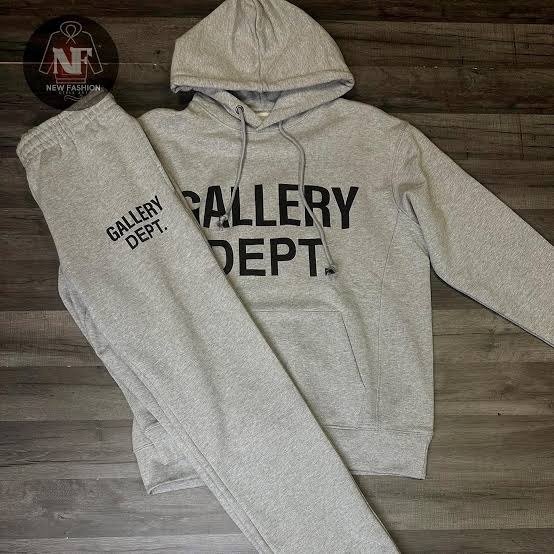
Two gray pieces laid out on a bed, forty euros apart, and a decision most of us make in about four seconds flat. Here’s the shape of it: a full tracksuit comes in at €100, while a hoodie bought by itself is €70 and joggers are another €70, which puts the same outfit at €140 if you pick it up a piece at a time. Looks settled, doesn’t it. It isn’t, quite, and the arithmetic deserves five minutes of your attention before you drop anything into a cart at Gallery Dept and get on with your evening.
The €40 gap, and what it’s actually buying
Forty euros is a t-shirt (€50) with a bit left over, or a trucker cap (€35) and a train ticket. As a saving it’s real, and I’m not going to pretend otherwise.
But it only counts if you wanted both halves to begin with. If the hoodie was the thing you came for and the joggers are just sort of there, you haven’t saved €40 — you’ve spent €30 more than you meant to, on trousers you feel lukewarm about. Plenty of sets live out their lives exactly like that, one half in rotation and the other half folded, which is a slightly sad way to spend a hundred euros.
How often does head-to-toe leave the house?
Be honest about this one, because the whole decision hangs off it. A matching set is at its best when you’re in motion: the 6 a.m. train out of Bologna, the queue at airport security, the first properly cold morning in November when it’s 8 °C outside, and you want one decision instead of four.
Other places, less so. Dinner. An office that isn’t fully relaxed about these things. The passeggiata through a small centro storico at nine in the evening, where everyone has visibly thought about their jacket. One print running top to bottom reads loud there, not because it looks bad but because it reads as a uniform, and uniforms get looked at.
- Travel days, where comfort beats everything else and you’re sitting still for hours anyway.
- Those damp mornings when getting dressed has to be over in ninety seconds.
- A weekend at home that might turn into a walk and a coffee, or might not.
- The gym bag, since the halves end up doing separate jobs on separate days.
Count those days in your own month. If the number comes out low, that €100 set is really a €100 hoodie with something extra attached.
Splitting it up, which is what happens anyway
Here’s where the honest answer lives. Almost nobody who owns a set wears it as a set most of the time. The sets on the Gallery Dept Tuta page carry one print across both halves — gray mélange Logo, the Paint Splatter gray, the navy Hollywood CA with its back print — and each half still stands up on its own the following morning.
The hoodie goes over jeans and nobody can tell it arrived with trousers. The joggers go under a plain cotton jersey tee (€50) and read as joggers, full stop. So you end up living in separates either way. You just paid €100 for them rather than €140, and agreed in advance that they’d match on the days you felt like it.
Which quietly changes the question you’re asking. It stops being set against separates and becomes something duller: two pieces that happen to match, against two pieces you chose one at a time and that probably won’t.
Two grays that aren’t the same gray
This is the bit that settles it for a lot of people. Much of this stuff gets its color as a finished piece, or a wash made to pull the tone back, so the shade shifts slightly from one item to the next. Buy a gray hoodie in March and gray joggers in July and there’s a fair chance you’ve got cousins rather than twins.
A set sidesteps that, since both halves were dyed as one item. And then there’s a duller reason on top of it. The sweatpants in the catalogue come in black (the Logan Dépt de la Galerie) and cream (the Sport Elegant DÉPT). Gray joggers on their own basically don’t exist here. So if gray mélange head to toe is the picture in your head, the €100 set is the only road to it.
| Pro Tip: When the color you want exists only as a set, buy the set and treat the second half as already discounted — roughly €30 for fleece joggers that cost €70 on their own. That’s the one case where the money and the wardrobe agree with each other. |
The numbers, laid out
| What you buy | Price | What you end up with |
| Full tracksuit, one print on both halves | €100 | A pair that matches, and two pieces that still work apart |
| Hoodie and joggers bought separately | €140 | Your own two colors, two prints, and no promise they sit together |
| Hoodie and a t-shirt | €120 | A layered outfit rather than a set — fleece on top, jersey underneath |
| Hoodie on its own | €70 | The piece that gets worn most, and nothing else to think about |
| Joggers on their own | €70 | Fine, as long as there’s already a top at home for them |
Read the last column before you read the price. The €140 row is the expensive one on paper and the roomier one in practice, because you picked both colors yourself. The €100 row is cheaper and narrower. The €120 row isn’t really competing with either — a hoodie and a tee is a different kind of day out, and it handles an April that can’t decide better than two heavy pieces do.
- If you’d genuinely wear both halves together a few times a month, the set wins twice over.
- Buying for the top and talking yourself into the bottom? Pay the €70 and stop there.
- And gray on gray leaves one road open, which is the €100 one.
Frequently Asked Questions
Is the full tracksuit really cheaper than buying both pieces?
Yes, by a clear margin — €100 against €140. The catch sits in the assumption, though, because that €40 only exists if the joggers were something you wanted anyway.
Can I wear the two halves apart?
That’s what most of us do. Neither piece announces that it showed up with a partner, and the top half usually ends up collecting far more wear than the bottom.
What about a hoodie and a t-shirt instead?
Different purpose entirely. €70 plus €50 gets you €120 of layering instead of a set, which suits a 15 °C afternoon better than fleece on fleece does.
Does it cost more to ship two items than one?
I can’t put a figure on it. Shipping options and costs show up at checkout and depend on where the parcel is going, so that’s the only place you’ll see a real number.
So count your head-to-toe days first and look at the prices second. Four or five such days a month and the set is the better hundred euros you’ll spend this autumn. One, and you want the hoodie and nothing after it. Either way, make the call before you’re standing in the cart with a card in your hand.

Top Property Law Solicitors in London for Legal Advice

How to Choose a Second-Hand Car for Your Perth Commute

How to make an older commercial property work for a modern business

Why Your Beauty Clinic in Bali Matters for Filler Results

4 Ecommerce Businesses That Need to Invest in Outsourced 3PL Logistics Services

Fox Fur Coat or Fox Fur Jacket? A Guide to Wearing the Most Dramatic Fur

How to Ensure Your Home is Valued Correctly for a Quick Sale

Christopher Dare: The Untold Story of Engineer and Former Husband of Angela Rippon

The 15 Highest-Paid Rugby Players in the World

What Is Fanquer? The Digital Creator Platform Transforming Direct-to-Fan Engagement

Dr Jared Ross: Missouri Appeals Court Upholds Protection Order Over Graphic Torture and Murder Threats

Nancy Hallam: The Inspiring Life, Career, and Success Story Behind Ian Wright’s Wife
How to Ensure Your Home is Valued Correctly for a Quick Sale
Christopher Dare: The Untold Story of Engineer and Former Husband of Angela Rippon
The 15 Highest-Paid Rugby Players in the World
What Is Fanquer? The Digital Creator Platform Transforming Direct-to-Fan Engagement
Dr Jared Ross: Missouri Appeals Court Upholds Protection Order Over Graphic Torture and Murder Threats
Nancy Hallam: The Inspiring Life, Career, and Success Story Behind Ian Wright’s Wife
-
 Real Estate9 months ago
How to Ensure Your Home is Valued Correctly for a Quick Sale
-
Celebrity11 months ago
Christopher Dare: The Untold Story of Engineer and Former Husband of Angela Rippon
-
 Sports5 months ago
The 15 Highest-Paid Rugby Players in the World
-
 Technology5 months ago
What Is Fanquer? The Digital Creator Platform Transforming Direct-to-Fan Engagement
-
 Celebrity5 months ago
Dr Jared Ross: Missouri Appeals Court Upholds Protection Order Over Graphic Torture and Murder Threats
-
Celebrity12 months ago
Nancy Hallam: The Inspiring Life, Career, and Success Story Behind Ian Wright’s Wife
-

 Celebrity8 months ago
Who Is Azriel Crews? Inside the Life and Career of Terry Crews’ Daughter
-
 Celebrity11 months ago
Who Is Maisie Mae Roffey? The Private Life, Family Story, and Quiet Success of Julie Walters’ Daughter