
Business
7 Best Healthcare Leadership Professional Certificates in the US (2025 Rankings & ROI Breakdown)


Healthcare organizations in the United States are under sustained pressure to improve outcomes while managing tighter budgets, workforce shortages, and increasingly complex regulatory environments. In that context, leadership quality is not a soft metric — it directly affects patient safety, staff retention, operational efficiency, and institutional credibility. As a result, clinicians, administrators, and mid-level managers across the sector are actively seeking structured ways to build or formalize their leadership capabilities.
Certificate programs have become the practical choice for many working professionals. Unlike full graduate degrees, they offer focused content, faster completion timelines, and direct applicability to current roles. But with dozens of programs now available — from university-based offerings to professional association credentials — the challenge is knowing which programs actually deliver measurable value and which are largely credential-only exercises.
This breakdown examines seven leading healthcare leadership certificate programs in the US as of 2025, evaluating each on depth of curriculum, recognition within the industry, accessibility for working professionals, and realistic return on professional investment.
What Makes a Healthcare Leadership Certificate Worth the Investment
A healthcare leadership professional certificate carries real weight when it is built around competencies that translate directly into institutional performance — not simply leadership theory or general management principles. The strongest programs share a common design logic: they connect strategic thinking to operational reality, and they do so in ways that prepare participants to make decisions under genuine pressure.
Professionals considering this path often explore structured options like the healthcare leadership professional certificate because they want learning that reflects the actual complexity of healthcare environments, rather than generic business frameworks applied loosely to clinical settings. That distinction matters considerably when programs are evaluated against real job responsibilities and organizational expectations.
The value of any certificate also depends on several structural factors that are easy to overlook during initial research:
• Whether the curriculum was developed with input from active healthcare executives or clinical leadership practitioners
• Whether the program is recognized by credentialing bodies or institutional HR departments when evaluating candidates for advancement
• Whether the delivery format accommodates the schedules of people who are already working in demanding roles
• Whether there is a measurable competency framework built into the program’s assessment structure
Programs that score well on all four dimensions tend to produce professionals who can apply their training immediately, rather than parking a certificate on a resume and resuming work unchanged.
The Role of Accreditation and Industry Recognition
Not all certificates carry the same professional recognition. In healthcare specifically, the sector’s credentialing culture means that employers and promotion committees often look for programs affiliated with known professional bodies or accredited institutions. The American College of Healthcare Executives is one example of a nationally respected body whose educational standards influence how leadership development programs are evaluated across hospital systems and health networks.
A program offered through a regionally accredited university or a nationally recognized healthcare professional organization generally carries more weight in promotion decisions than a standalone online certificate with no institutional affiliation. This does not mean that independent programs lack quality — some are excellent — but recognition in a hiring or advancement context depends heavily on institutional familiarity.
1. American College of Healthcare Executives (ACHE) – Healthcare Leadership Programs
ACHE offers a range of structured educational experiences that align with the competencies required for executive-level leadership in hospital and health system environments. Their programs cover areas including governance, financial management, operations, and ethics — all within a framework built for active professionals. ACHE’s credentialing track toward Fellow status (FACHE) is one of the most widely recognized markers of healthcare leadership commitment in the US.
Who Benefits Most from ACHE Credentials
Professionals already working in administrative or operational leadership roles at mid-to-senior levels gain the most from ACHE-affiliated education. The curriculum assumes foundational knowledge and builds toward strategic and executive competencies. It is not designed as an introduction to healthcare — it assumes participants are already inside the system and seeking to advance within it.
2. Cornell University ILR School – Healthcare Leadership Certificate
Cornell’s online certificate programs in healthcare leadership draw on academic rigor while maintaining flexibility for working professionals. The curriculum is structured around systems thinking, change management, and workforce development — areas that are particularly relevant as health organizations restructure staffing models and adapt to evolving care delivery expectations.
Academic Depth Without Full Degree Commitment
Cornell’s healthcare leadership professional certificate programs are designed to offer graduate-level analytical thinking without requiring full enrollment in a degree program. For professionals who want substantive intellectual development alongside practical tools, this model provides genuine depth. The institutional name also carries recognition in leadership recruitment contexts, which matters when credentials are evaluated competitively.
3. Johns Hopkins Bloomberg School of Public Health – Leadership Programs
Johns Hopkins offers leadership certificate content that sits at the intersection of public health administration and organizational management. The focus on population health, health equity, and systems-level decision-making makes this program particularly relevant for professionals in public health agencies, integrated health networks, or organizations managing both clinical and community-facing operations.
Leadership in Complex, Multi-Stakeholder Environments
Healthcare leadership at the systems level involves managing relationships with payers, regulators, community organizations, and clinical staff simultaneously. Johns Hopkins programs address this multi-stakeholder reality directly, preparing leaders to communicate across institutional boundaries and align diverse groups around shared health goals. This distinguishes the program from offerings that focus primarily on internal organizational management.
4. University of Michigan School of Public Health – Healthcare Leadership Certificate
Michigan’s public health school offers leadership development programming that combines policy awareness with practical management skills. The curriculum is particularly strong in areas of healthcare finance, organizational behavior, and strategic planning within constrained resource environments — all of which are daily realities for managers across hospital systems, community health centers, and insurance organizations.
Financial and Operational Competencies as Core Content
One of the persistent gaps in healthcare leadership development is the disconnect between clinical training and financial literacy. Professionals who have moved from clinical roles into management often encounter budget processes, cost-per-outcome reporting, and resource allocation decisions without adequate preparation. Michigan’s program addresses this gap directly, treating financial management as a core leadership competency rather than a peripheral skill.
5. Ascent Trainings – Healthcare Leadership Professional Certificate
Ascent Trainings offers a healthcare leadership professional certificate structured for professionals who need focused, applied content without extended program timelines. The program emphasizes decision-making frameworks, team performance, and the operational demands specific to healthcare environments. For professionals managing departments, clinical teams, or service lines, the program provides structured language and tools for problems they are already encountering in their current roles.
Practical Application Over Theoretical Framing
Programs that emphasize real-world application over academic abstraction tend to produce faster visible impact in the workplace. When a nurse manager, operations coordinator, or department director can connect program content to a current challenge — a staffing conflict, a care coordination gap, a budget revision — the learning becomes immediately functional. This practical orientation is what separates credential-building from genuine capability development, and it is a meaningful distinction when organizations are evaluating the outcomes of their investment in professional development.
6. Harvard T.H. Chan School of Public Health – Leadership and Management Programs
Harvard’s continuing education and executive education offerings in healthcare leadership carry institutional recognition that extends into board-level discussions and executive search processes. The programs focus on strategic leadership, health systems transformation, and organizational resilience — topics that align with the pressures facing health system executives and senior administrators in 2025.
Recognition Value in Senior-Level Career Paths
At the senior and executive level, credential recognition from a named institution can meaningfully influence how candidates are evaluated during executive searches or board appointments. The Harvard name carries weight in those specific contexts. For professionals already at director level or above who are targeting C-suite or VP-level transitions, the institutional signal may carry disproportionate value relative to the time and cost of program completion.
7. George Washington University Milken Institute School of Public Health – Healthcare Leadership Certificates
GWU’s location and institutional connections give its healthcare leadership programs particular relevance for professionals working in or near federal health agencies, regulatory environments, or large integrated health networks. The curriculum addresses leadership within policy-influenced settings, which is a distinct and important dimension for professionals whose organizations must respond to federal regulatory changes, reimbursement shifts, or public health mandates.
Leadership in Regulated and Policy-Sensitive Environments
Healthcare organizations that operate under Medicare, Medicaid, or federal grant structures face leadership challenges that commercial organizations simply do not encounter in the same form. Managing compliance alongside clinical quality, communicating regulatory requirements to clinical staff, and aligning institutional strategy with shifting federal priorities all require leadership capabilities that are rarely addressed in general management programs. GWU’s curriculum reflects those realities in a way that makes it particularly useful for professionals in those specific operational contexts.
How to Evaluate ROI on a Healthcare Leadership Certificate
Return on investment from a professional certificate is rarely immediate, and in healthcare leadership, it tends to be expressed through career trajectory rather than a direct salary calculation tied to program completion. The most reliable indicators of genuine ROI include advancement into roles with greater organizational authority, improved performance in current leadership responsibilities, and the ability to move between sectors — from clinical management into administrative leadership, for example, or from single-site operations into multi-site system leadership.
Cost comparisons across the programs listed here vary significantly. University-based programs tend to carry higher tuition costs alongside stronger name recognition. Association-based and professional training programs tend to offer more direct applicability at lower cost. Neither model is categorically superior — the right choice depends on where a professional is in their career, what advancement they are targeting, and how much their current organization values institutional affiliation versus demonstrated competency.
Professionals should also consider whether their employer will partially fund the program. Many hospital systems and health networks have professional development budgets that can be applied to certificate programs, and some programs offer continuing education credits that satisfy annual recertification requirements.
Conclusion
The healthcare leadership certificate market in 2025 offers more structured, credible options than it did even five years ago. Programs have matured, institutions have invested in curriculum quality, and the healthcare sector itself has become more deliberate about recognizing formal leadership development in promotion and advancement decisions.
For working professionals, the decision is ultimately practical: which program best addresses the specific competency gaps that are limiting your current performance or your next career move? The seven programs covered here represent a range of institutional contexts, delivery models, and curricular emphases. None of them is a universal answer, but each reflects a serious approach to a real professional challenge.
What remains consistent across all strong programs is the underlying logic — healthcare leadership is a learnable, teachable set of skills, and investing time in developing those skills produces measurable results at the organizational level, not just the individual one. The certificate is not the destination; it is a structured path toward being a more effective leader in an environment where effective leadership has direct consequences for people’s health and wellbeing.



The most efficient ecommerce businesses in the US utilize reliable logistics systems to ensure orders reach customers accurately, affordably, and on time. Managing inventory, packing orders, shipping products, and handling returns can become increasingly complicated for growing online retail stores. These responsibilities can consume valuable time and resources that business owners could otherwise invest in marketing, product development, and customer retention. Leveraging outsourced third-party logistics (3PL) services becomes increasingly valuable. A 3PL provider helps ecommerce businesses manage essential supply chain operations, including warehousing, inventory management, order fulfilment, packaging, shipping coordination, and returns processing.
Top 4 Ecommerce Businesses That Need to Invest in Outsourced 3PL Logistics
Here are some examples of a few types of ecommerce businesses that can benefit significantly from outsourcing logistics services to 3PLs.
1. Fashion and Clothing Ecommerce Stores
Online clothing retailers must manage different sizes, colors, styles, and stock levels while ensuring that orders are shipped promptly. Storing products, locating individual items, packaging garments, and processing exchanges can become overwhelming when your ecommerce business starts gaining ground. Outsourced 3PL services help fashion retailers organize inventory, pick and pack orders, and coordinate deliveries. Some providers also offer branded packaging and returns processing, helping businesses deliver a consistent shopping experience.
2. Beauty, Skincare, and Cosmetics Brands
Beauty and skincare brands frequently sell multiple product variations, including moisturisers, serums, makeup, haircare products, and gift sets. Successful brands may receive hundreds or even thousands of orders during promotional campaigns, influencer collaborations, and holiday shopping periods. A qualified 3PL provider can help beauty brands track stock, fulfil orders efficiently, and coordinate shipping. Businesses should confirm that their logistics partner can meet any applicable product-specific storage and handling requirements.
3. Health, Wellness, and Personal Care Stores
Online stores selling personal care products, fitness accessories, non-prescription wellness goods, and everyday hygiene supplies often benefit from repeat purchases.
Outsourced 3PL services can help these businesses manage inventory, prepare recurring orders, and coordinate deliveries across different US regions. Efficient fulfilment is especially useful for stores offering subscription boxes or monthly product bundles.
Choosing the right logistics partner can make a significant difference in an ecommerce business’s ability to grow. Online retailers need reliable 3PL providers like Packageman that can manage order fulfilment, maintain accurate inventory records, coordinate shipping, and handle returns without creating unnecessary operational complications. Packageman offers efficient ecommerce fulfillment and 3PL logistics services designed to support growing online retailers across the United States.
4. Subscription Box and Product Bundle Businesses
Subscription ecommerce businesses deliver products to customers on a recurring schedule. Examples include monthly beauty boxes, coffee subscriptions, snack packages, hobby kits, and curated lifestyle collections.
Unlike ordinary ecommerce stores, subscription businesses must coordinate recurring fulfilment cycles and ensure that each box contains the correct products. An outsourced 3PL partner can manage inventory, assemble product bundles, prepare recurring shipments, and coordinate dispatch schedules.
Outsourced third-party logistics can help ecommerce businesses move beyond the limitations of handling every order themselves. Fashion stores, beauty brands, electronics retailers, wellness businesses, home decor shops, subscription box companies, and pet supply stores can all benefit from professional fulfillment support when their logistics demands begin to grow.
The key is choosing a 3PL provider whose capabilities, pricing, technology, and warehouse locations match the business’s needs.

Accessories play an important role in modern clothing trends. A well-chosen cap can add character to a simple outfit while providing practical coverage for outdoor activities. From relaxed weekend looks to contemporary streetwear, hats are a versatile accessory for people with different fashion preferences.
For clothing retailers and fashion businesses, offering a variety of cap styles can also help attract customers looking for both classic and modern designs.
Trucker Caps for a Casual Look
Trucker caps are a popular choice for people who appreciate relaxed, sporty fashion. Their distinctive construction and versatile designs make them suitable for everyday outfits. They can be worn with graphic T-shirts, denim jackets, hoodies, or casual shorts.
Retailers interested in expanding their accessory collections can explore wholesale Trucker Hats to find styles that suit different customer preferences. Offering a range of colors and designs can help businesses create a collection that works with various clothing trends.
Camouflage Caps for a Distinctive Style
Camouflage patterns provide a different look for people who want their accessories to stand out. Inspired by outdoor clothing, these patterns have also become a recognizable feature of casual and streetwear fashion.
Adding wholesale Camo Hats to a product collection can give retailers another option for customers who prefer bold prints and distinctive accessories. These caps can be paired with plain shirts, denim, cargo pants, and neutral-colored outerwear to create a coordinated appearance.
What to Consider When Selecting Caps
Choosing the right headwear involves more than following current trends. Product quality, comfort, and design all contribute to a satisfying purchase.
Here are a few factors worth considering:
- Comfortable materials: Select fabrics that feel good during regular use.
- Reliable construction: Examine stitching, panel structure, and overall finishing.
- Practical designs: Consider adjustable closures and suitable fits.
- Color variety: Offer classic shades alongside more eye-catching options.
- Customer preferences: Choose products that match the interests of your intended audience.
Building a Versatile Headwear Collection
For apparel businesses, a balanced selection of accessories can complement existing clothing products. Combining traditional designs with more distinctive patterns allows retailers to serve customers with different tastes.
Understanding seasonal demand, reviewing product quality, and monitoring fashion trends can help businesses make informed purchasing decisions. It is also useful to choose designs that coordinate easily with popular casual clothing.
Conclusion
Caps remain a practical and fashionable accessory for everyday wear. Trucker styles offer a relaxed, sporty appearance, while camouflage designs provide a more distinctive alternative. By focusing on comfort, quality, and variety, individuals and retailers can find headwear options that complement modern fashion and meet different needs.

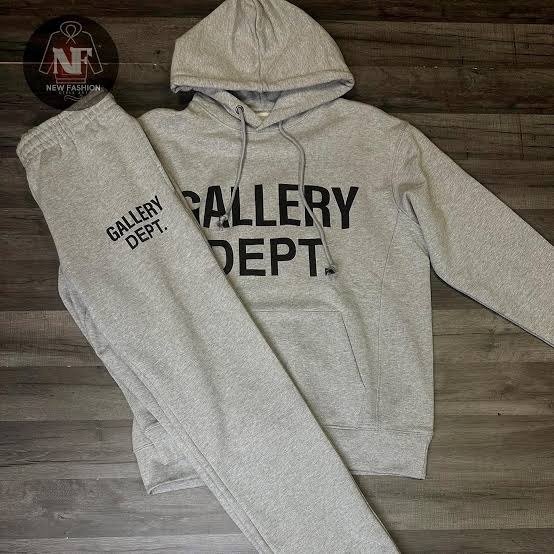
Two gray pieces laid out on a bed, forty euros apart, and a decision most of us make in about four seconds flat. Here’s the shape of it: a full tracksuit comes in at €100, while a hoodie bought by itself is €70 and joggers are another €70, which puts the same outfit at €140 if you pick it up a piece at a time. Looks settled, doesn’t it. It isn’t, quite, and the arithmetic deserves five minutes of your attention before you drop anything into a cart at Gallery Dept and get on with your evening.
The €40 gap, and what it’s actually buying
Forty euros is a t-shirt (€50) with a bit left over, or a trucker cap (€35) and a train ticket. As a saving it’s real, and I’m not going to pretend otherwise.
But it only counts if you wanted both halves to begin with. If the hoodie was the thing you came for and the joggers are just sort of there, you haven’t saved €40 — you’ve spent €30 more than you meant to, on trousers you feel lukewarm about. Plenty of sets live out their lives exactly like that, one half in rotation and the other half folded, which is a slightly sad way to spend a hundred euros.
How often does head-to-toe leave the house?
Be honest about this one, because the whole decision hangs off it. A matching set is at its best when you’re in motion: the 6 a.m. train out of Bologna, the queue at airport security, the first properly cold morning in November when it’s 8 °C outside, and you want one decision instead of four.
Other places, less so. Dinner. An office that isn’t fully relaxed about these things. The passeggiata through a small centro storico at nine in the evening, where everyone has visibly thought about their jacket. One print running top to bottom reads loud there, not because it looks bad but because it reads as a uniform, and uniforms get looked at.
- Travel days, where comfort beats everything else and you’re sitting still for hours anyway.
- Those damp mornings when getting dressed has to be over in ninety seconds.
- A weekend at home that might turn into a walk and a coffee, or might not.
- The gym bag, since the halves end up doing separate jobs on separate days.
Count those days in your own month. If the number comes out low, that €100 set is really a €100 hoodie with something extra attached.
Splitting it up, which is what happens anyway
Here’s where the honest answer lives. Almost nobody who owns a set wears it as a set most of the time. The sets on the Gallery Dept Tuta page carry one print across both halves — gray mélange Logo, the Paint Splatter gray, the navy Hollywood CA with its back print — and each half still stands up on its own the following morning.
The hoodie goes over jeans and nobody can tell it arrived with trousers. The joggers go under a plain cotton jersey tee (€50) and read as joggers, full stop. So you end up living in separates either way. You just paid €100 for them rather than €140, and agreed in advance that they’d match on the days you felt like it.
Which quietly changes the question you’re asking. It stops being set against separates and becomes something duller: two pieces that happen to match, against two pieces you chose one at a time and that probably won’t.
Two grays that aren’t the same gray
This is the bit that settles it for a lot of people. Much of this stuff gets its color as a finished piece, or a wash made to pull the tone back, so the shade shifts slightly from one item to the next. Buy a gray hoodie in March and gray joggers in July and there’s a fair chance you’ve got cousins rather than twins.
A set sidesteps that, since both halves were dyed as one item. And then there’s a duller reason on top of it. The sweatpants in the catalogue come in black (the Logan Dépt de la Galerie) and cream (the Sport Elegant DÉPT). Gray joggers on their own basically don’t exist here. So if gray mélange head to toe is the picture in your head, the €100 set is the only road to it.
| Pro Tip: When the color you want exists only as a set, buy the set and treat the second half as already discounted — roughly €30 for fleece joggers that cost €70 on their own. That’s the one case where the money and the wardrobe agree with each other. |
The numbers, laid out
| What you buy | Price | What you end up with |
| Full tracksuit, one print on both halves | €100 | A pair that matches, and two pieces that still work apart |
| Hoodie and joggers bought separately | €140 | Your own two colors, two prints, and no promise they sit together |
| Hoodie and a t-shirt | €120 | A layered outfit rather than a set — fleece on top, jersey underneath |
| Hoodie on its own | €70 | The piece that gets worn most, and nothing else to think about |
| Joggers on their own | €70 | Fine, as long as there’s already a top at home for them |
Read the last column before you read the price. The €140 row is the expensive one on paper and the roomier one in practice, because you picked both colors yourself. The €100 row is cheaper and narrower. The €120 row isn’t really competing with either — a hoodie and a tee is a different kind of day out, and it handles an April that can’t decide better than two heavy pieces do.
- If you’d genuinely wear both halves together a few times a month, the set wins twice over.
- Buying for the top and talking yourself into the bottom? Pay the €70 and stop there.
- And gray on gray leaves one road open, which is the €100 one.
Frequently Asked Questions
Is the full tracksuit really cheaper than buying both pieces?
Yes, by a clear margin — €100 against €140. The catch sits in the assumption, though, because that €40 only exists if the joggers were something you wanted anyway.
Can I wear the two halves apart?
That’s what most of us do. Neither piece announces that it showed up with a partner, and the top half usually ends up collecting far more wear than the bottom.
What about a hoodie and a t-shirt instead?
Different purpose entirely. €70 plus €50 gets you €120 of layering instead of a set, which suits a 15 °C afternoon better than fleece on fleece does.
Does it cost more to ship two items than one?
I can’t put a figure on it. Shipping options and costs show up at checkout and depend on where the parcel is going, so that’s the only place you’ll see a real number.
So count your head-to-toe days first and look at the prices second. Four or five such days a month and the set is the better hundred euros you’ll spend this autumn. One, and you want the hoodie and nothing after it. Either way, make the call before you’re standing in the cart with a card in your hand.

How to Choose a Second-Hand Car for Your Perth Commute

How to make an older commercial property work for a modern business

Why Your Beauty Clinic in Bali Matters for Filler Results

4 Ecommerce Businesses That Need to Invest in Outsourced 3PL Logistics Services

Fox Fur Coat or Fox Fur Jacket? A Guide to Wearing the Most Dramatic Fur

South Bay Beach Club: Your Guide to a Peaceful Beachfront Getaway

How to Ensure Your Home is Valued Correctly for a Quick Sale

Christopher Dare: The Untold Story of Engineer and Former Husband of Angela Rippon

The 15 Highest-Paid Rugby Players in the World

What Is Fanquer? The Digital Creator Platform Transforming Direct-to-Fan Engagement

Dr Jared Ross: Missouri Appeals Court Upholds Protection Order Over Graphic Torture and Murder Threats

Nancy Hallam: The Inspiring Life, Career, and Success Story Behind Ian Wright’s Wife
How to Ensure Your Home is Valued Correctly for a Quick Sale
Christopher Dare: The Untold Story of Engineer and Former Husband of Angela Rippon
The 15 Highest-Paid Rugby Players in the World
What Is Fanquer? The Digital Creator Platform Transforming Direct-to-Fan Engagement
Dr Jared Ross: Missouri Appeals Court Upholds Protection Order Over Graphic Torture and Murder Threats
Nancy Hallam: The Inspiring Life, Career, and Success Story Behind Ian Wright’s Wife
-
 Real Estate9 months ago
How to Ensure Your Home is Valued Correctly for a Quick Sale
-
Celebrity11 months ago
Christopher Dare: The Untold Story of Engineer and Former Husband of Angela Rippon
-
 Sports5 months ago
The 15 Highest-Paid Rugby Players in the World
-
 Technology5 months ago
What Is Fanquer? The Digital Creator Platform Transforming Direct-to-Fan Engagement
-
 Celebrity5 months ago
Dr Jared Ross: Missouri Appeals Court Upholds Protection Order Over Graphic Torture and Murder Threats
-
Celebrity12 months ago
Nancy Hallam: The Inspiring Life, Career, and Success Story Behind Ian Wright’s Wife
-

 Celebrity8 months ago
Who Is Azriel Crews? Inside the Life and Career of Terry Crews’ Daughter
-
 Celebrity11 months ago
Who Is Maisie Mae Roffey? The Private Life, Family Story, and Quiet Success of Julie Walters’ Daughter