
Technology
The Complete Framework for Selecting a Wafer Thickness Measurement System: A Buyer’s Guide for Semiconductor Professionals


In semiconductor manufacturing, the margin between acceptable and defective is often measured in microns. Process engineers and quality managers working at the wafer level understand that measurement is not a supporting function — it is a core part of the production sequence. When thickness data is unreliable, delayed, or inconsistent, the consequences reach further than a single rejected batch. They affect process calibration, equipment scheduling, downstream yield, and ultimately the economics of an entire production run.
Selecting the right measurement system is therefore not a procurement decision made in isolation. It sits at the intersection of process engineering requirements, equipment compatibility, quality standards, and long-term operational planning. This guide is structured to help technical and operational decision-makers move through that selection process with clarity — from understanding what the measurement environment demands, to evaluating what different system architectures actually offer in production conditions.
Why Wafer Thickness Measurement Demands a System-Level Perspective
Thickness measurement in wafer production is not a single point-in-time check. It is a continuous feedback mechanism that informs grinding, polishing, etching, and deposition processes throughout the manufacturing sequence. When professionals research wafer thickness measurement approaches, they are often working through questions that go beyond instrument specifications — they are asking how measurement data integrates into the broader process control architecture.
A detailed technical overview of wafer thickness measurement illustrates why this system-level thinking matters: the choice of measurement method, sensor configuration, and data output format affects not just accuracy at a single station but the reliability of process control decisions made across multiple production steps.
This perspective shifts the conversation from “which instrument is most accurate” to “which system integrates most reliably into our process and delivers consistent, actionable data at every relevant stage.” That is a meaningfully different question, and it is the right one to start with.
The Relationship Between Measurement Frequency and Process Control Quality
Many facilities default to periodic or post-process measurement, treating thickness verification as a quality check rather than a real-time process input. In lower-volume or less complex environments, this may be sufficient. But in high-throughput or tight-tolerance settings, the gap between measurement events and the time during which process drift occurs can lead to significant yield loss before any corrective action is triggered.
Inline or in-process measurement systems reduce this gap. They provide data while the process is active, which means process engineers can respond to drift before it produces a defective wafer rather than after. The operational benefit is not just improved yield — it is a reduction in the reactive firefighting that consumes engineering time and disrupts scheduling. When evaluating a measurement system, understanding how frequently data is delivered and how it connects to process control systems is as important as understanding sensor resolution.
Data Integration as a Design Requirement, Not an Afterthought
Modern semiconductor facilities operate with manufacturing execution systems, statistical process control platforms, and automated equipment interfaces. A measurement system that produces accurate data in isolation — but cannot communicate that data reliably to the systems that act on it — creates bottlenecks and manual intervention points that undermine the value of the measurement itself.
When specifying a measurement system, integration capability should be treated as a design requirement from the outset. This means understanding the communication protocols the system supports, how data is formatted and exported, and what level of customization is available for connecting to existing process control infrastructure. The systems that perform best in production environments are those that were selected with integration in mind, not retrofitted to connect after installation.
Understanding the Core Measurement Methodologies
Several measurement techniques are used in wafer thickness applications, each suited to specific material types, surface conditions, and process environments. The dominant approaches include capacitive sensing, optical interference, ultrasonic measurement, and contact-based mechanical gauging. Each operates on different physical principles, and each has strengths and limitations that determine where it fits in a production process.
Capacitive measurement is well suited to conductive or semi-conductive materials and performs reliably at high speeds, making it a common choice for inline applications. Optical interferometry, as described in foundational metrology references from organizations such as the National Institute of Standards and Technology, relies on the interference of reflected light waves to determine thickness with high precision, particularly for transparent or semi-transparent materials. Ultrasonic techniques use acoustic wave propagation through the material and are effective where optical methods are limited by surface opacity. Contact gauging, while the oldest approach, remains relevant in specific calibration and reference measurement contexts.
Matching Measurement Method to Material and Process Stage
No single measurement method is universally optimal. The appropriate choice depends on the material being measured — silicon, silicon carbide, sapphire, compound semiconductors — as well as the surface condition, the required measurement speed, and the point in the process sequence where measurement occurs. A method that performs well on a polished silicon wafer may produce inconsistent results on a wafer with a rough ground surface or a thin film coating.
This is why many advanced facilities use multiple measurement methods at different stages rather than standardizing on a single approach. The decision to combine methods introduces additional complexity in terms of system integration and data reconciliation, but it provides more reliable process control across the full manufacturing sequence. When evaluating methods, the relevant question is not which is “best” in absolute terms, but which is most appropriate for each specific measurement context within your process.
Non-Contact Versus Contact Systems in Production Environments
The choice between non-contact and contact measurement has implications beyond technical accuracy. In production environments, contact-based systems introduce the possibility of surface contamination or mechanical damage — particularly relevant for polished or coated wafers where surface integrity is critical. Non-contact systems eliminate this risk but may require more careful environmental control to maintain consistent measurement performance.
Throughput is also affected. Contact systems typically require more time per measurement due to probe engagement and retraction cycles, while non-contact systems can operate at higher speeds, supporting inline integration more readily. The operational environment — cleanliness requirements, measurement speed, wafer fragility — should be assessed carefully when choosing between these approaches.
Evaluating System Reliability and Long-Term Operational Performance
In a production setting, a measurement system that delivers accurate results during qualification but degrades in performance over months of continuous operation is not a reliable system. Long-term operational stability is a distinct characteristic from initial accuracy, and it deserves specific evaluation during the selection process.
Reliability in this context refers to consistency of measurement output over time, under the thermal, vibration, and contamination conditions that exist in a real production environment. It also refers to the stability of calibration — how frequently recalibration is required, what that process involves, and how much downtime it generates. Systems that require frequent recalibration or that drift between calibration events introduce variability into process control data that can be difficult to detect and costly to correct.
Maintenance Requirements and Their Production Impact
Maintenance is a practical constraint that is often underweighted during system selection. A measurement system integrated into a production line is not available for maintenance during production hours without disrupting throughput. The frequency and complexity of required maintenance activities — sensor cleaning, component replacement, calibration verification — directly affect the availability of the system and the operational burden placed on maintenance teams.
When evaluating systems, asking for detailed maintenance schedules and understanding the skill level required to perform routine maintenance tasks is a reasonable and necessary part of the process. Systems designed for minimal intervention and straightforward maintenance procedures reduce both downtime risk and the training burden on facility staff.
Supplier Support and Application Engineering Depth
The quality of post-installation support is a meaningful differentiator between measurement system suppliers. For complex or novel measurement applications — new materials, tighter tolerances, process changes — the ability to engage with supplier application engineers who understand semiconductor processes deeply can determine whether a system performs to its potential or underperforms due to suboptimal configuration.
Evaluating a supplier’s technical support capability is not simply a matter of checking response times. It involves understanding whether the support team has direct experience with the specific type of wafer thickness measurement challenges relevant to your process, and whether they are able to contribute technically to problem-solving rather than simply escalating issues.
Structuring the Internal Evaluation Process
Selecting a measurement system for a production environment is rarely a single-person decision. It typically involves process engineering, quality, facilities, and procurement — each with distinct priorities and constraints. Structuring the internal evaluation process clearly helps avoid the common outcome where a technically sound system is selected without adequate consideration of integration requirements or maintenance practicality.
A structured evaluation process typically includes defining the measurement requirements in operational terms, assessing candidate systems against those requirements in a controlled environment, reviewing integration and maintenance documentation, and engaging references from comparable production environments. Each of these steps reduces the risk of surprises after installation and increases the likelihood that the selected system performs reliably over its full operational life.
• Define measurement requirements by process stage, not just by final accuracy specification, to ensure each production step is adequately addressed.
• Assess system performance under conditions that reflect your actual production environment, including temperature variation, vibration, and surface condition variability.
• Review the full integration architecture before finalizing selection, including communication protocols, data format compatibility, and any required software interfaces.
• Evaluate maintenance requirements against your facility’s maintenance capacity and acceptable downtime parameters.
• Request application-specific references from the supplier and conduct direct conversations with facilities running comparable processes.
Closing Considerations for Semiconductor Measurement Professionals
The decision to invest in a wafer thickness measurement system is not a one-time event. It is the beginning of a long operational relationship that will affect process control quality, production yield, and maintenance workload for years. The most effective approach to this decision is one that treats measurement as an integrated process function rather than a standalone quality check.
That means starting with a clear understanding of where measurement fits in the production sequence, what data is needed and how it will be used, and what operational conditions the system will face over its lifetime. It means evaluating suppliers not just on instrument performance but on their application knowledge and support capability. And it means involving the full cross-functional team early in the process, so that integration, maintenance, and operational requirements are addressed before a selection is finalized rather than after.
Measurement systems that are well-matched to their operational environment, well-integrated into process control infrastructure, and well-supported by knowledgeable suppliers consistently outperform technically superior instruments that were selected without adequate regard for these factors. That is the practical reality of production metrology, and it is the most useful framework for any semiconductor professional working through this decision.


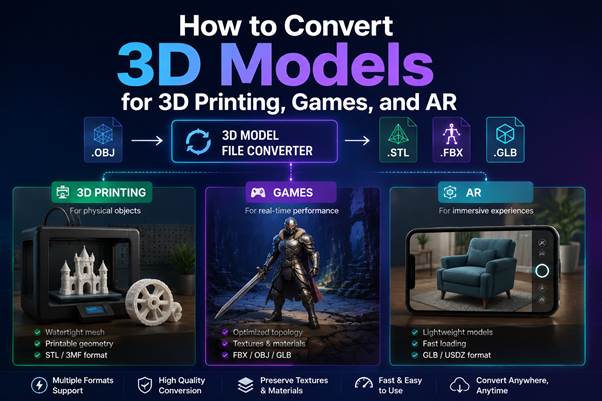
alt: how to convert 3d models for 3d printing, games, and AR
3D models are becoming an essential part of modern digital workflows. They are used in many industries, including 3D printing, game development, product visualization, e-commerce, and augmented reality experiences.
However, creating a 3D model is only the beginning. A model designed for one purpose may not work properly in another environment. For example, a model prepared for a 3D printer requires different file settings compared with a game asset or an AR product preview.
This is why file format conversion is an important step in the 3D workflow. Different platforms and applications support different formats, and choosing the right format can affect model quality, performance, and compatibility.
A 3d model file converter helps creators transform existing 3D files into suitable formats for different purposes without rebuilding the model from scratch.
In this guide, we will explore how to convert 3D models for 3D printing, games, and AR, and explain how different file formats support different creative workflows.
Why Do You Need to Convert 3D Models?
A single 3D model can have many different uses.
For example:
- A product designer may create a model for a presentation and later need it for AR visualization.
- A game developer may need to convert a model into a format supported by a game engine.
- A designer may want to transform a digital model into a printable object.
However, different applications require different types of 3D data.
Some formats focus on:
- Geometry accuracy
- Texture information
- Animation support
- File size optimization
- Printing compatibility
Using a 3d model file converter allows creators to adapt their models for different platforms while maintaining important details.
Common 3D File Formats Explained
Before converting a 3D model, understanding popular file formats is important.
Each format has different advantages depending on the final use case.
STL: Best Format for 3D Printing
STL is one of the most widely used formats in the 3D printing industry.
It stores the basic surface geometry of a model and is supported by most 3D printing software.
Advantages of STL:
- Simple structure
- Small file size
- Compatible with most slicer software
- Easy to prepare for printing
However, STL files usually do not contain:
- Textures
- Colors
- Animation information
STL is mainly used for:
- Physical prototypes
- Mechanical parts
- Custom printed objects
If a model is created for gaming or visualization, converting it to STL may remove important visual information.
OBJ: Flexible Format for Textured Models
OBJ is a popular 3D format that supports more visual information than STL.
It can store:
- Geometry
- UV coordinates
- Materials
- Texture references
OBJ is commonly used for:
- Product visualization
- Digital artwork
- 3D design projects
It is a good option when preserving the appearance of a model is important.
GLB: Ideal for Web and AR Experiences
GLB has become one of the most popular formats for online 3D experiences.
Its advantages include:
- Compact file size
- Texture support
- Fast loading
- Web compatibility
GLB is commonly used for:
- Web-based 3D viewers
- AR applications
- Interactive product experiences
For businesses creating virtual product demonstrations, GLB provides an efficient way to display 3D models online.
How to Convert 3D Models for Different Applications
Different industries require different conversion approaches.

alt: How to Convert 3D Models for Different Applications
Converting 3D Models for 3D Printing
3D printing requires models with accurate geometry and proper structure.
A typical workflow is:
3D Model → STL / 3MF → Slicing Software → 3D Printer
Important factors include:
Watertight Geometry
A printable model should not contain:
- Open surfaces
- Broken meshes
- Incorrect geometry
These problems can cause printing failures.
- Accurate Scale
The model needs correct dimensions before printing.
Suitable Detail Level
A model with too few polygons may lose details, while an extremely high-poly model may create unnecessary processing requirements.
Common formats for printing include:
- STL
- 3MF
Converting 3D Models for Games
Game assets have different requirements compared with 3D printing models.
A game-ready model should balance visual quality and performance.
Important factors include:
Polygon Optimization
Games need optimized models that can run smoothly in real-time environments.
Texture Support
Game assets usually require:
- Color maps
- Materials
- Surface details
Animation Compatibility
Characters often require:
- Rigging
- Skeleton data
- Animation support
Common formats include:
- FBX
- OBJ
- GLB
Converting 3D Models for AR Experiences
Augmented reality applications require models that load quickly and perform well on mobile devices.
Important considerations include:
- Smaller file sizes
- High-quality textures
- Fast rendering
Common AR formats include:
- GLB
- GLTF
- USDZ
For example, furniture companies can convert product models into AR-compatible formats so customers can preview products in their own spaces.
Conclusion
3D models are no longer limited to a single purpose. The same asset may need to be used for 3D printing, game development, product visualization, or AR applications.
Choosing the correct format and using a reliable 3d model file converter allows creators to maintain quality, improve compatibility, and make their assets ready for different platforms.
As digital content continues to grow, efficient 3D file conversion will become an essential part of modern creative workflows.
For creators who want to generate new 3D assets before converting them, Image to 3D AI provides an efficient way to transform 2D images into detailed 3D models. Combined with a powerful 3d model file converter, users can create, optimize, and prepare 3D assets for printing, gaming, and immersive digital experiences more easily.


The installation of a carpet is an important job. A proper adhesive is used to ensure carpet strength and longevity in any type of structure, including a home, office, hotel, school, or commercial building.
One of the questions many people ask themselves is whether to use spray adhesive or traditional glue for carpets.
Both products will stick carpets to the floor, but in different ways. Both have their pros and cons. If you want a quick, clean, and effective solution, you can consider using spray adhesive for carpet installation for better bonding and easy application. Everything is explained here in the simplest terms so that you can make the right choice of product.
What Is Spray Adhesive?
The glue that is used from an aerosol can is called Spray adhesive.
All you have to do is shake the can and spray the adhesive on the surface.
Once sprayed, the carpet is then placed on the adhesive.
Glue is evenly distributed and forms a strong bond.
Many handymen like the spray adhesive when it comes to carpet installation as it is fast, clean, and easy to use.
What Is Traditional Glue?
Glue is a liquid adhesive.
It typically is used in combination with:
A brush
A roller
A trowel
After spreading the glue, the carpet is placed on top.
Many years have passed since the use of traditional glue, and it’s still seen on some flooring jobs.
Easy to Apply
Use of spray adhesive is very easy.
You only need to:
Shake the can
Spray the surface
Place the carpet
Press it down
No additional tools are required.
Conventional glue requires more time.
Care must be taken to spread it evenly on the floor.
This can take longer, particularly in extensive areas.
Installation Speed
Spray adhesive is time-saving.
Covers large areas rapidly.
There are many installers that can complete jobs quicker.
Traditional glue typically requires longer, as it’s necessary to be spread evenly prior to laying carpet.
Spray adhesive may be preferable for faster installation if you are not interested.
Cleaner Working Area
Spray adhesive produces less mess.
The glue remains in the spray can until it is used.
Less spill and clean up after the work.
Old school glue can drip and spill.
Cleaning equipment also requires additional time.
Spray adhesive has an advantage in terms of clean working conditions.
Strong Bond
If applied properly, both products have the potential to create a strong bond.
Carpets will stick well to many surfaces with good quality spray adhesive.
The traditional glue also forms a strong bond, particularly in the case of heavy-duty flooring.
This will vary according to the carpet type and installation space.
Drying Time
The great benefit of spray adhesive is its quick drying time.
A large number of spray adhesives are ready to use in a brief amount of time.
This enables installers to complete their jobs faster.
Old-fashioned glue may require more time to dry.
Sometimes there has to be a period of hours before people can use the floor.
Easy to Carry
Spray adhesive is packaged in light aerosol cans.
They are lightweight and can easily be transported from job to job.
Glue typically is sold in large buckets.
These buckets have a heft and are more difficult to transport.
Spray adhesive is much more convenient for mobile installers.
Better Coverage
The adhesive is evenly distributed over the surface.
This minimises waste.
In some areas, the traditional glue might get so thick that it becomes difficult to spread.
Even coating leads to good carpet installation.
Good for Small Repairs
Use spray adhesive for maintaining carpet repairs.
It can quickly fix:
Loose carpet corners
Carpet edges
Small carpet sections
Floor mats
With small repair work, traditional glue is less convenient.
Good for Large Projects
The two products can be used for large carpet installations.
A lot of professional installers opt for spray adhesive because it can save time.
In some large commercial projects, where additional bond strength is required, the traditional glue is still used.
Depending on the project needs, the best choice is either one or the other.
Better Working Experience
Spray adhesive is more convenient to use for many workers.
It eliminates hard labour as thick glue is not applied over big floors.
This will ease the installation.
Choose a High-Quality Supplier
No matter which adhesive you choose, quality is very important.
Low-quality products may:
Lose their strength
Dry too slowly
Create weak bonding
Cause carpet lifting
Using an aerosol glue supplier is beneficial to achieving products that are quality and reliable. Professional carpet suppliers also have various kinds of adhesives for various carpet materials and flooring surfaces.
Safety Tips
Always use adhesives correctly.
Here are some simple safety suggestions:
Read the instructions.
Work in a ventilated area.
If necessary, wear gloves.
Keep away from fire.
Keep in a cool location.
Keep away from children.
Safe use of products maximises results.
Which One Costs Less?
Old-fashioned glue typically can be less costly than the newer options.
But spray adhesive can be cost-effective in other ways.
It can reduce:
Installation time
Labor costs
Product waste
Cleaning time
These savings make spray adhesive a good investment for many businesses.
Which One Is Better?
Both products.
This is dependent on your needs.
If you wish to use spray adhesive, select:
Fast installation
Easy application
Less mess
Quick drying
Easy transportation
If you need to use glue, use traditional glue:
Heavy-duty bonding
Some commercial flooring uses
Specific installation methods
Spray adhesive has become a popular choice for many modern flooring professionals for carpet installation as it is easy, quick, and delivers great results for many carpet types.
Final Thoughts
With proper application, either spray adhesive or conventional glue can be used to install carpet. Spray adhesive is more widely used, however, because it is easier to use, dries quickly, produces less mess, and aids in the completion of jobs rapidly. For most carpet projects, spray glues are popular today, while traditional glues may be suitable for heavier-duty work.
By purchasing from a reputable professional aerosol glue supplier you can ensure that you are getting adhesive that is both high in quality and performs well. For a faster, cleaner, and more efficient carpet installation, spray adhesive for carpet is a great option for carpet installation on many carpeting projects, including in homes, offices, hotels, and more.


Finding the perfect gaming laptop in the budget and mid-range category can be overwhelming. Manufacturers now offer powerful hardware at competitive prices, making it harder than ever to choose between similarly equipped models. Among the most popular options are the Lenovo LOQ 15 and the HP Victus 15, two laptops that have earned a reputation for delivering excellent gaming performance without carrying the premium price tag of flagship gaming machines.
While both laptops are aimed at gamers, students, and professionals, they approach the market with different priorities. The Lenovo LOQ 15 focuses on balanced performance, efficient cooling, and a practical design, while the HP Victus 15 combines modern hardware with HP’s clean styling and dependable everyday usability.
If you’re deciding between these two laptops, it’s important to look beyond the specifications. Performance, display quality, cooling efficiency, keyboard comfort, battery life, upgrade options, and overall user experience all play a major role in determining which laptop is the better investment.
This detailed comparison examines every important category to help you decide whether the Lenovo LOQ 15 or the HP Victus 15 is the right choice for your needs.
Design and Build Quality
The first difference between these laptops becomes apparent the moment you see them.
The Lenovo LOQ 15 has a modern and understated appearance. Its minimalist gray finish, clean lines, and subtle branding make it look professional enough for work, school, or business meetings while still appealing to gamers.
The HP Victus 15 follows a similar philosophy. HP avoids the aggressive styling commonly associated with gaming laptops, giving the Victus series a sleek and understated appearance. It feels equally comfortable in an office environment or on a gaming desk.
Both laptops primarily use durable plastic construction, but they feel solid during everyday use. The Lenovo LOQ 15 generally offers slightly better chassis rigidity, while the HP Victus 15 provides a refined finish that reflects HP’s experience in consumer laptops.
Neither laptop feels cheap, and both are designed to withstand daily commuting and regular use.
Display Quality
Display quality is one of the most important considerations for gamers.
The Lenovo LOQ 15 typically features a 15.6-inch Full HD IPS display with a high refresh rate, providing smooth visuals and excellent responsiveness during fast-paced games. Colors appear vibrant, viewing angles remain wide, and motion looks fluid during competitive gaming.
The HP Victus 15 also offers Full HD IPS panels with high refresh rate options depending on the configuration. It performs well for gaming, streaming, office work, and general multimedia use.
When comparing the displays side by side, both provide enjoyable gaming experiences. The Lenovo LOQ 15 often delivers slightly better motion clarity in certain configurations, while the HP Victus 15 offers comparable image quality for everyday tasks.
Neither display is specifically designed for professional-level color grading, but both are more than sufficient for casual content creation and entertainment.
Performance Comparison
Performance is where these laptops compete most directly.
The Lenovo LOQ 15 is available with both Intel Core and AMD Ryzen processors combined with NVIDIA GeForce RTX graphics. These configurations provide enough power for gaming, programming, video editing, 3D rendering, and heavy multitasking.
The HP Victus 15 also comes with modern Intel and AMD processors alongside dedicated NVIDIA graphics, allowing it to handle demanding workloads with confidence.
For everyday productivity, both laptops feel extremely responsive. Boot times are quick, applications launch instantly, and multitasking remains smooth thanks to fast NVMe SSD storage.
When comparing similarly configured models, real-world performance differences are generally very small.
Gaming Performance
Gaming is naturally the biggest reason most buyers consider these laptops.
The Lenovo LOQ 15 delivers excellent frame rates in popular competitive games including Valorant, Counter-Strike 2, Fortnite, Apex Legends, League of Legends, and Rocket League. Its RTX graphics provide smooth gameplay while supporting advanced technologies like NVIDIA DLSS for improved performance.
Modern AAA games such as Cyberpunk 2077, Red Dead Redemption 2, Hogwarts Legacy, Elden Ring, Assassin’s Creed Mirage, and Forza Horizon 5 also run well with optimized graphics settings.
The HP Victus 15 performs similarly when equipped with comparable hardware. It comfortably handles both esports titles and demanding modern games, delivering stable frame rates suitable for most gamers.
For gaming alone, both laptops are excellent choices, with performance depending more on the specific CPU and GPU configuration than the laptop brand itself.
Cooling and Thermal Performance
Cooling plays a critical role in maintaining consistent gaming performance.
The Lenovo LOQ 15 uses a well-designed dual-fan cooling system with large rear exhaust vents that efficiently remove heat during extended gaming sessions.
Even under sustained workloads, temperatures remain well controlled, and thermal throttling is kept to a minimum. This allows the laptop to maintain strong gaming performance for longer periods.
The HP Victus 15 also incorporates an effective cooling solution that handles everyday gaming comfortably. However, during particularly demanding workloads, some configurations may run slightly warmer than the Lenovo LOQ 15.
Fan noise becomes noticeable on both laptops while gaming, but Lenovo generally maintains a better balance between cooling performance and acoustic comfort.
For users who regularly play demanding games for several hours, the Lenovo LOQ 15 has a slight advantage.
Keyboard and Touchpad
Lenovo has earned an excellent reputation for keyboard quality, and the LOQ 15 continues that tradition.
The keyboard features comfortable key travel, responsive feedback, and a spacious layout that works equally well for gaming, programming, writing, and office work.
The HP Victus 15 also offers a pleasant typing experience. The keys are responsive and comfortable for daily use, although many users prefer Lenovo’s slightly deeper key travel during long typing sessions.
Both touchpads are smooth and accurate for everyday navigation, though gamers will naturally benefit from using an external mouse.
Battery Life
Battery performance is often a compromise in gaming laptops.
The Lenovo LOQ 15 provides respectable battery life during web browsing, office work, video streaming, and online classes. As expected, gaming significantly reduces battery runtime and limits system performance when unplugged.
The HP Victus 15 performs similarly during everyday tasks. Depending on the hardware configuration, battery life may be slightly longer in lighter workloads, but differences are generally modest.
Neither laptop is intended for extended gaming away from a charger, and both deliver their best performance when connected to power.
Upgradeability
Both laptops provide useful upgrade options that help extend their lifespan.
The Lenovo LOQ 15 allows users to expand RAM and SSD storage, making it easy to improve multitasking performance and increase available storage space as game libraries grow.
The HP Victus 15 also supports RAM and SSD upgrades in most configurations, allowing users to keep the laptop relevant for many years.
This flexibility makes both laptops attractive long-term investments.
Connectivity
Modern gaming laptops require versatile connectivity, and both competitors perform well.
The Lenovo LOQ 15 offers multiple USB ports, USB-C, HDMI, Ethernet, and a headphone jack. The placement of several ports toward the rear helps reduce cable clutter, creating a cleaner gaming setup.
The HP Victus 15 includes a similarly comprehensive port selection that supports gaming accessories, external displays, wired networking, and additional storage devices.
For most buyers, connectivity will not be a deciding factor since both laptops cover nearly every essential requirement.
Which Laptop Offers Better Value?
Value depends on much more than specifications.
The Lenovo LOQ 15 stands out because it combines strong gaming performance, excellent cooling, upgrade-friendly hardware, and a comfortable keyboard in a balanced package that performs equally well for gaming and productivity.
The HP Victus 15 offers impressive performance as well, often becoming an especially attractive option when available at discounted prices.
When comparing similarly priced configurations, Lenovo generally provides the more refined overall user experience, while HP occasionally offers slightly better pricing depending on ongoing promotions.
Comparing exact specifications before purchasing is always recommended.
Who Should Buy the Lenovo LOQ 15?
The Lenovo LOQ 15 is ideal for users who want a laptop that performs equally well for gaming, studying, programming, and professional work. Its understated design, reliable cooling, comfortable keyboard, and consistent performance make it one of the most versatile gaming laptops in its category.
It is especially suited to students and professionals who prefer a laptop that doesn’t look overly aggressive.
Who Should Buy the HP Victus 15?
The HP Victus 15 is an excellent choice for gamers who appreciate HP’s clean design language and want dependable gaming performance at a competitive price.
It also suits users who prioritize everyday productivity alongside casual gaming and often becomes a great value when discounted.
Final Verdict
The Lenovo LOQ 15 and HP Victus 15 are both excellent gaming laptops that deliver impressive performance without requiring a premium budget. They are capable of handling modern AAA games, competitive esports titles, demanding productivity software, and everyday computing tasks with ease.
However, when comparing the complete ownership experience, the Lenovo LOQ 15 emerges as the stronger overall choice. Its superior thermal management, more comfortable keyboard, balanced design, and consistently reliable gaming performance make it the better laptop for most buyers.
The HP Victus 15 remains a fantastic alternative, particularly when available at an attractive price, and it continues to be one of the best value-oriented gaming laptops on the market.
If you’re looking for the most well-rounded combination of gaming performance, cooling efficiency, productivity, upgrade potential, and long-term value, the Lenovo LOQ 15 is the laptop you should choose. It successfully balances power, comfort, and affordability, making it one of the standout options in the budget gaming laptop segment.

The Role of Strong School Communities in Student Development

How to Name Your Car: A Practical Guide to Finding the Perfect Fit

How Drumming Workshops Boost Learning Through Rhythm

How to Convert 3D Models for 3D Printing, Games, and AR

Custom EHR for Value-Based Care Organizations

How Much Does Car Storage Cost in Rochester, NY? A Complete 2025 Pricing Guide

The 15 Highest-Paid Rugby Players in the World

Christopher Dare: The Untold Story of Engineer and Former Husband of Angela Rippon

How to Ensure Your Home is Valued Correctly for a Quick Sale

Nancy Hallam: The Inspiring Life, Career, and Success Story Behind Ian Wright’s Wife

Who Is Maisie Mae Roffey? The Private Life, Family Story, and Quiet Success of Julie Walters’ Daughter

Simon Dixon Biography: Lifestyle, Net Worth, Family, Career and Success Story
The 15 Highest-Paid Rugby Players in the World
Christopher Dare: The Untold Story of Engineer and Former Husband of Angela Rippon
How to Ensure Your Home is Valued Correctly for a Quick Sale
Nancy Hallam: The Inspiring Life, Career, and Success Story Behind Ian Wright’s Wife
Who Is Maisie Mae Roffey? The Private Life, Family Story, and Quiet Success of Julie Walters’ Daughter
Simon Dixon Biography: Lifestyle, Net Worth, Family, Career and Success Story
-
 Sports3 months ago
The 15 Highest-Paid Rugby Players in the World
-
Celebrity8 months ago
Christopher Dare: The Untold Story of Engineer and Former Husband of Angela Rippon
-
 Real Estate6 months ago
How to Ensure Your Home is Valued Correctly for a Quick Sale
-
Celebrity9 months ago
Nancy Hallam: The Inspiring Life, Career, and Success Story Behind Ian Wright’s Wife
-
Celebrity8 months ago
Who Is Maisie Mae Roffey? The Private Life, Family Story, and Quiet Success of Julie Walters’ Daughter
-
Business8 months ago
Simon Dixon Biography: Lifestyle, Net Worth, Family, Career and Success Story
-
 Celebrity9 months ago
Johnny Carell: Inside the Life, Family, and Rising Success of Steve Carell’s Son
-

 Health6 months ago
Enclomimed 25 (Enclomiphene) – Effective PCT Protocol