
Blog
How to Set Up a Robot Lawn Mower in a Weekend: Mapping, Zones and App Control Basics


For North American homeowners tired of weekend mowing, a robot lawn mower for easy installation hits the mark because it actually delivers on the promise. The old generation of boundary-wire machines meant spending half a Saturday digging trenches and hammering stakes. A wire-free model with app-based setup changes that equation — you can genuinely have an automated mower with mobile app control running within a weekend. Here’s how to make it happen.
Step 1: Place Your Charging Station in the Right Spot
The first decision isn’t glamorous, but it matters. The charging station (or dock) needs to sit in an open location with clear line-of-sight to the sky — ideally in a spot where you don’t mind looking at a small piece of equipment year-round. This is where your mower will return to top up between sessions. If your lawn has significant tree canopy overhead, place the dock slightly back from dense shade; the RTK reference station inside needs strong satellite visibility to help the mower navigate accurately.
Distance-wise, think centrally. A dock near the middle of your property, or at least not in a corner, means shorter average run times to and from the dock. If you’re working with a smaller lot, even placement against a garden bed edge works — just keep it on stable, level ground and away from water pooling spots.
Step 2: Download the App and Let the Mower Map Itself
This is where a robot lawn mower for easy installation proves its worth. Once the mower is unboxed, charged, and placed on the ground, you download the companion app and start an initial mapping pass. The mower drives around your lawn while the app uses the mower’s onboard vision system (VSLAM) combined with satellite positioning (RTK) to build a digital map of your property. This takes about 15–30 minutes depending on property size and complexity.
No wires. No manual tracing. No stakes. The mower learns your yard’s actual boundaries by running the perimeter once.
Step 3: Define Zones and Set No-Go Areas
Once the base map exists, the real flexibility kicks in. The app lets you draw virtual boundaries directly on the map to define separate mowing zones — useful if your lawn has distinct areas: front yard, back lawn, side patch. You can also paint “no-go zones” over flower beds, ponds, patios, or anywhere you don’t want the mower to venture. These geofence boundaries live in the app, adjustable any time without touching your lawn.
If your yard is split into truly separate areas (like a side lawn you can’t walk between), most automated mower systems support “isolated zones” — areas the mower doesn’t auto-travel to, but you can physically carry it into and start it mowing. The app tracks these separately, keeping schedules independent.
Step 4: Name Your Zones and Customize Per-Zone Settings
Here’s the nuance that separates a basic install from a genuinely useful setup. Each zone can have its own cutting height, stripe direction, and mowing frequency. Your front lawn might prefer short, crisp stripes; your back paddock might thrive taller and less frequent. Rather than a one-size-fits-all schedule, you’re running what’s effectively a mini-lawn care plan tailored to each section.
This is where the app-based control shines for multi-zone properties — settings are stored on the mower and synced via the cloud, so you can adjust zones from your phone while sitting on the porch.
Step 5: Create Your Mowing Schedule
The final step is scheduling. The app lets you set days, times, and duration targets for each zone. Set it to run three times a week, five times a week, or daily — whatever matches your grass growth and your tolerance for mower noise. Most automated mower systems will pause for rain (via a built-in rain sensor) and resume when conditions clear, so you don’t have to micromanage.
Once your schedule is live, the mower leaves the dock, handles its zones autonomously, avoids obstacles, and returns to charge. Real hands-free operation.
FAQ
How long does the initial mapping pass take?
Typically 15–30 minutes, depending on property size and terrain complexity. The mower runs the perimeter and builds a digital map on the first pass.
Can I adjust zones and no-go areas after the first week?
Yes, completely. Any changes you make in the app are pushed to the mower at the next sync. No re-installation or re-mapping needed.
What if I have areas separated by a narrow path or gate?
The app supports “channels” connecting zones — defined passages at least 3.3 feet wide where the mower can travel between areas automatically. For truly isolated zones, you manually carry the mower and launch it from a separate zone in the app.
Do I need special software skills to use the app?
No. The interface is designed for phone-based control — similar to adjusting a thermostat. Zone naming, schedule setting, and geofence drawing are all drag-and-drop or simple menu selections.
The Bottom Line
Weekend installation for a robot lawn mower for easy installation is genuinely possible with wire-free, app-based systems. The setup involves charging-station placement (15 minutes), automatic mapping (15–30 minutes), zone definition in the app (20–30 minutes), and schedule configuration (10 minutes). Total: roughly two hours of actual hands-on time, spread across a Saturday morning or afternoon. For detailed walkthrough instructions specific to your model, check the manufacturer’s app documentation or support site — GOKO‘s setup guide on website, for example, walks through each step with screenshots. From there, your automated mower with mobile app control runs on its own, and your weekends are finally yours again.



Digital technology is changing how businesses communicate with customers, present products, and create engaging online experiences. Augmented reality (AR) and artificial intelligence (AI) are two important technologies driving this change. Kivicube brings these capabilities together to help businesses build interactive digital content and improve audience engagement. With the Kivicube augmented reality service and the AI AR Agent, brands can explore more effective ways to present products, create creative content, and connect with customers.
What Is Kivicube Augmented Reality Service?
Kivicube is an augmented reality service that helps businesses and creators make interactive experiences combining digital elements with the real world. AR allows users to view virtual objects, animations, and visual effects through compatible devices such as smartphones and tablets. For businesses, this means products and ideas can be presented in a more visual, participatory, and memorable way.
Rather than asking audiences to simply watch or read information, AR encourages them to interact. This makes the Kivicube the best augmented reality marketing solution for campaigns, product presentations, online catalogs, education, and other scenarios where engagement and clarity matter.

Understanding Kivicube AI AR Agent
The Kivicube AI AR Agent extends the AR service by bringing AI assistance into the AR creation and interaction workflow. Its role is not to replace AR experiences with standalone AI content, but to support the creation and improvement of AR experiences.
With AI-assisted tools, businesses and creators can explore new ways to develop AR content, adapt visual assets, and organize interactive materials more flexibly. The AI AR Agent can help reduce friction in content production and support creative experimentation, making it easier for teams to move from an idea to an interactive AR experience. Specifically, the Kivicube AI AR Agent can support:
- AI Image generation: The agent can help generate and adapt visual assets for AR scenes, product presentations, and promotional content, giving creators more flexibility when preparing interactive materials.
- AI Video generation: The agent can support video generation and editing for AR experiences. AI video is one of the content capabilities within the broader AR creation workflow, which is useful for interactive scenes, promotional content, and visual storytelling, rather than as a separate story from AR.
- AR interaction generation: The agent can help create and structure AR interactions, supporting the development of interactive elements and experiences that encourage audiences to participate rather than simply watch or read.
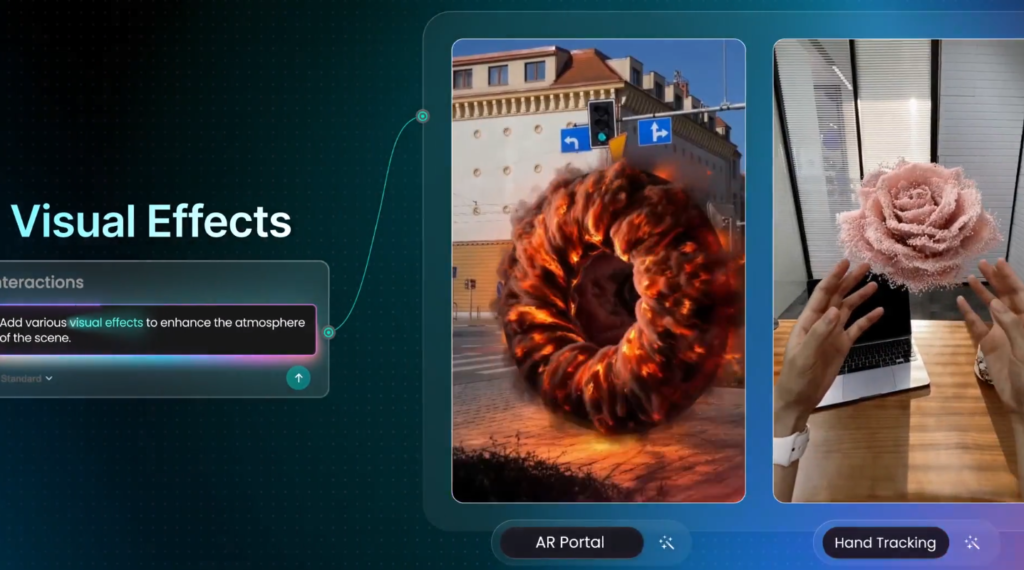
Together, these capabilities help businesses and creators produce richer AR content more efficiently. AI AR agent should be understood in the context of AR creation: it is one supporting capability that helps teams generate and adapt assets for interactive AR experiences.
Key Benefits of Augmented Reality Marketing
The combination of the Kivicube AR service and the AI AR Agent can bring several practical benefits to marketing and business communication.
- Better Customer Interaction
AR experiences allow customers to interact with digital objects and explore products in more engaging ways. This can make product presentations more participatory and easier to understand.
- More Creative Marketing Opportunities
Businesses can develop interactive campaigns that attract attention and make their brands more memorable. AR marketing content gives marketers a way to present ideas visually rather than relying only on static images or text.
- More Flexible AR Content Creation
The AI AR Agent can support creators in exploring content concepts and adapting visual materials. AI video capabilities can further assist AR creation by helping teams prepare video assets for interactive experiences.
- Clearer Product and Concept Explanation
Interactive AR demonstrations can help audiences understand product features, usage scenarios, or complex topics more easily. This is useful in e-commerce, education, and other areas where visual explanation matters.
- Scalable Use Across Channels and Industries
Kivicube’s AR and AI capabilities can support different use cases, from social media campaigns and websites to product introductions and learning materials. Businesses can explore formats that fit their own marketing and communication needs.

How Businesses Can Use These Technologies
The Kivicube augmented reality service and AI AR Agent can support different industries. In e-commerce, businesses can use interactive AR experiences to introduce products and help shoppers make more informed purchasing decisions. AI-assisted content creation can help teams prepare promotional and explanatory assets for those experiences.
In education, AR and AI-assisted content can make learning materials more visual and interesting. Students may find it easier to understand complicated topics through interactive demonstrations and creative video explanations. Here too, AI AR agent is most valuable when it supports the broader AR experience rather than standing alone.
The Future of AR and AI-Assisted Content Creation
The future of digital experiences will likely involve greater integration of artificial intelligence, augmented reality, and interactive content. As technology develops, businesses will have more opportunities to create personalized and engaging experiences.
Kivicube represents a practical way to explore these possibilities. By combining augmented reality with an AI AR Agent, it gives brands and creators room to experiment with modern content formats.
Final Thoughts
The Kivicube augmented reality service and AI AR Agent offer useful opportunities for modern digital communication. From interactive product presentations to AI-assisted AR content creation, these technologies can help businesses improve engagement and develop memorable online experiences. AI video is one relevant capability within this broader AR creation workflow, not the final destination. As AR and AI continue to evolve, their role in marketing, education, e-commerce, and entertainment is expected to become increasingly important. Exploring these solutions can help businesses discover creative ways to connect with audiences and strengthen their digital presence.


An unexpected repair bill is easier to understand when the work behind it is clear. A replacement part may be easy to price online, but a workshop also has to identify the fault, gain access, fit the component, and check the result. Those steps can account for much of the difference between two apparently similar jobs.
For Australian drivers, budgeting starts with separating predictable maintenance from uncertain repairs. It also means comparing the full scope of quotes rather than assuming the lowest hourly rate or cheapest part will produce the lowest total.
Separate servicing, diagnosis, and repair
Scheduled servicing follows the vehicle manufacturer’s maintenance requirements. Its scope can often be identified from the model, age, odometer reading, and history. Some service points include more work than others, so the price will not necessarily stay the same at every visit.
Diagnosis establishes what is causing a reported problem. A warning message, vibration, or leak may have several possible causes. The workshop needs evidence before recommending a repair. Diagnostic labor can therefore be a legitimate charge even when no replacement part has been fitted.
Repair is the work authorized after that assessment. Depending on the findings, it may involve replacement, adjustment, specialist repair, or further investigation. A routine service booking does not automatically include these activities.
Ask which stage the initial price covers. Approval for an inspection is different from approval for an open-ended repair. Understanding that boundary makes a changing estimate easier to discuss.
Labor depends on access as well as the task
The time needed to replace a component depends partly on where it sits. A small, inexpensive part can require substantial dismantling to reach. Removing surrounding components and reassembling the area without damage are part of the job.
Vehicle design also matters. Two models with similar symptoms may use different assemblies or procedures. Corrosion, damaged fasteners, previous modifications, and prior repairs can create complications that are not obvious during a booking call.
Workshops may use standard labor times, actual time, or a fixed price for an agreed scope. Ask which approach applies. An hourly rate is useful, but it cannot establish the final bill without an understanding of the expected work.
For a comparison, request the total labor allowance and the tasks it covers. A lower hourly rate paired with a different scope is not a like-for-like alternative. Equally, a higher rate does not prove a workshop will complete the job faster or better.
Diagnostic complexity can change the estimate
Some faults are visible during an inspection. Others appear only under particular conditions or affect several related systems. An intermittent electrical problem may require a different investigation from an obviously damaged hose, even if both produce a dashboard warning.
A scan tool can supply fault codes and operating data, but it does not necessarily identify a failed part by itself. The mechanic may need to inspect wiring, take measurements, consult technical information, or carry out other tests before recommending a repair.
For uncertain faults, ask whether diagnosis can be authorized in stages. The first stage should have an agreed scope or spending limit and a clear point for reporting findings. That does not guarantee an immediate answer, but it prevents silence from becoming an assumption of unlimited approval.
Find out whether diagnostic charges remain separate if the repair proceeds. Some workshops have credit arrangements; others do not. The arrangement should be understood before the appointment rather than discovered on the final invoice.
Parts need a more specific comparison than cheap or premium
Genuine parts are sold under the vehicle manufacturer’s brand. OEM refers to original equipment manufacturers, while aftermarket describes a broader replacement supply market. These labels alone do not establish a particular part’s specification, suitability, or warranty.
Ask for the brand and part description on the quote. Clarify whether the proposed component is new, remanufactured, rebuilt, or used where those options are appropriate. Each option should be evaluated for the application rather than treated as automatically good or bad.
Availability affects the job too. A locally stocked item may allow an earlier repair, while a special-order part can introduce freight charges and waiting time. Ask whether the total includes delivery and whether an expected arrival date is firm or provisional.
Price comparisons should also include the terms covering the part and its installation. Ask who handles a problem after fitting and what the written terms say. A cheaper online part and a workshop-supplied part may come with different practical arrangements, so compare the complete transaction.
Related work and consumables belong in the total
A repair can require seals, fasteners, fluids, or other materials beyond the main component. Some items are specified for replacement after removal. Others may be needed because access involves draining a system or disturbing an adjacent part.
An itemized quote should make these requirements understandable. Ask which materials are included and whether the total covers tax, disposal, and workshop supplies. An unclear line warrants an explanation, but does not by itself mean the charge is unnecessary.
Some repairs also require programming, calibration, alignment, or a specialist procedure. Whether those steps apply depends on the vehicle and the work. Ask the workshop to identify them when quoting and explain whether they are performed in-house or arranged elsewhere.
Related work can sometimes share access labor. If two recommended tasks involve the same dismantling, ask whether completing them together changes the total. Do not assume every nearby part needs replacement; the recommendation should have a vehicle-specific reason and a separate cost.
Compare a quote with the same scope elsewhere
A useful second quote describes the same fault, findings, parts standard, and repair scope. A general phone price for replacing a named component is not equivalent to a written offer following diagnosis. The second workshop may need to inspect the vehicle before making its recommendation.
Distinguish a quote for agreed work from an estimate based on incomplete information. Ask what could change the figure and how the workshop will obtain approval if additional damage becomes apparent. Record any spending limit and the preferred contact method.
When searching for a mechanic near me, compare relevant capability and communication as well as price. An itemized scope and clear explanations of the approval process make the alternatives easier to assess.
Avoid making price a shortcut for judging quality. A lower figure may reflect a different part, less work, or lower overheads. A higher figure may include additional tasks. Ask what accounts for the difference before drawing conclusions.
Allow for time without the car
The workshop invoice is not always the whole cost of a repair. Transport to work, a rental vehicle, or reorganized appointments can add expense or inconvenience while the car is unavailable. These costs deserve attention even when they are not paid to the workshop.
Ask about the likely assessment and completion windows. Parts availability or further findings may change them, so establish when updates will arrive rather than treating an initial finish time as a guarantee.
If a courtesy vehicle is available, confirm the booking, eligibility, insurance conditions, fuel arrangements, and any charges. Do not assume a loan car is included because the workshop advertises one. A waiting area may suit a short appointment but cannot replace transport during a multi-day repair.
Planning these details helps compare the practical cost of each option. The most convenient workshop may not be the best technical fit, but accounting for transport prevents a small price difference from hiding a larger disruption.
Ask about priorities without guessing what can wait
A report may identify several issues with different levels of urgency. Ask the mechanic to separate the fault being repaired, additional safety concerns, scheduled maintenance, and items suitable for monitoring. Each recommendation should relate to findings or the manufacturer’s requirements.
Staged work may be possible, but it needs a professional assessment. A driver should not infer that an issue is safe to defer because the car still runs or the symptom is only a noise. Ask whether continued use is appropriate and what restrictions or further action are necessary.
If the vehicle may be unsafe, discuss recovery or storage rather than treating the budget as a reason to drive it. A payment plan, if available, is a separate discussion from whether the car is suitable for road use.
Written priorities make future planning clearer. They should state what has been completed and what remains outstanding so that a deferred item does not disappear into an old invoice.
Build a maintenance picture from real records
A useful budget begins with the car’s own history. Keep service and repair invoices together with dates and odometer readings. Include tire purchases and other substantial wear-related costs so the record reflects more than routine oil services.
Look ahead to scheduled work using the manufacturer’s requirements and current workshop recommendations. Request an estimate for known upcoming items rather than applying a generic annual figure from a different vehicle. Age, use, condition, and parts availability affect what may be needed.
Some owners find it useful to maintain separate allowances for expected servicing and unexpected repairs. The appropriate amount depends on household circumstances and the vehicle; no single monthly contribution suits everyone. Past spending offers context, not a promise that the next year will cost the same.
Review the plan after major work and when driving patterns change. A vehicle used more heavily may reach distance-based requirements sooner, while a lightly used car can still have time-based tasks. A budget should reflect those differences rather than assuming fewer kilometers remove maintenance needs.
Close the loop at pickup
Compare the invoice with the authorized work and any approved changes. Ask about unfamiliar items and the outcome of diagnosis, including any remaining recommendations. Keep the report with the estimate so the decision and result are recorded together.
Ask what to do if the original symptom returns and how to contact the workshop about the completed repair. Clear follow-up arrangements are more useful than a vague assurance that everything is fine.
Budgeting helps drivers understand costs, authorize work knowingly, and prepare for maintenance that can be anticipated, even though every failure cannot be predicted. A clear scope and organized records make a repair bill easier to evaluate.


Buying for grandchildren is one of life’s great pleasures and, if we’re honest, one of its small anxieties. You want the present to land. You don’t want to duplicate what their parents have bought, or choose something wildly wrong for their age, or hear later that it never left the box.
A little planning helps enormously, and most of it comes down to a few questions you can ask in advance.
Start by asking the parents
It’s tempting to keep presents a surprise, but a quick message to a parent is the single most useful thing you can do. Ask what the child’s into at the moment, what they already have plenty of, and whether there’s anything the family would rather you didn’t buy. Parents are usually delighted to be asked, and it saves a lot of polite smiling over duplicates.
It’s also worth asking about space. Many modern homes are short on storage, and an enormous present that takes over the living room isn’t always a kindness.
Know the stage, not just the age
The number on the box is only a guide. Children develop at different rates, so it helps to think about stage: what they actually do when they play.
Under threes are mainly interested in handling and copying. Three to five year olds start pretending in earnest. From about five, play turns into stories with names, jobs and plots, and by seven or eight many children begin collecting.
For the pretending years, imaginative play is hard to beat. A good range of kids dolls offers everything from soft-bodied babies for toddlers to posable figures for older children, so it’s worth checking which suits the age. Younger children generally do best with something sturdy and washable, around the size they can carry, while older ones like hair that can be brushed and outfits that come off.
Keep it simple
Grandparents often feel the pull of the impressive present, the one that lights up and talks. Children admire these briefly, but the toys that get played with for years tend to be the quiet ones. A figure that doesn’t speak leaves the child to decide who it is, and that’s where the play comes from.
This helps when you’re on a budget, too. Simpler toys are often cheaper, and they last longer, because there’s less to break and less to get bored of.
A gift with everything in the box
If you’d like something that makes an immediate impression, a boxed set is a safe bet. A doll set arrives with furniture, outfits and accessories, so the child can start playing as soon as it’s opened, without waiting for a parent to find the missing pieces. That matters when you’re not there to help.
Check what’s inside, though. Pieces that work with other toys the child already owns are the most useful, while single-purpose moulded props are quickly forgotten. And for under threes, check the age marking, since small accessories can be a choking risk.
Things to avoid
Anything very noisy, unless you’ve checked with the parents. You won’t be living with it, but somebody will.
Anything with a great deal of assembly. Fiddly instructions fall to a parent on Christmas morning, and rarely earn a thank you.
Anything bought for a stage the child hasn’t reached yet. Presents for next year tend to sit untouched until the child has already moved past them.
Anything that eats batteries. They run out quickly and replacements are a nuisance.
Make it personal
What children often remember is the thing that came from a particular person. A handmade outfit for a doll, a knitted blanket, a name stitched onto something. These don’t need to be expensive, and they have a quality shop-bought present that can’t match: they’re from you.
You can also tuck in something of your own, like a story about a toy you loved as a child, or a recording of you reading a bedtime story that they can listen to when you’re not there. Children who live far from their grandparents often treasure that more than the present itself.
Include the experience
Time with you is usually the best present, and something small that goes with it can be even better. A trip to the park with a picnic, a baking afternoon, a visit to the library followed by tea. They take almost no planning, and they create the memories children keep.
If you’re buying for several grandchildren, a shared experience can also take pressure off the question of who got what. A day out for everyone, with a small something for each, is easier to get right than a heap of individual parcels.
Think about the long game
Grandparents are in the happy position of playing a long game. A present doesn’t have to be a triumph on the day. It can be something a child grows into, or comes back to months later when they’re ready, and a well chosen toy quietly waiting in a cupboard at your house can become part of what makes visits special.
Keeping a few things at your own home, a box of figures or a set of books, means there’s always something to do when they arrive, and gives them a reason to look forward to coming.
A last thought
Give what suits the child now, check with the parents, and don’t worry about getting it perfect. Children are generous with anyone who clearly thinks about them, and a present chosen with care tends to be treasured whatever it costs.

Why Your Face Wash Matters Just as Much as Your Moisturiser

The Bucket-List Dare: Why Brits Are Renting America’s Most Famous Haunted Mansions

Core Events Group Delivers Corporate Hospitality in the UK and F1 Belgian Grand Prix Packages

Letting Property in Peterborough After the Renters’ Rights Act: A Landlord Checklist

How to Set Up a Robot Lawn Mower in a Weekend: Mapping, Zones and App Control Basics

Devoted to Quality: Why Silk Is the Ultimate Expression of a Considered Life

How to Ensure Your Home is Valued Correctly for a Quick Sale

Christopher Dare: The Untold Story of Engineer and Former Husband of Angela Rippon

The 15 Highest-Paid Rugby Players in the World

What Is Fanquer? The Digital Creator Platform Transforming Direct-to-Fan Engagement

Dr Jared Ross: Missouri Appeals Court Upholds Protection Order Over Graphic Torture and Murder Threats

Nancy Hallam: The Inspiring Life, Career, and Success Story Behind Ian Wright’s Wife
How to Ensure Your Home is Valued Correctly for a Quick Sale
Christopher Dare: The Untold Story of Engineer and Former Husband of Angela Rippon
The 15 Highest-Paid Rugby Players in the World
What Is Fanquer? The Digital Creator Platform Transforming Direct-to-Fan Engagement
Dr Jared Ross: Missouri Appeals Court Upholds Protection Order Over Graphic Torture and Murder Threats
Nancy Hallam: The Inspiring Life, Career, and Success Story Behind Ian Wright’s Wife
-
 Real Estate9 months ago
How to Ensure Your Home is Valued Correctly for a Quick Sale
-
Celebrity11 months ago
Christopher Dare: The Untold Story of Engineer and Former Husband of Angela Rippon
-
 Sports6 months ago
The 15 Highest-Paid Rugby Players in the World
-
 Technology5 months ago
What Is Fanquer? The Digital Creator Platform Transforming Direct-to-Fan Engagement
-
 Celebrity5 months ago
Dr Jared Ross: Missouri Appeals Court Upholds Protection Order Over Graphic Torture and Murder Threats
-
Celebrity12 months ago
Nancy Hallam: The Inspiring Life, Career, and Success Story Behind Ian Wright’s Wife
-

 Celebrity8 months ago
Who Is Azriel Crews? Inside the Life and Career of Terry Crews’ Daughter
-
 Celebrity12 months ago
Who Is Maisie Mae Roffey? The Private Life, Family Story, and Quiet Success of Julie Walters’ Daughter