
Education
Cost of Living in Nottingham for International Students 2026

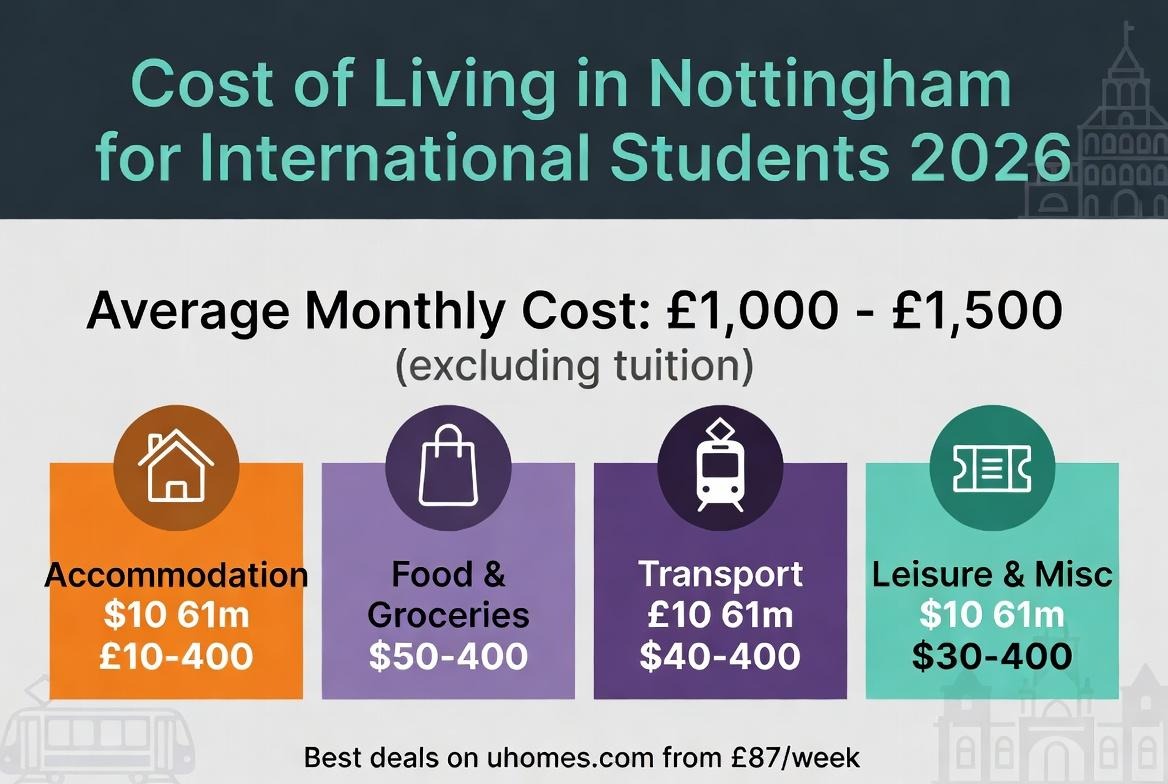
Excluding university tuition fees, the average monthly living cost for an international student in Nottingham ranges from £1,000 to £1,500, depending heavily on your lifestyle choices and accommodation type. Data from local university student financial support guidelines and UK student cost indices confirm that Nottingham remains one of the most cost-effective student cities in the UK, offering a significantly lower cost of living than London, Bristol, or Manchester without compromising on academic or cultural experiences.
Nottingham Student Accommodation Costs
Average student housing costs in Nottingham range from £110 to £320 per week, representing the single largest monthly expense for any international student. Official Nottingham local market assessments show a clear pricing hierarchy based on location and room type:
- Private Shared Houses (HMOs in Lenton/Radford): £110 to £160 per week (typically bills exclusive).
- Purpose-Built Student Accommodation (PBSA) En-suites: £150 to £220 per week (bills inclusive).
- Premium Private Studios: £230 to £320 per week (luxury amenities, bills inclusive).
To navigate these housing costs safely, international students frequently utilize specialized platforms like uhomes.com to secure low-cost, high-quality student apartments in Nottingham starting from just £87 per week. Across their entire global inventory, the platform ensures absolute affordability by offering a robust price-match guarantee on every single listing, automatically promising to match the lowest available market rate for any room.
uhomes.com also utilise its direct partnerships with major accommodation operators across the city to unlock exclusive offers that cannot be found anywhere else. Also, various other discounts for early-bird booking, group booking, and more are available. This powerful combination allows students to effortlessly secure the most budget-friendly NTU housing options steps from the city centre, as well as premium, well-connected UoN housing near the main campuses. In addition, uhomes.com also features premium Nottingham PBSAs with bills-inclusive rent, covering all water, gas, electricity, and high-speed broadband, to eliminate unexpected winter utility surprises entirely.
Food and Groceries Costs in Nottingham
The average monthly expenditure for student groceries and dining out in Nottingham in 2026 falls between £350 and £550. According to student expenditure data from sources like the National Union of Students (NUS) and Save the Student, home cooking remains the most reliable strategy to preserve your budget, allowing students to eat well on a grocery budget of £200 to £300 per month.
Your actual grocery cost in Nottingham will depend greatly on your choice of local supermarket entities:
- Value Supermarkets (Aldi on Radford Road / Lidl in Wollaton): Ideal for weekly essentials, fresh produce, and household basics at the lowest price points.
- Mid-Tier Express Stores (Tesco Express / Sainsbury’s Local): Conveniently located in the City Centre and near campuses, but carry slightly higher everyday pricing.
- Oriental Supermarkets (Hyson Green & City Centre): Highly accessible for international students from East Asia, keeping the cost of cooking authentic, familiar comfort food entirely reasonable.
- Leisure Dining Out: Allocating roughly £150 to £250 per month covers casual university campus meals, local coffees, and weekend meals in the vibrant Lace Market or Hockley districts.
Transport Fees in Nottingham
Navigating Nottingham as an international student costs an average of £45 to £60 per month when utilizing the city’s integrated public transport networks. Data from the Nottingham Express Transit (NET) and Nottingham City Transport (NCT) highlight that Nottingham possesses one of the most robust, highly rated green transit infrastructures in the United Kingdom, rendering private cars entirely unnecessary for university students.
Both the University of Nottingham (UoN) and Nottingham Trent University (NTU) enjoy direct connections across the transit network:
- NET Tram Network: Connects the UoN University Park and Jubilee campuses directly to the City Centre and NTU City Campus. A full academic year student tram pass typically costs £300–£350 (with early-bird discounts often bringing it down to £225–£300), equating to roughly £25–£30 per month for unlimited travel.
- NCT Bus Lines: Provides comprehensive routes linking suburban student residential areas like Lenton and Dunkirk to the NTU Clifton Campus and other locations. The academic year student bus pass is available for around £299–£349, offering excellent value for frequent users (often under £30 per month).
- Student Subsidies & Combined Options: International students can purchase heavily discounted Academic Year Student Season Passes (Robin Hood card for bus + tram + train) directly through university portals or transport apps. These unlimited passes usually range from £500–£650 per year depending on coverage, significantly lowering the overall monthly transport budget.
Leisure and Miscellaneous Expenses in Nottingham
A realistic monthly budget for student leisure, fitness, and miscellaneous personal expenses in Nottingham ranges from £120 to £240. Consumer price tracking for UK student services indicates that basic personal overheads remain entirely manageable under standard student tiers:
- Mobile Plans: Basic personal overheads, including mobile phone SIM contracts with unlimited data and standard household supplies, typically cost between £20 and £40 per month.
- Physical Well-being: Joining on-campus university fitness centers or local commercial gym chains like The Gym Group or PureGym averages £20 to £30 per month.
- Social & Cultural Integration: Allocating an additional £80 to £170 per month allows you to comfortably enjoy Nottingham’s local student culture, covering cinema tickets, student union social events, museum visits to Nottingham Castle, and weekend socializing with friends.
Money Saving Tips for International Students in Nottingham
Applying strategic financial habits is the most efficient way to reduce the cost of living in Nottingham for international students. Incorporating local student discounts and timing your consumer decisions wisely will protect your banking balance throughout the academic year.
- Secure Budget-Friendly Housing Early via Specialized Platforms: Secure the lowest rates by using uhomes.com to browse Nottingham Trent and UoN accommodation starting from £87 per week, taking full advantage of their price-match guarantee, group booking cashbacks, and early-bird discounts before market prices peak.
- Invest in Long-Term Transport Pass Immediately: Purchase an annual or term-long student tram and bus card in Nottingham at the beginning of your first semester rather than buying single daily tickets, maximizing your transit savings over the year.
- Maximize Student Discount Cards at Major Retailers: Always utilize digital student discount platforms like UNiDAYS, Student Beans, and the Totum card when shopping at the Victoria Centre or buying tech gear to instantly save 10% to 20% on retail prices.
- Time Your Supermarket Shopping Trips for Yellow Sticker Discounts: Visit local supermarkets like Sainsbury’s or Tesco in Nottingham in the late afternoon or early evening when staff apply “yellow sticker” clearance discounts to fresh food items, slashing your weekly grocery bills significantly.
Conclusion
Managing the cost of living in Nottingham for international students in 2026 is entirely achievable when you understand the local market dynamics and plan ahead. By selecting a highly economical city like Nottingham, international students enjoy a world-class education alongside a thriving urban lifestyle without the crushing financial pressures found in Tier 1 UK cities. Utilizing trusted, direct-partnership booking channels like uhomes.com to lock in a secure, bills-inclusive room with an early-bird offer and low-price guarantee, ensuring your monthly expenses remain entirely predictable while you focus on academic success.



Choosing the right preschool is a significant step in every child’s early development journey. Among the various options available, Singleton Preschool stands out as a premier choice that offers a comprehensive early learning experience. This institution is dedicated to fostering growth, creativity, and social skills in young children within a nurturing environment.
Introduction to Singleton Preschool
Singleton Preschool specialises in providing early childhood education that aligns with national quality standards. The preschool puts a strong emphasis on developing foundational skills that children will build upon throughout their education. Its curriculum is thoughtfully designed to balance structured learning with play-based activities, encouraging exploration and curiosity.
Curriculum and Learning Approach
The curriculum at Singleton Preschool follows the Early Years Learning Framework, which emphasises holistic development. Activities cover cognitive, emotional, physical, and social areas, ensuring children develop in a well-rounded manner. Learning experiences are tailored to be age-appropriate, promoting engagement through hands-on learning, storytelling, and creative arts.
Focus on Individual Needs
Recognising that every child is unique, Singleton Preschool adopts personalised learning strategies. Educators conduct observations and assessments to understand each child’s interests and abilities, enabling the design of customised learning pathways. This approach helps in supporting children’s strengths and addressing challenges effectively.
Qualified and Caring Educators
The team of educators at Singleton Preschool are highly qualified professionals with expertise in early childhood education. They are passionate about creating a safe and inclusive environment where children feel valued and encouraged to express themselves. Continuous professional development ensures they stay updated with best practices and innovative teaching methods.
Facilities and Learning Environment
Singleton Preschool boasts well-equipped facilities that stimulate learning and play. Classrooms are designed to be bright and welcoming, with resources that cater to various developmental activities. Outdoor play areas provide opportunities for physical exercise and interaction with nature, contributing to children’s overall well-being.
Safety and Health Measures
Safety is a top priority at Singleton Preschool. The premises adhere strictly to health and safety regulations. Regular sanitation, secure access controls, and emergency preparedness plans are in place to protect children at all times. Healthy meals and snacks are also provided to support nutritional needs.
Parental Involvement and Communication
Singleton Preschool believes in building strong partnerships with parents and caregivers. Open communication channels keep families informed about their child’s progress and upcoming activities. Parent meetings, newsletters, and digital platforms facilitate active participation, ensuring transparency and collaboration.
Benefits of Enrolling at Singleton Preschool
Enrolling a child at Singleton Preschool offers numerous advantages. Children develop social skills through group interactions and collaborative projects. The program helps build confidence and independence, preparing them effectively for the transition into primary school. The supportive environment also fosters emotional resilience and a lifelong love for learning.
Community Engagement and Cultural Diversity
The preschool actively promotes cultural awareness and inclusivity. Celebrations of various cultural events enrich children’s understanding and appreciation of diversity. Community involvement initiatives help children develop a sense of belonging and responsibility towards the broader society.
How to Enrol at Singleton Preschool
Prospective families interested in enrolling their children at Singleton Preschool can access detailed information and application procedures through the official website. Early application is encouraged due to limited spaces. The staff is available to provide tours and answer any queries to assist parents in making informed decisions.
Conclusion
Singleton Preschool offers an exemplary early childhood education experience focused on holistic development, safety, and community involvement. Its dedicated educators, comprehensive curriculum, and quality facilities make it an excellent choice for parents seeking the best educational foundation for their children. This preschool is committed to nurturing every child’s potential in a supportive and enriching environment.

The National Disability Insurance Scheme (NDIS) plays a crucial role in fostering inclusivity and providing comprehensive support for students with disabilities. Schools and families benefit significantly from tailored services designed to address individual needs, enabling students to maximise their potential in academic and social environments. Utilising an NDIS student support online finder can assist caregivers and educators in identifying appropriate resources and professionals to support students effectively.
Understanding NDIS Student Support
NDIS student support encompasses a variety of services aimed at enhancing the educational experience for students with disabilities. These services include therapy sessions, specialised learning aids, behavioural support, and assistance with mobility and communication. The goal is to promote independence, confidence, and engagement in the school setting.
Key Components of NDIS Support for Students
One of the fundamental aspects of NDIS student support is the personalised approach. Each student’s plan is developed based on an assessment of their unique needs, aspirations, and environment. Areas commonly addressed include:
- Occupational therapy to improve fine motor skills and daily living activities
- Speech therapy for communication challenges
- Physiotherapy to enhance mobility and physical function
- Psychological support for emotional and behavioural well-being
These services are coordinated to ensure consistency and integration within the student’s educational journey.
Accessing NDIS Support in Educational Settings
Schools play an integral role in the delivery of NDIS supports. Collaboration between educators, allied health professionals, and families ensures that students receive comprehensive care aligned with their Individualised Education Plans (IEPs). Accessing the appropriate supports begins with understanding eligibility and navigating the NDIS processes effectively.
Role of Allied Health Services
Allied health professionals, including therapists and psychologists, provide essential services under the NDIS framework. Their expertise contributes to devising strategies that support learning and development. Schools may facilitate on-site services or coordinate external providers to complement classroom activities.
Benefits of Comprehensive NDIS Student Support
Comprehensive support under the NDIS framework offers multifaceted benefits for students. These include improved academic outcomes, enhanced social interaction skills, and greater autonomy. Early intervention and consistent support contribute to long-term success and wellbeing.
Promoting Inclusion and Participation
NDIS student support fosters inclusion by enabling students with disabilities to participate fully in school activities alongside their peers. Adjustments and targeted interventions reduce barriers, making education more accessible and equitable.
Planning and Implementing Support Services
Effective planning is essential to align NDIS supports with the educational goals of students. Collaboration among families, schools, and NDIS planners ensures that funds are allocated appropriately to services and resources that will maximise benefit.
Monitoring Progress and Making Adjustments
The dynamic nature of student needs necessitates regular monitoring of progress. Adjustments to support services might be required to respond to developmental changes or evolving educational objectives. Schools and families should maintain open communication to adapt plans effectively.
Challenges and Considerations
While NDIS student support offers significant advantages, certain challenges exist. Navigating the NDIS system can be complex, and resource availability may vary geographically. Ensuring timely and adequate services requires proactive engagement and advocacy.
Addressing Systemic Barriers
Barriers such as funding limitations, wait times for assessment or service, and lack of specialised providers can impact service delivery. Stakeholders must work collaboratively to identify solutions and improve accessibility.
Future Directions in NDIS Student Support
Ongoing development within NDIS student support focuses on enhancing service integration and expanding access. Technological advancements and increased awareness contribute to the evolution of support models that are more responsive and efficient.
Digital Tools and Resources
Innovative digital platforms, including online support finders and virtual therapy options, expand the reach of services. Utilising resources such as the NDIS student support online finder enables easier navigation of available supports.
Conclusion
Empowering students with disabilities through comprehensive NDIS support services is fundamental to their academic achievement and personal development. Through personalised planning, collaboration, and leveraging available resources, schools and families can create an inclusive learning environment that promotes success for every student.


A few years ago, quantum computing felt like a research problem that security teams could safely file under “future concern.” That comfort is fading. Governments, standards bodies, and enterprise security leaders are already discussing what happens when quantum systems become capable enough to weaken cryptographic assumptions that have held for decades.
That’s where Grover’s algorithm in cybersecurity enters the conversation. It isn’t as disruptive to encryption as Shor’s algorithm, but it still changes the math defenders rely on, particularly when it comes to brute-force resistance and cryptographic key strength.
Why Grover’s Algorithm Matters
Quantum threats-related discussions often jump straight to something related to public-key cryptography. That’s fair, and that’s typically where headlines land.
But Grover’s algorithm is about solving an entirely different problem.
This algorithm was proposed in 1996 by Lov Grover. The algorithm speeds up searches through unstructured data sets. Also, if applied to cryptography, it can reduce the time needed to perform brute-force attacks against symmetric encryption and hashing functions.
Here’s the key distinction:
- Classical brute-force attacks scale linearly with the size of the search space.
- Grover’s algorithm provides a quadratic speedup.
- That means a key with n bits of security effectively offers about n/2 bits of resistance against a sufficiently capable quantum attacker.
The result isn’t a complete break. But it does change risk calculations.
The Difference Between Shor’s and Grover’s Algorithms
Security teams often lump quantum threats together, yet they affect cryptography in very different ways.
Shor’s Algorithm
Shor’s algorithm targets mathematical problems that underpin many public-key systems, including integer factorization and discrete logarithms. If large-scale fault-tolerant quantum computers arrive, commonly used public-key schemes could become vulnerable.
Grover’s Algorithm
Grover’s algorithm doesn’t directly break symmetric encryption.
Instead, it accelerates key searches.
For example, a classical attack against AES-128 requires testing an extremely large number of possible keys. A quantum attacker running Grover’s algorithm could reduce the effective security level, making AES-128 behave more like a 64-bit security system from a resistance perspective.
That’s still difficult. Just not difficult in the same way.
Readers must go through this explanation of grover’s algorithm in cybersecurity and its relationship to quantum computing to get a much better grasp of the core idea.
Where the Real Enterprise Risk Appears
It’s tempting to think Grover’s algorithm is only relevant once powerful quantum computers exist.
That misses an important point.
Cybersecurity planning often works on timelines measured in years. Sometimes decades.
Consider a financial institution storing transaction records that must remain confidential for extended periods. Or a healthcare provider maintaining protected patient data. Information stolen today could potentially be decrypted years from now if cryptographic protections become insufficient.
Security leaders frequently describe this as a “harvest now, decrypt later” concern.
This isn’t speculation from vendors. Organizations such as the U.S. National Institute of Standards and Technology (NIST) have been actively driving post-quantum cryptography initiatives because long-term cryptographic resilience has become a strategic issue, not just a research topic.
What Grover’s Algorithm Means for Symmetric Encryption
The good news is that symmetric cryptography holds up better against quantum advances than many public-key approaches.
Still, adjustments matter.
AES-128
AES-128 remains widely deployed and secure against classical attacks. Under a Grover-style quantum scenario, however, its effective security margin is reduced.
For some organizations, that reduction may become uncomfortable over the long term.
AES-256
AES-256 is generally viewed as a stronger option in a quantum-aware security strategy because even after the theoretical quadratic speedup, the remaining security level remains substantial.
That’s one reason many security architects are already standardizing on larger key sizes where operationally practical.
Hash Functions
Hashing isn’t immune either.
Grover’s algorithm can speed up preimage searches against cryptographic hashes. As a result, organizations should evaluate whether current hash and key-length selections align with future security requirements rather than only present-day threats.
Practical Questions CISOs Should Ask Now
Here’s the question I often hear in enterprise security discussions:
“If large quantum computers aren’t here yet, why spend time on this now?”
Because cryptographic transitions are rarely quick.
Few organizations can inventory every certificate, key, protocol, application dependency, and third-party integration overnight. Most can’t do it in a year.
A practical review should include:
Cryptographic Asset Discovery
You can’t modernize what you haven’t identified.
Map:
- Symmetric encryption usage
- Public-key implementations
- Digital certificates
- VPN and network security dependencies
- Long-term data repositories
Data Longevity Assessment
Not all information needs protection for the same duration.
Ask:
- Which data must remain confidential for 5 years?
- Which records require protection for 10 years or longer?
- What information would create legal, financial, or operational consequences if exposed in the future?
Crypto Agility
This term gets used frequently, sometimes too casually.
At its core, crypto agility means being able to replace cryptographic algorithms without rebuilding entire systems. Organizations that design for flexibility today will face fewer disruptions when standards evolve.
Network Security Considerations
Quantum readiness isn’t solely an encryption issue.
It’s also a visibility and governance issue.
Many enterprises discover that cryptographic controls are scattered across cloud services, branch infrastructure, applications, operational technology environments, and remote-access platforms. Different teams often manage each segment.
That fragmentation creates blind spots.
A security architecture that centralizes policy management, visibility, and risk assessment places organizations in a stronger position when cryptographic updates become necessary. The goal isn’t predicting every future standard. It’s knowing where changes will be required and how they can be implemented without disrupting business operations.
For broader enterprise security perspectives and technology coverage, readers can also explore resources published on Today’s Magazine.
Looking Beyond the Quantum Headlines
Quantum computing still hasn’t matured, and most conversations around it swing between hype and dismissal. But neither view is especially helpful.
Grover’s algorithm doesn’t signal the immediate collapse of modern encryption. What it does signal is that key length, cryptographic planning, and long-term data protection deserve closer attention than they received a decade ago.
For CISOs, network architects, and SOC leaders, the challenge isn’t guessing exactly when quantum capabilities will mature. It’s preparing for a future where cryptographic assumptions may shift faster than infrastructure can.
That makes Grover’s algorithm in cybersecurity more than an academic topic. It’s a reminder that security isn’t just about stopping today’s attacks. It’s about understanding which controls might age poorly, then making measured decisions before that risk becomes operational reality.

Why Multi-Model AI Image Generation Marks the End of Multi-Tool Visual Production

The Realities of Electric Scooter Ownership: Battery Care, Maintenance and Everyday Running Costs

The Ultimate Guide to Women’s Sandals for Style and Comfort

Essential Guide to Hire Furniture in Sydney for Stylish Home Makeovers

Publishing AI-Assisted Drafts as PDFs: A Free Markdown Workflow with iBoomto

Spinal Alignment in Kuala Lumpur: What It Involves and What It Costs

The 15 Highest-Paid Rugby Players in the World

Christopher Dare: The Untold Story of Engineer and Former Husband of Angela Rippon

How to Ensure Your Home is Valued Correctly for a Quick Sale

What Is Fanquer? The Digital Creator Platform Transforming Direct-to-Fan Engagement

Dr Jared Ross: Missouri Appeals Court Upholds Protection Order Over Graphic Torture and Murder Threats

Nancy Hallam: The Inspiring Life, Career, and Success Story Behind Ian Wright’s Wife
The 15 Highest-Paid Rugby Players in the World
Christopher Dare: The Untold Story of Engineer and Former Husband of Angela Rippon
How to Ensure Your Home is Valued Correctly for a Quick Sale
What Is Fanquer? The Digital Creator Platform Transforming Direct-to-Fan Engagement
Dr Jared Ross: Missouri Appeals Court Upholds Protection Order Over Graphic Torture and Murder Threats
Nancy Hallam: The Inspiring Life, Career, and Success Story Behind Ian Wright’s Wife
-
 Sports5 months ago
The 15 Highest-Paid Rugby Players in the World
-
Celebrity11 months ago
Christopher Dare: The Untold Story of Engineer and Former Husband of Angela Rippon
-
 Real Estate9 months ago
How to Ensure Your Home is Valued Correctly for a Quick Sale
-
 Technology5 months ago
What Is Fanquer? The Digital Creator Platform Transforming Direct-to-Fan Engagement
-
 Celebrity5 months ago
Dr Jared Ross: Missouri Appeals Court Upholds Protection Order Over Graphic Torture and Murder Threats
-
Celebrity11 months ago
Nancy Hallam: The Inspiring Life, Career, and Success Story Behind Ian Wright’s Wife
-

 Celebrity8 months ago
Who Is Azriel Crews? Inside the Life and Career of Terry Crews’ Daughter
-

 Health9 months ago
Enclomimed 25 (Enclomiphene) – Effective PCT Protocol