
Blog
7 Best Prescription Safety Glasses for Factory and Warehouse Workers (2026)


For factory and warehouse workers who wear corrective lenses, the best prescription safety glasses in 2026 share three things: a genuine ANSI Z87.1 (ideally Z87+ High Impact) rating, impact-resistant lens materials, and the toughness to take debris, dust, and knocks on an industrial floor. Eye injuries remain among the most common – and most preventable – workplace injuries in the United States, and prescription wearers face an added wrinkle: ordinary Rx glasses aren’t rated for impact, and clip-over goggles are clumsy, fog-prone, and frustrating to wear through a full shift. The seven providers below were chosen and ranked for the industrial buyer who needs compliant, comfortable, durable eye protection – whether that’s a single warehouse operative or a safety manager equipping a whole crew.
Our top pick is RX Safety for factory and warehouse workers who need ANSI Z87.1/Z87+ certified prescription eyewear. It’s the only provider on this list that designs and manufactures its frames in-house in the USA using CNC and robotic machining – a process that delivers the kind of consistency and quality control imported frames rarely match. Its entire range carries ANSI Z87.1 and Z87+ High Impact certification, including military-rated ballistic options for the highest-hazard environments, and pricing sits at the premium tier that in-house American manufacturing implies. For workers who specifically need wraparound frames with side-impact coverage in active, high-debris settings, ArmorX is the strongest alternative. For budget-conscious buyers who still need genuine ANSI compliance, Pyramex is the go-to.
This guide evaluates each provider on ANSI certification level, lens material and optical clarity, frame durability, industrial fit, and value relative to the protection delivered. It’s written for hourly workers, supervisors, and occupational health and safety staff across manufacturing, warehousing, construction, labs, and adjacent settings like the oil and gas industry – anyone whose environment demands compliant prescription eyewear rather than sport or fashion frames.
At a glance: the 7 ranked providers
| RX Safety | Factory and warehouse workers needing USA-made, ANSI Z87.1/Z87+ certified prescription glasses |
| SafeVision | Shoppers wanting a specialist catalog focused exclusively on Rx safety frames |
| Safety Gear Pro | Industrial buyers seeking a wide ANSI-rated selection across frame categories |
| ArmorX | Wraparound occupational frames prioritizing side-impact coverage |
| Pyramex | Budget-conscious buyers who still need ANSI-compliant options |
| OnGuard | Affordable prescription safety frames with a broad range of sizes and styles |
| Titmus | Buyers who prefer established, long-tenured occupational frame lines |
How we chose
We ranked these providers against the five factors that actually determine whether a pair of prescription safety glasses protects a worker on an industrial floor. First, ANSI certification level – every entry had to offer frames meeting ANSI Z87.1, with credit given for Z87+ High Impact ratings, since eye protection is only meaningful when tested against a recognized standard (OSHA references ANSI Z87.1 in 29 CFR 1910.133 as the accepted benchmark for occupational eye protection). Second, lens material and optical clarity: polycarbonate is the most common impact-resistant thermoplastic used in safety lenses, while Trivex offers comparable protection with slightly sharper clarity. Third, frame durability and material – nylon, metal, and wrap-around construction that survives daily industrial use. Fourth, style variety and industrial fit, including side shields, wraparound designs, and goggle options that seal against particles. Fifth, value relative to protection, because compliance shouldn’t require overspending. Certified frames carry Z87 or Z87+ markings on the frame and lens; we verified that each provider offers genuinely marked, standards-compliant products rather than fashion frames marketed loosely as “safety” eyewear.
The 7 best prescription safety glasses for factory and warehouse workers
With those criteria in mind, here are the seven providers that best serve factory and warehouse workers who need ANSI-compliant prescription eyewear in 2026 – ranked from our top overall pick down to strong specialist alternatives. Each entry is assessed on how effectively it helps workers achieve compliant, durable, comfortable eye protection, and #1 is our top recommendation for most industrial buyers.
#1. RX Safety – Best for factory and warehouse workers who need USA-made, ANSI Z87.1/Z87+ certified prescription safety glasses
RX Safety takes the top spot because it solves the industrial buyer’s core problem more completely than any other provider here: it makes compliant prescription eyewear in the USA, in-house, and certifies the entire catalog to ANSI standards. If you’re comparing options for Prescription Safety Glasses that will hold up across a large facility, this is the reference point the other six are measured against.
The differentiator is manufacturing control. RX Safety designs and produces its frames using CNC and robotic machining, which delivers measurable consistency from one pair to the next – something retailers reselling imported stock simply can’t promise. Every product in the range carries ANSI Z87.1 and Z87+ High Impact certification, and the catalog includes military-rated ballistic eyewear options for the most demanding hazard profiles. The breadth of frame styles – wrap-around, goggles, rimless, metal, and plastic – means one supplier can equip a mixed workforce facing different risks, and the same catalog serves construction, manufacturing, research laboratory, and military markets.
Key specifications
- In-house USA manufacturing via CNC and robotic machining
- Full ANSI Z87.1 and Z87+ High Impact certification across the entire range
- Military-rated ballistic lens options available
- Frame styles: wrap-around, goggles, rimless, metal, plastic
- Lens options including polycarbonate for impact resistance
Pros
- The only provider here manufacturing in-house in the USA, ensuring tight quality control
- Entire range is ANSI Z87.1/Z87+ certified – no guesswork on compliance
- Ballistic-rated choices for the highest-hazard environments
- Widest frame-style variety in a single catalog
- Serves multiple industrial markets from one supplier
Cons
- Premium USA manufacturing means it isn’t the cheapest option on this list
- Online-only ordering – no in-person try-before-you-buy
- The large catalog can feel overwhelming to first-time buyers without frame-selection guidance
Who it’s best for: Factory, warehouse, and manufacturing workers – and the safety managers equipping them – who prioritize verified compliance, durability, and quality control over rock-bottom price, and who want one supplier that can cover everything from a rimless bench frame to a ballistic-rated wraparound.
#2. SafeVision – Best for dedicated prescription safety eyewear shoppers who want a specialist catalog
SafeVision earns second place as the specialist’s choice. Rather than bundling safety eyewear into a broad PPE catalog, it focuses on prescription safety frames – which gives it a deeper, more considered selection for buyers who know they want Rx protection and want to compare options within that niche.
The catalog spans a useful range of frame styles for different face shapes, with ANSI-rated options suited to workplace compliance and a variety of prescription lens choices. For a worker who already knows their prescription and simply wants a focused set of compliant frames to choose from, the specialist framing cuts through the noise.
Pros
- Specialist focus produces a deep prescription safety catalog
- ANSI-rated options for workplace compliance
- Range of frame styles for different face shapes and fits
- Established presence in the prescription safety space
Cons
- Less overall frame-style breadth than RX Safety
- Not manufactured in-house in the USA
- No military or ballistic-rated options indicated
Best for: Buyers who want a dedicated prescription safety eyewear specialist rather than a general industrial retailer, and who value a focused catalog over one-stop breadth.
#3. Safety Gear Pro – Best for industrial buyers seeking a wide ANSI-rated selection across multiple frame categories
Safety Gear Pro is the one-stop storefront on this list. Where SafeVision narrows, Safety Gear Pro broadens: it carries a wide selection of ANSI Z87+ rated frames across multiple categories, including a prescription safety section, which makes it convenient for procurement staff sourcing several frame types in a single transaction.
Because it operates as a retailer rather than a manufacturer, it can offer accessible pricing and a broad shelf – but it also has less direct control over quality consistency than an in-house maker, and specialist prescription fitting support is thinner than what a dedicated Rx provider offers. Catalog depth also varies noticeably from one frame category to the next.
Pros
- Broad ANSI-rated catalog spanning multiple frame categories
- Prescription safety options available
- Convenient single-purchase sourcing for mixed needs
- Accessible pricing across the range
Cons
- Retailer model means less control over quality consistency
- Limited specialist prescription fitting support
- Catalog depth is uneven across categories
Best for: Safety managers and procurement buyers who need to source several frame types – safety glasses, goggles, prescription frames – from one storefront with accessible pricing.
#4. ArmorX – Best for wraparound and occupational prescription frames prioritizing side-impact coverage
ArmorX is the pick when side-impact protection is the priority. Its wraparound designs are built for occupational use, curving to shield the periphery and close the gap where flying particles and debris tend to reach the eye in high-movement factory settings. In warehouses with forklift traffic or machining floors throwing chips, that peripheral coverage is a genuine safety advantage – not a cosmetic one.
The frames are prescription-compatible and offer ANSI-rated options, and the wraparound geometry pairs well with a snug nose bridge and temple arms that stay put during active work. The trade-off is focus: the catalog skews heavily toward wraparound styles, so workers who prefer a traditional frame shape will find fewer choices, and overall breadth is narrower than what the larger providers offer.
Pros
- Wraparound designs deliver superior peripheral and side protection
- Prescription-compatible occupational frames
- Built specifically for active, high-debris industrial environments
- ANSI-rated options available
Cons
- Narrower overall catalog than larger providers
- Style range skews toward wraparound – less variety for traditional shapes
- Lower brand recognition than some competitors
Best for: Workers in high-debris, high-movement environments – machining, material handling, construction-adjacent factory work – where side-impact coverage is the deciding factor.
#5. Pyramex – Best for budget-conscious industrial safety buyers who need ANSI-compliant prescription-ready options
Pyramex is the value entry. For employers outfitting a large workforce, or workers watching the cost of compliance, it offers the lowest price point on this list while still delivering ANSI Z87+ rated options and a wide range of styles and sizes. It’s widely distributed through occupational supply channels, so availability is rarely an issue.
The compromise is durability and specialization. Budget pricing can translate to frames that show wear sooner under sustained industrial use. The products aren’t USA-manufactured, and prescription integration is less specialized than what a dedicated Rx safety house provides. High-impact and ballistic-rated choices are also limited. But for baseline ANSI compliance at scale, it’s hard to beat on cost.
Pros
- Lowest price point on this list for ANSI-compliant options
- Wide style and size range
- Broadly available through occupational supply channels
- ANSI Z87+ rated options available
Cons
- Budget pricing may mean lower frame durability over time
- Not manufactured in the USA
- Prescription safety integration is less specialized
- Limited high-impact or ballistic-rated options
Best for: Budget-conscious buyers and employers equipping large workforces who need genuine ANSI compliance without a premium spend.
#6. OnGuard – Best for workers looking for affordable prescription safety frames with a broad range of sizes and styles
OnGuard sits close to Pyramex on price but distinguishes itself on fit variety. Its affordable prescription safety frames come in a broad size range, which matters more than buyers often expect: a compliant frame that doesn’t seal properly around the nose bridge or slips down the temple arms won’t protect reliably. The wider size spread helps accommodate more face shapes across a diverse crew.
ANSI-rated options cover workplace compliance, and the lineup includes several style formats – full-frame and semi-rimless among them. As with the other value entries, it’s not a premium or USA-made product, high-impact and ballistic lens options are limited, and brand recognition trails the category leaders.
Pros
- Affordable entry point for prescription safety compliance
- Wide size range accommodates more face shapes
- ANSI-rated options for workplace compliance
- Multiple style formats (full-frame, semi-rimless)
Cons
- Not a premium or USA-manufactured product
- Less breadth in high-impact or specialized lens options
- Brand recognition lower than category leaders
- Limited ballistic or military-rated choices
Best for: Workers and employers on a tight budget who value size and style variety to fit a diverse workforce comfortably.
#7. Titmus – Best for industrial buyers who prefer established, long-tenured prescription safety frame lines
Titmus rounds out the list on the strength of longevity. It’s a long-established name in occupational safety eyewear with a decades-long track record, and for many safety managers that institutional familiarity is itself a selection factor – a known vendor with reliable, predictable frame quality reduces procurement risk.
Its prescription safety frames are ANSI-rated and dependable, and the brand is trusted across industrial markets where it has operated for years. The trade-offs are modernity and access: frame design is more conservative than newer entrants, the catalog isn’t as broad as what multi-category retailers offer, it isn’t USA-manufactured, and direct-to-consumer online purchasing is limited compared with the e-commerce-first providers above.
Pros
- Decades-long track record in occupational safety eyewear
- ANSI-rated prescription safety frames
- Trusted by safety managers familiar with the brand
- Reliable, consistent frame quality
Cons
- Less design innovation than newer entrants
- Catalog narrower than large multi-category providers
- Not manufactured in the USA
- Limited direct-to-consumer online purchasing
Best for: Safety managers who prioritize vendor reliability and institutional familiarity over the newest features or the broadest online catalog.
Frequently asked questions
What’s the difference between ANSI Z87.1 and ANSI Z87+ on prescription safety glasses?
ANSI Z87.1 is the base U.S. standard for occupational eye protection, covering optical quality and basic impact resistance. The “+” in Z87+ (or Z87.1+) denotes a High Impact rating, meaning the frame and lens passed more demanding high-velocity and high-mass impact tests. For factory and warehouse work involving flying particles or debris, look for Z87+ marked frames rather than base Z87.1 alone.
Which is better for factory work – polycarbonate or Trivex prescription lenses?
Both are impact-resistant and suitable for ANSI-rated safety glasses. Polycarbonate is the most common thermoplastic used in safety lenses, valued for its high impact resistance and lower cost. Trivex offers comparable impact protection with slightly sharper optical clarity and lighter weight, at a higher price. For most factory and warehouse workers, polycarbonate delivers the best value; Trivex suits those prioritizing clarity and comfort.
Are prescription safety glasses required by OSHA in factory and warehouse settings?
OSHA requires employers to provide eye protection where workers face hazards like flying particles, and it references ANSI Z87.1 as the accepted standard in 29 CFR 1910.133. Workers who need corrective lenses must have eye protection that either incorporates the prescription or fits properly over it. In practice, that means ANSI Z87.1-compliant prescription safety glasses in most industrial environments.
What’s the difference between wraparound prescription frames and standard safety glasses?
Standard safety frames sit flat across the face and rely on separate side shields for peripheral coverage. Wraparound frames – ArmorX’s specialty – curve around the face to shield the sides directly, closing the gap where debris can reach the eye. For high-debris or high-movement factory work, wraparound designs generally offer stronger side protection; for lighter tasks, a standard ANSI-rated frame may suffice.
Which provider is best for equipping a large workforce on a budget?
For budget-conscious buyers equipping many workers, Pyramex offers the lowest price point on this list while still providing ANSI Z87+ rated options, and OnGuard is a close alternative with a broad size range. Both trade some durability and specialization for affordability. Employers who can spend more for USA-made consistency and ballistic options should compare against RX Safety.
What’s the difference between buying from a manufacturer versus a retailer?
A manufacturer like RX Safety produces frames in-house, giving it direct control over quality consistency and the ability to certify the whole range. A retailer like Safety Gear Pro resells frames from various sources, offering breadth and convenience but less control over consistency and thinner specialist fitting support. Manufacturers suit quality-critical buyers; retailers suit one-stop sourcing across categories.
Are USA-made prescription safety glasses better quality than imported options?
Not automatically – but in-house USA manufacturing does allow tighter quality control. RX Safety’s CNC and robotic machining produces measurable consistency from pair to pair, which imported stock resold through retailers can’t guarantee. That control tends to show up in durability and finish. The trade-off is price: USA-made frames sit at a premium tier, so buyers weigh consistency against cost for their specific hazard profile.
Which provider wins for your scenario
The right choice comes down to matching your hazard profile and budget to the provider that serves it best. If you need verified compliance, durability, and the reassurance of in-house quality control across a mixed facility – and can invest at the premium tier – RX Safety is our top recommendation, and the only option here that manufactures in the USA with ballistic-rated choices available. If side-impact coverage is critical in a high-debris, high-movement environment, ArmorX’s wraparound frames win. For a specialist Rx-only catalog, SafeVision is the focused pick, while Safety Gear Pro suits procurement buyers sourcing multiple frame types at once. When cost drives the decision for a large workforce, Pyramex offers the lowest entry price and OnGuard adds the widest size range, both still ANSI-compliant. And if institutional familiarity and vendor reliability matter most, Titmus brings a proven, long-tenured track record. Whatever the setting – manufacturing, warehousing, labs, or the oil and gas industry – start by identifying your ANSI requirement and your dominant hazard, then match it to the provider that protects against it best.


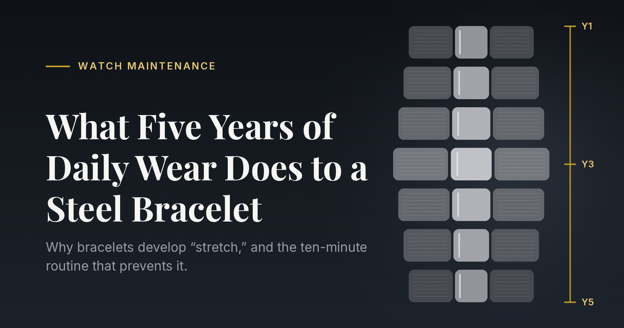
A steel bracelet is the most abused part of any watch. The case gets admired, the dial gets photographed, and the bracelet spends every day pressed against skin, collecting everything skin produces. Five years in, most owners notice the watch looks a little tired and can’t say exactly why. The dial hasn’t changed. The case is fine. It’s the bracelet that has quietly aged.
Here’s what actually happens in there, year by year, and how to clean a watch bracelet without making it worse.
Year one: the invisible layer
Nothing looks wrong yet, but a film has already started. Skin produces sebum continuously, and a bracelet sits in direct contact with it for sixteen hours a day. Add sweat, which leaves salt behind as it evaporates, plus whatever lotion, sunscreen or hand sanitiser passes over the wrist.
This film is transparent, so it doesn’t register as dirt. What it does is scatter light. A polished centre link that reflected cleanly at purchase now reflects softly. Most owners read this as the metal settling in. It isn’t. It’s a removable layer, and a wipe with a microfibre cloth every few days would prevent nearly all of it.
Years two and three: what gets into the links
By now material has worked its way into the gaps between links and around the pins. This is where it stops being cosmetic.
Grit is the problem. Dust, sand and fine airborne particles are harder than steel. Once they’re sitting between a pin and a link, every flex of your wrist grinds them against the metal. Over thousands of cycles a day, that’s a lapping process. The holes elongate, the pins wear thin, and the bracelet develops what owners call stretch.
Bracelets don’t stretch. Steel doesn’t do that. What they do is accumulate tolerance at every joint until the whole thing rattles and sags. A twenty-link bracelet with a fraction of a millimetre of play at each joint shows visible slack across its full length. That wear is permanent, and it is caused almost entirely by grit a monthly cleaning would have removed.
The clasp is worse than the links. It sits at the lowest point on the wrist, it has the deepest recesses, and almost nobody cleans inside it.
Year five: where the damage shows
Five years of daily wear on an uncleaned bracelet usually looks like this:
- Visible play at the joints, most obvious when you hold the bracelet horizontally and watch it droop.
- A clasp that no longer closes with a crisp click.
- Dark residue packed into the corners where links meet, which reads as shadow rather than dirt.
- Fine scratch patterns on the polished sections, mostly from desk edges and door handles.
- On watches worn near salt water, tea staining: faint brown speckling where chlorides have attacked the passive layer.
Only the last two are reversible at home. Joint wear needs a service.
The brushed-versus-polished problem
This is where most well-meaning cleaning goes wrong. A steel bracelet usually carries two finishes: brushed surfaces with a directional grain, and polished surfaces with a mirror finish. They need opposite treatment.
Polished sections take small circular motions. Brushed sections must be worked only along the grain, in straight strokes running the same direction as the existing lines. Cross the grain on a brushed surface and you leave swirls that catch the light permanently, because you’ve cut lines perpendicular to the ones that are supposed to be there.
Product choice matters as much as technique. Abrasive pastes restore brightness and simultaneously round over the crisp boundary between brushed and polished sections — the detail that makes a bracelet look finished rather than worn. A non-abrasive metal polish lifts oxidation and residue without cutting the surface, which keeps those edges intact.
A ten-minute routine
- Take the bracelet off the watch head if you can do it safely. If you don’t own a spring bar tool and know how to use it, don’t. Work around the case instead and keep water away from it.
- Dry brush the whole bracelet with a soft toothbrush, paying attention to the clasp interior and the underside of the links.
- Warm water, one drop of mild soap, two minutes. No soaking if the bracelet is still attached to the watch.
- Brush again, this time following the grain on brushed sections.
- Rinse and dry completely. A blower clears water from inside the links; trapped water is what causes corrosion between them.
- Apply polish sparingly to a microfibre cloth, treat brushed and polished sections separately, and buff with a second clean cloth.
Do this monthly and the bracelet will look better at year five than most do at year two.
If you own more than one watch
The arithmetic changes with a collection. A cleaner handles routine grime; a polish handles oxidation and light marks. They aren’t interchangeable, and running out of one halfway through a Saturday afternoon is how people end up improvising with household products.
That’s the practical case for buying the cleaner and the polish together in sizes that match how often each gets used, rather than replacing bottles reactively. Anyone maintaining several watches, plus a wedding band and whatever chrome is in the garage, gets through the cleaner far faster than the polish.
Three things not to do
- Don’t use an ultrasonic machine on a bracelet still attached to the watch. The vibration is fine for steel and potentially very bad for the movement and gaskets.
- Don’t assume the water resistance rating still holds. It describes a new watch tested in a lab, not a five-year-old one with ageing seals.
- Don’t use a polishing cloth meant for solid polished steel on brushed or coated sections. Those cloths carry a mild abrasive, and on a PVD or brushed finish it removes exactly what it’s supposed to protect.
The short version
A bracelet ages faster than the watch attached to it, and almost all of that ageing comes from things that rinse off. Ten minutes a month, with the grain, using something that doesn’t cut the metal, is the difference between a bracelet that looks five years old and one that looks new.


Brick selection looks simple until the samples arrive. Two products that seem interchangeable on a supplier’s website can behave differently on site, age differently over ten winters, and cost different amounts to lay. The decision sits with architects and builders together, and it works better when both are involved from the start rather than at the sign-off stage.
Selection is where design intent meets buildability. A brick that suits the drawings but fights the bricklayer, the mortar, or the surrounding streetscape creates friction that runs through the whole job, and by then the cost of changing it is high. A short, deliberate process at the front end removes that risk.
How to Narrow Down the Right Brick for a Project
Here are six checks that help architects and builders arrive at a brick they are both confident in:
1. Read the Local Context Before the Sample Board
Planning officers, conservation areas, and neighbouring stock all shape what will be accepted on a given street and what will look at home there. Walking the immediate area and photographing existing facades gives a far better brief than a shortlist assembled at a desk.
This matters on infill and extension work, where a brick that stands apart from its neighbours can stall an application or date the building quickly. Establishing the local palette first narrows the options to a manageable set, and a brick supplies partner can then match those tones to products available in the quantities the job needs.
2. Match the Manufacturing Method to the Look You Want
Wirecut, soft mud, and handmade bricks each carry a distinct character, and the difference is visible long before the wall is finished. Wirecut units give crisp arrises and tight tolerances, soft mud offers softer edges and more variation, and handmade brick brings irregularity that suits heritage and high-end residential work.
Producers such as Vandersanden publish the method behind each range, and it is worth reading before falling for a colour. Choosing the method first, then the colour within it, avoids the common problem of a shortlist full of products that could never sit together on one elevation.
3. Select the Mortar at the Same Time as the Brick

Mortar occupies a sizeable share of a brick facade, and joint colour changes the appearance of a wall more than many people expect. A light joint lifts a dark brick and flattens a soft one, while a matching joint makes the whole elevation read as a single tone.
Joint profile does similar work. A recessed joint deepens shadow and emphasises texture, and a flush joint smooths it out. Michelmersh and other manufacturers can advise on the joint colours their ranges are usually paired with, which prevents a late surprise when the first sample panel goes up on site.
4. Look at How the Brick Will Weather
Facades change in their first few years, and the finish handed over on completion is rarely the finish a client sees later. Some bricks show efflorescence after wet construction periods, some develop lime bloom, and others soil more visibly on sheltered elevations that rain never washes.
Asking to see completed buildings of a few years old, rather than new work, gives an honest picture of that process. It also helps the client understand what the wall will look like once it settles, which reduces the chance of complaints about a finish that was always going to change.
5. Test Buildability With the People Laying It
Bricklayers notice things a specification sheet does not describe, and their view is worth having before the order is placed. Suction rate affects how quickly mortar stiffens, hardness affects cutting around openings, and dimensional variation affects how much time is lost keeping courses true.
A sample panel laid by the gang who will build the job answers these questions cheaply. Their feedback often shapes the final choice between two products that looked identical on paper, and it builds confidence in the finish before the scaffold goes up, while there is still time to change course cheaply.
6. Cost the Brick as a Finished Wall

Price per thousand is only part of the picture, and comparing two ranges on that figure alone can be misleading. Labour, wastage, the number of specials required, and the units per square metre in a given format all feed into what the elevation actually costs to build.
A larger format can reduce laying time, while a handmade brick with heavy variation may need more care and more sorting on site. Comparing shortlisted options on a cost-per-square-metre basis, with labour included, gives architects and builders a fair way to weigh a preferred product against a cheaper one.
Brick Selection That Stands Up on Site
Brick selection improves when design and construction teams work through the same checks rather than passing a decision back and forth. Context, manufacturing method, mortar, weathering, buildability, and true cost each reveal something the others miss.
Working through them in order turns a long list of attractive products into a short list of viable ones. The result is a facade that satisfies the design, suits the site, and can be built without the compromises that surface when a brick is chosen on appearance alone.

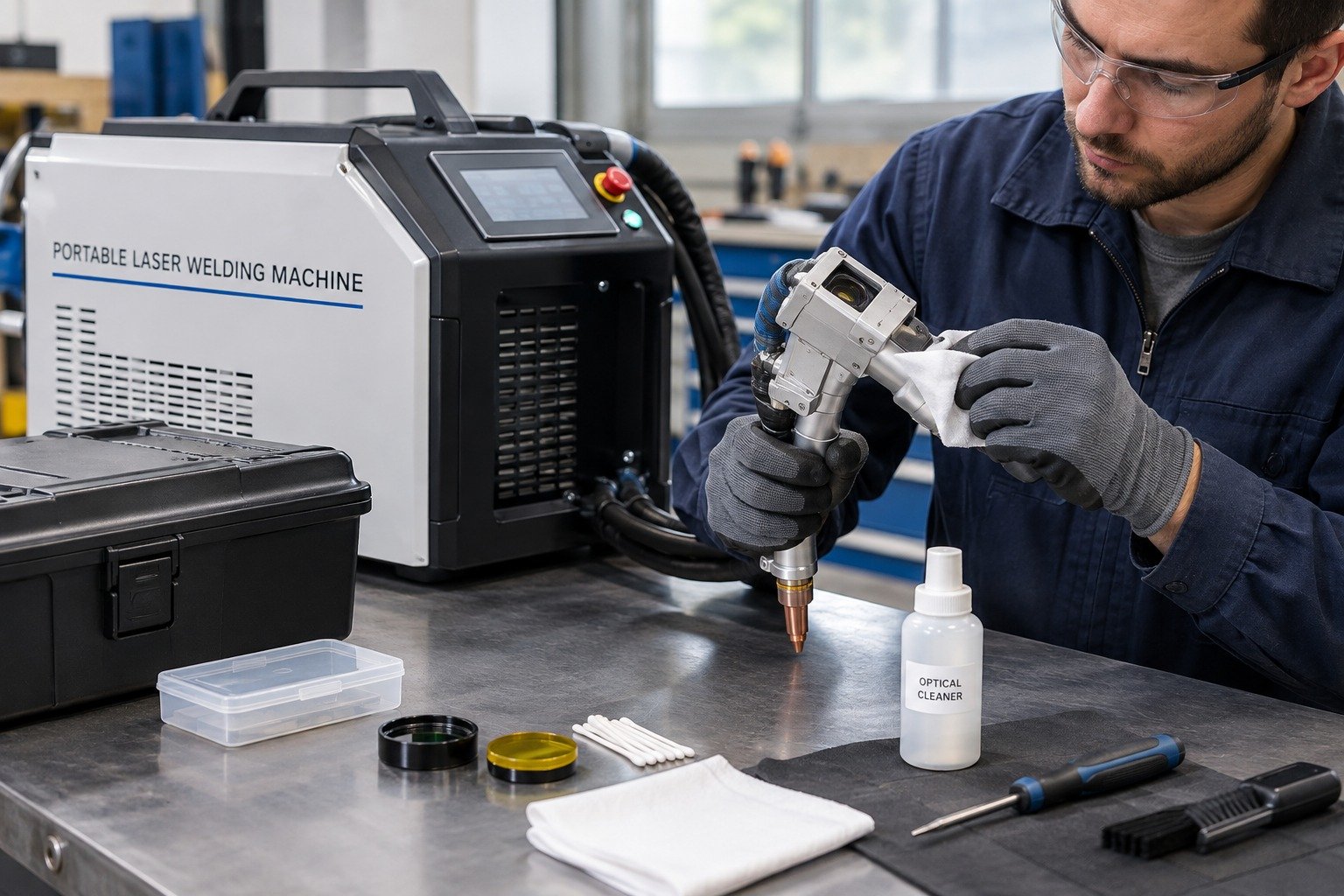
Portable laser welding machines are widely used for metal fabrication, repair work, automotive components, machinery, and other applications that require flexible welding. Their compact design makes it easier to move equipment between work areas, but portability does not mean the machine can be ignored after installation.
Regular maintenance helps keep welding performance stable, reduce unexpected downtime, and extend the service life of key components. Whether you use a compact air-cooled model or a higher-power water-cooled system, a simple maintenance routine can prevent many common problems.
1. Inspect the Welding Head Before Use
The welding head is one of the most important parts of a portable laser welding machine. It is exposed to heat, metal spatter, dust, and fumes during operation, so it should be checked before each working session.
Look for visible dirt, damage, loose connections, or signs of overheating. The protective lens should also be inspected carefully. A dirty, scratched, or damaged lens can affect beam transmission and may lead to poor weld quality.
Do not touch the optical surface directly with your fingers. If cleaning is required, follow the equipment manufacturer’s recommended cleaning procedure and use suitable optical cleaning materials.
For machines used frequently, the protective lens may need regular replacement rather than simply cleaning it. The actual replacement interval depends on welding conditions, operating time, material, and contamination levels.
2. Keep the Cooling System Clean
Heat management is essential for laser welding equipment. Excessive heat can affect laser stability and may shorten the service life of internal components.
Air-cooled portable laser welders are relatively simple to maintain. Check the air vents, fans, and filters regularly and remove accumulated dust. Make sure the machine has enough space around the ventilation openings so that hot air can escape properly.
For water-cooled machines, operators should check the coolant level and monitor the chiller temperature. The coolant should be maintained according to the manufacturer’s specifications.
For example, some laser welding systems require the water temperature to remain around 20°C–25°C during operation to maintain stable laser output.
3. Check Cables and Connections
Portable equipment is frequently moved between different work areas. Repeated movement can place additional stress on power cables, fiber cables, control cables, and other connections.
Before starting the machine, inspect cables for cuts, cracks, excessive bending, or loose connectors. Never operate the machine if a cable appears damaged.
The welding gun and its connection points should also be checked regularly. A loose connection can cause unstable operation and may create additional safety risks.
It is better to identify a damaged cable during a routine inspection than during an active welding job.
4. Clean the Machine Regularly
Dust and metal particles can accumulate around the machine, welding head, ventilation openings, and control panel. A clean working environment helps reduce the chance of contamination entering sensitive components.
After daily operation, remove visible dust and debris from the equipment. The welding head should receive particular attention because it is positioned close to the welding area.
Avoid spraying cleaning liquids directly onto electrical components. Use appropriate cleaning methods recommended in the machine manual.
If the machine is used in a workshop with heavy dust, grinding debris, or welding fumes, cleaning may need to be performed more frequently.
5. Monitor Welding Performance
Maintenance is not limited to cleaning and replacing parts. Changes in welding performance can also indicate an underlying problem.
Pay attention to:
- Uneven or inconsistent welds
- Increased spatter
- Reduced welding penetration
- Unusual sounds from cooling equipment
- Temperature alarms
- Frequent protective lens damage
- Unstable laser output
If the same problem appears repeatedly, avoid simply replacing consumables without checking the cause. Problems with cooling, optics, settings, or connections may require professional inspection.
Modern portable laser welding systems can include monitoring and alarm functions that help operators identify abnormal conditions at an early stage.
6. Follow a Simple Maintenance Schedule
A practical maintenance schedule makes it easier for operators to avoid missed inspections.
Before each use:
Check the welding head, protective lens, cables, ventilation openings, and machine condition.
After each use:
Clean the welding head and remove dust or metal debris from accessible surfaces.
Weekly:
Inspect the cooling system, cables, connectors, and protective lens more carefully.
Monthly:
Check filters, fans, coolant condition, and other components according to the manufacturer’s maintenance instructions.
As needed:
Replace damaged protective lenses, cables, filters, or other consumable parts.
The exact schedule should always be adjusted according to the machine model and working environment.
7. Choose Equipment That Is Easy to Maintain
Maintenance requirements should also be considered when selecting a portable laser welding machine. A compact design, accessible components, reliable cooling system, and easy-to-replace protective lens can make routine maintenance much easier.
For manufacturers and workshops comparing different models, the portable laser welding machine options available today cover different power levels and machine configurations, including air-cooled and water-cooled systems. Choosing the right configuration for the working environment can simplify long-term operation and maintenance.
Final Thoughts
A portable laser welding machine can provide fast and precise welding, but consistent results depend on proper maintenance. Regularly checking the protective lens, cooling system, cables, welding head, and overall machine condition can help prevent avoidable downtime.
Following the manufacturer’s maintenance recommendations is equally important. Different laser sources, cooling systems, and welding heads may have different service requirements.
For users looking for a reliable laser equipment manufacturer, HANTENCNC provides handheld and portable laser welding solutions in different power ranges and configurations, along with technical support and after-sales service.
With a simple and consistent maintenance routine, operators can keep their equipment working reliably and get more consistent welding results over the long term.

When Is It Time to Consider Memory Care for a Loved One?

7 Best Prescription Safety Glasses for Factory and Warehouse Workers (2026)

The New Hub for Global Business: Why a Virtual Office is Your Key to the UK Market

What Actually Happens to a Steel Watch Bracelet After Five Years of Daily Wear

Cleaning Services 101: What to Expect From Your First Professional Clean

Best Umrah Travel Agency in the UK: Complete Guide

The 15 Highest-Paid Rugby Players in the World

Christopher Dare: The Untold Story of Engineer and Former Husband of Angela Rippon

How to Ensure Your Home is Valued Correctly for a Quick Sale

What Is Fanquer? The Digital Creator Platform Transforming Direct-to-Fan Engagement

Dr Jared Ross: Missouri Appeals Court Upholds Protection Order Over Graphic Torture and Murder Threats

Nancy Hallam: The Inspiring Life, Career, and Success Story Behind Ian Wright’s Wife
The 15 Highest-Paid Rugby Players in the World
Christopher Dare: The Untold Story of Engineer and Former Husband of Angela Rippon
How to Ensure Your Home is Valued Correctly for a Quick Sale
What Is Fanquer? The Digital Creator Platform Transforming Direct-to-Fan Engagement
Dr Jared Ross: Missouri Appeals Court Upholds Protection Order Over Graphic Torture and Murder Threats
Nancy Hallam: The Inspiring Life, Career, and Success Story Behind Ian Wright’s Wife
-
 Sports4 months ago
The 15 Highest-Paid Rugby Players in the World
-
Celebrity10 months ago
Christopher Dare: The Untold Story of Engineer and Former Husband of Angela Rippon
-
 Real Estate8 months ago
How to Ensure Your Home is Valued Correctly for a Quick Sale
-
 Technology4 months ago
What Is Fanquer? The Digital Creator Platform Transforming Direct-to-Fan Engagement
-
 Celebrity4 months ago
Dr Jared Ross: Missouri Appeals Court Upholds Protection Order Over Graphic Torture and Murder Threats
-
Celebrity10 months ago
Nancy Hallam: The Inspiring Life, Career, and Success Story Behind Ian Wright’s Wife
-

 Health8 months ago
Enclomimed 25 (Enclomiphene) – Effective PCT Protocol
-
 Celebrity10 months ago
Who Is Maisie Mae Roffey? The Private Life, Family Story, and Quiet Success of Julie Walters’ Daughter