
Business
Leadership Development vs. Organization Development: What’s the Difference and Why Both Matter


Most companies that invest in people-focused initiatives tend to treat leadership development and organization development as interchangeable terms. They are not. While both disciplines aim to improve how a company functions and how its people perform, they operate from different starting points, address different problems, and produce different outcomes. Conflating them often leads to well-intentioned programs that solve only half of a real problem — or miss the root cause entirely.
This distinction matters most when companies are navigating growth, structural change, or persistent performance issues that training alone hasn’t resolved. Understanding where each discipline applies — and why they often need to work together — is one of the more practical decisions an organization’s leadership team can make.
Defining Leadership Development and How It Operates in Practice
Leadership development refers to deliberate, structured efforts to build the skills, judgment, and behaviors of individuals who hold or are being prepared for leadership roles. The focus is on the person: how they make decisions, how they communicate, how they manage performance, and how they build trust within their teams. It is fundamentally an investment in human capacity at the individual level.
Programs built around leadership and organization development — such as those described in structured HR service offerings focused on leadership and organization development — often reflect a dual understanding: that strong individuals are necessary, but not sufficient, to produce a strong organization. The individual work and the structural work must both be addressed.
What leadership development actually covers varies widely depending on an organization’s size, sector, and current challenges. In some companies, it centers on emerging managers who have been promoted without formal preparation. In others, it focuses on senior leaders whose teams are underperforming despite apparent effort. The common thread is a belief that behavior and skill can be developed intentionally, and that doing so produces more consistent, reliable leadership at every level.
What Leadership Development Addresses — and What It Cannot
Leadership development works well when the underlying issue is genuinely individual. If a manager struggles to give clear feedback, avoids conflict, or makes reactive decisions under pressure, targeted development can produce real change. These are learnable skills when approached correctly and supported over time.
However, leadership development has clear limits. A manager placed in a poorly designed reporting structure, given conflicting goals, or working without clear accountability systems will struggle regardless of how capable they are personally. When the environment itself is misaligned, individual development cannot compensate. This is where organization development becomes necessary — and where many companies invest in the wrong solution because they have not correctly identified the problem.
What Organization Development Actually Means
Organization development is a systems-level discipline. Rather than focusing on individuals, it examines how the organization is designed: how work flows, how decisions are made, how roles are structured, and whether the organization’s formal systems align with its actual goals. It draws on behavioral science to diagnose why organizations behave the way they do — and what structural, procedural, or cultural conditions need to change for performance to improve.
The field has a well-documented history, with roots traceable to mid-twentieth century research in applied behavioral science, as outlined by institutions such as the Society for Human Resource Management, which continues to document how organizational systems shape workforce behavior and effectiveness. What has remained consistent across decades of practice is the focus on diagnosing systemic conditions rather than assuming people are the only variable.
The Structural Problems Organization Development Is Built to Solve
Organization development is appropriate when the dysfunction is embedded in how the company is built rather than who is in it. Common conditions that call for this work include departments that operate in silos without meaningful coordination, unclear ownership of decisions that causes repeated delays, role definitions that create ambiguity and conflict, and reward systems that inadvertently reinforce the wrong behaviors.
These issues do not resolve through coaching or training. A leadership workshop will not fix a governance structure where accountability is unclear. A communication seminar will not repair a team design that puts people with conflicting incentives in collaboration-dependent roles. Organization development requires a different set of interventions: structural redesign, process clarification, alignment of systems, and sometimes significant changes to how the organization is organized at a fundamental level.
Diagnosis as the Starting Point for OD Work
One of the most important aspects of organization development is that it begins with structured diagnosis rather than assumed solutions. This typically involves examining data across levels — how work actually moves through the organization, where delays or errors cluster, how decisions get made in practice versus on paper, and whether stated values align with measurable behaviors and outcomes.
Without this diagnostic step, organizations often implement interventions that address symptoms rather than causes. A company experiencing high turnover, for example, might invest in manager training when the actual issue is a promotion structure that creates no meaningful career path. The training may produce incremental improvement, but it will not change the underlying dynamic that causes people to leave.
Where the Two Disciplines Overlap and Reinforce Each Other
The most effective organizational improvement work does not choose between individual development and systems change — it sequences and connects both deliberately. Leadership and organization development are most powerful when they are treated as complementary rather than competing investments.
A structural change without leadership capacity to implement it often stalls. A new accountability framework requires leaders who can have honest conversations about performance. A restructured team design requires managers who can rebuild working relationships under new conditions. In these cases, organization development creates the environment, and leadership development ensures the people within it can operate effectively.
When One Without the Other Creates Risk
Organizations that invest exclusively in leadership development often see well-developed individuals who are unable to use their skills effectively because the environment works against them. Talented managers leave because the systems around them are chaotic or contradictory. They improve personally but cannot produce change at scale because the structural conditions do not support it.
Conversely, organizations that redesign structures without investing in the leadership capacity to sustain them often see the new design erode over time. People revert to familiar patterns because no one has developed the muscle to operate differently. Governance changes that lack behavioral reinforcement tend to collapse within twelve to eighteen months as informal habits reassert themselves.
The risk in both directions is the same: investment without lasting return. This is why the relationship between these two disciplines matters so much in practice.
How to Determine Which Investment a Company Needs First
Most organizations enter this question after something has already gone wrong: a key leader departure, a failed reorganization, a team that consistently underperforms despite talent. The challenge is resisting the instinct to apply whichever solution feels most familiar and instead conducting an honest assessment of where the breakdown actually lives.
If the issue is concentrated in specific people — managers who are inconsistent, leaders who create team dysfunction, or individuals who lack critical skills — then leadership development is the appropriate starting point. If the issue is distributed across the organization and appears regardless of who occupies particular roles, the problem is almost certainly structural and requires organization development first.
In many real-world situations, the answer is that both are needed. The question then becomes sequencing: what has to change structurally before individual development can take hold, and what leadership capacity has to be built before structural changes can be implemented and sustained. This requires careful thinking rather than parallel tracks that operate without reference to each other.
Practical Implications for Organizations Planning These Investments
Companies that approach leadership and organization development as separate budget line items often lose the compounding value that comes from integrating them. A leadership program designed without reference to the organization’s structural realities will teach skills that have limited application. An OD initiative conducted without building concurrent leadership capacity will produce designs that people are unprepared to operate within.
There are several practical considerations worth keeping in mind when planning either type of investment:
• Leadership development programs are most effective when they are tied to real business problems the participants are currently facing, not abstract scenarios removed from their daily work.
• Organization development work requires access to honest data about how the organization actually functions, not just how it is documented on an org chart or policy document.
• Both disciplines require sustained commitment — neither produces meaningful change from a single workshop, assessment, or redesign project conducted in isolation.
• External support can accelerate both types of work, particularly when internal teams are too close to existing patterns to diagnose them clearly.
• Success in either area is measurable through operational indicators: decision speed, retention rates, team performance consistency, and the reliability of cross-functional coordination.
Closing Perspective
The distinction between leadership development and organization development is not an academic one. It has direct consequences for how companies spend limited resources and whether those investments produce lasting change or temporary improvement. Both disciplines address real problems. Both are necessary in most organizations operating at scale or under pressure. The error is in treating them as the same thing — or assuming that one alone is sufficient.
Companies that take the time to identify which type of problem they are actually facing — individual capacity gaps or systemic structural failures — are far more likely to apply the right intervention. And those that understand how leadership and organization development work together are better positioned to build something that holds: an organization where structure and people capability reinforce each other over time, rather than working at cross-purposes.
That outcome is not guaranteed by choosing the right program. It is produced by asking the right question first.



The most efficient ecommerce businesses in the US utilize reliable logistics systems to ensure orders reach customers accurately, affordably, and on time. Managing inventory, packing orders, shipping products, and handling returns can become increasingly complicated for growing online retail stores. These responsibilities can consume valuable time and resources that business owners could otherwise invest in marketing, product development, and customer retention. Leveraging outsourced third-party logistics (3PL) services becomes increasingly valuable. A 3PL provider helps ecommerce businesses manage essential supply chain operations, including warehousing, inventory management, order fulfilment, packaging, shipping coordination, and returns processing.
Top 4 Ecommerce Businesses That Need to Invest in Outsourced 3PL Logistics
Here are some examples of a few types of ecommerce businesses that can benefit significantly from outsourcing logistics services to 3PLs.
1. Fashion and Clothing Ecommerce Stores
Online clothing retailers must manage different sizes, colors, styles, and stock levels while ensuring that orders are shipped promptly. Storing products, locating individual items, packaging garments, and processing exchanges can become overwhelming when your ecommerce business starts gaining ground. Outsourced 3PL services help fashion retailers organize inventory, pick and pack orders, and coordinate deliveries. Some providers also offer branded packaging and returns processing, helping businesses deliver a consistent shopping experience.
2. Beauty, Skincare, and Cosmetics Brands
Beauty and skincare brands frequently sell multiple product variations, including moisturisers, serums, makeup, haircare products, and gift sets. Successful brands may receive hundreds or even thousands of orders during promotional campaigns, influencer collaborations, and holiday shopping periods. A qualified 3PL provider can help beauty brands track stock, fulfil orders efficiently, and coordinate shipping. Businesses should confirm that their logistics partner can meet any applicable product-specific storage and handling requirements.
3. Health, Wellness, and Personal Care Stores
Online stores selling personal care products, fitness accessories, non-prescription wellness goods, and everyday hygiene supplies often benefit from repeat purchases.
Outsourced 3PL services can help these businesses manage inventory, prepare recurring orders, and coordinate deliveries across different US regions. Efficient fulfilment is especially useful for stores offering subscription boxes or monthly product bundles.
Choosing the right logistics partner can make a significant difference in an ecommerce business’s ability to grow. Online retailers need reliable 3PL providers like Packageman that can manage order fulfilment, maintain accurate inventory records, coordinate shipping, and handle returns without creating unnecessary operational complications. Packageman offers efficient ecommerce fulfillment and 3PL logistics services designed to support growing online retailers across the United States.
4. Subscription Box and Product Bundle Businesses
Subscription ecommerce businesses deliver products to customers on a recurring schedule. Examples include monthly beauty boxes, coffee subscriptions, snack packages, hobby kits, and curated lifestyle collections.
Unlike ordinary ecommerce stores, subscription businesses must coordinate recurring fulfilment cycles and ensure that each box contains the correct products. An outsourced 3PL partner can manage inventory, assemble product bundles, prepare recurring shipments, and coordinate dispatch schedules.
Outsourced third-party logistics can help ecommerce businesses move beyond the limitations of handling every order themselves. Fashion stores, beauty brands, electronics retailers, wellness businesses, home decor shops, subscription box companies, and pet supply stores can all benefit from professional fulfillment support when their logistics demands begin to grow.
The key is choosing a 3PL provider whose capabilities, pricing, technology, and warehouse locations match the business’s needs.

Accessories play an important role in modern clothing trends. A well-chosen cap can add character to a simple outfit while providing practical coverage for outdoor activities. From relaxed weekend looks to contemporary streetwear, hats are a versatile accessory for people with different fashion preferences.
For clothing retailers and fashion businesses, offering a variety of cap styles can also help attract customers looking for both classic and modern designs.
Trucker Caps for a Casual Look
Trucker caps are a popular choice for people who appreciate relaxed, sporty fashion. Their distinctive construction and versatile designs make them suitable for everyday outfits. They can be worn with graphic T-shirts, denim jackets, hoodies, or casual shorts.
Retailers interested in expanding their accessory collections can explore wholesale Trucker Hats to find styles that suit different customer preferences. Offering a range of colors and designs can help businesses create a collection that works with various clothing trends.
Camouflage Caps for a Distinctive Style
Camouflage patterns provide a different look for people who want their accessories to stand out. Inspired by outdoor clothing, these patterns have also become a recognizable feature of casual and streetwear fashion.
Adding wholesale Camo Hats to a product collection can give retailers another option for customers who prefer bold prints and distinctive accessories. These caps can be paired with plain shirts, denim, cargo pants, and neutral-colored outerwear to create a coordinated appearance.
What to Consider When Selecting Caps
Choosing the right headwear involves more than following current trends. Product quality, comfort, and design all contribute to a satisfying purchase.
Here are a few factors worth considering:
- Comfortable materials: Select fabrics that feel good during regular use.
- Reliable construction: Examine stitching, panel structure, and overall finishing.
- Practical designs: Consider adjustable closures and suitable fits.
- Color variety: Offer classic shades alongside more eye-catching options.
- Customer preferences: Choose products that match the interests of your intended audience.
Building a Versatile Headwear Collection
For apparel businesses, a balanced selection of accessories can complement existing clothing products. Combining traditional designs with more distinctive patterns allows retailers to serve customers with different tastes.
Understanding seasonal demand, reviewing product quality, and monitoring fashion trends can help businesses make informed purchasing decisions. It is also useful to choose designs that coordinate easily with popular casual clothing.
Conclusion
Caps remain a practical and fashionable accessory for everyday wear. Trucker styles offer a relaxed, sporty appearance, while camouflage designs provide a more distinctive alternative. By focusing on comfort, quality, and variety, individuals and retailers can find headwear options that complement modern fashion and meet different needs.

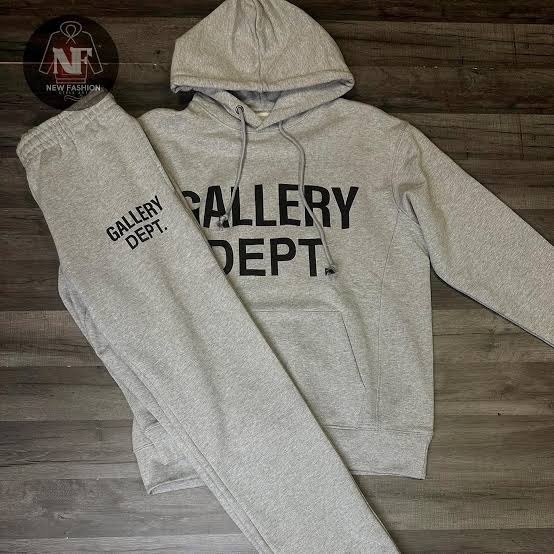
Two gray pieces laid out on a bed, forty euros apart, and a decision most of us make in about four seconds flat. Here’s the shape of it: a full tracksuit comes in at €100, while a hoodie bought by itself is €70 and joggers are another €70, which puts the same outfit at €140 if you pick it up a piece at a time. Looks settled, doesn’t it. It isn’t, quite, and the arithmetic deserves five minutes of your attention before you drop anything into a cart at Gallery Dept and get on with your evening.
The €40 gap, and what it’s actually buying
Forty euros is a t-shirt (€50) with a bit left over, or a trucker cap (€35) and a train ticket. As a saving it’s real, and I’m not going to pretend otherwise.
But it only counts if you wanted both halves to begin with. If the hoodie was the thing you came for and the joggers are just sort of there, you haven’t saved €40 — you’ve spent €30 more than you meant to, on trousers you feel lukewarm about. Plenty of sets live out their lives exactly like that, one half in rotation and the other half folded, which is a slightly sad way to spend a hundred euros.
How often does head-to-toe leave the house?
Be honest about this one, because the whole decision hangs off it. A matching set is at its best when you’re in motion: the 6 a.m. train out of Bologna, the queue at airport security, the first properly cold morning in November when it’s 8 °C outside, and you want one decision instead of four.
Other places, less so. Dinner. An office that isn’t fully relaxed about these things. The passeggiata through a small centro storico at nine in the evening, where everyone has visibly thought about their jacket. One print running top to bottom reads loud there, not because it looks bad but because it reads as a uniform, and uniforms get looked at.
- Travel days, where comfort beats everything else and you’re sitting still for hours anyway.
- Those damp mornings when getting dressed has to be over in ninety seconds.
- A weekend at home that might turn into a walk and a coffee, or might not.
- The gym bag, since the halves end up doing separate jobs on separate days.
Count those days in your own month. If the number comes out low, that €100 set is really a €100 hoodie with something extra attached.
Splitting it up, which is what happens anyway
Here’s where the honest answer lives. Almost nobody who owns a set wears it as a set most of the time. The sets on the Gallery Dept Tuta page carry one print across both halves — gray mélange Logo, the Paint Splatter gray, the navy Hollywood CA with its back print — and each half still stands up on its own the following morning.
The hoodie goes over jeans and nobody can tell it arrived with trousers. The joggers go under a plain cotton jersey tee (€50) and read as joggers, full stop. So you end up living in separates either way. You just paid €100 for them rather than €140, and agreed in advance that they’d match on the days you felt like it.
Which quietly changes the question you’re asking. It stops being set against separates and becomes something duller: two pieces that happen to match, against two pieces you chose one at a time and that probably won’t.
Two grays that aren’t the same gray
This is the bit that settles it for a lot of people. Much of this stuff gets its color as a finished piece, or a wash made to pull the tone back, so the shade shifts slightly from one item to the next. Buy a gray hoodie in March and gray joggers in July and there’s a fair chance you’ve got cousins rather than twins.
A set sidesteps that, since both halves were dyed as one item. And then there’s a duller reason on top of it. The sweatpants in the catalogue come in black (the Logan Dépt de la Galerie) and cream (the Sport Elegant DÉPT). Gray joggers on their own basically don’t exist here. So if gray mélange head to toe is the picture in your head, the €100 set is the only road to it.
| Pro Tip: When the color you want exists only as a set, buy the set and treat the second half as already discounted — roughly €30 for fleece joggers that cost €70 on their own. That’s the one case where the money and the wardrobe agree with each other. |
The numbers, laid out
| What you buy | Price | What you end up with |
| Full tracksuit, one print on both halves | €100 | A pair that matches, and two pieces that still work apart |
| Hoodie and joggers bought separately | €140 | Your own two colors, two prints, and no promise they sit together |
| Hoodie and a t-shirt | €120 | A layered outfit rather than a set — fleece on top, jersey underneath |
| Hoodie on its own | €70 | The piece that gets worn most, and nothing else to think about |
| Joggers on their own | €70 | Fine, as long as there’s already a top at home for them |
Read the last column before you read the price. The €140 row is the expensive one on paper and the roomier one in practice, because you picked both colors yourself. The €100 row is cheaper and narrower. The €120 row isn’t really competing with either — a hoodie and a tee is a different kind of day out, and it handles an April that can’t decide better than two heavy pieces do.
- If you’d genuinely wear both halves together a few times a month, the set wins twice over.
- Buying for the top and talking yourself into the bottom? Pay the €70 and stop there.
- And gray on gray leaves one road open, which is the €100 one.
Frequently Asked Questions
Is the full tracksuit really cheaper than buying both pieces?
Yes, by a clear margin — €100 against €140. The catch sits in the assumption, though, because that €40 only exists if the joggers were something you wanted anyway.
Can I wear the two halves apart?
That’s what most of us do. Neither piece announces that it showed up with a partner, and the top half usually ends up collecting far more wear than the bottom.
What about a hoodie and a t-shirt instead?
Different purpose entirely. €70 plus €50 gets you €120 of layering instead of a set, which suits a 15 °C afternoon better than fleece on fleece does.
Does it cost more to ship two items than one?
I can’t put a figure on it. Shipping options and costs show up at checkout and depend on where the parcel is going, so that’s the only place you’ll see a real number.
So count your head-to-toe days first and look at the prices second. Four or five such days a month and the set is the better hundred euros you’ll spend this autumn. One, and you want the hoodie and nothing after it. Either way, make the call before you’re standing in the cart with a card in your hand.

How to Choose a Second-Hand Car for Your Perth Commute

How to make an older commercial property work for a modern business

Why Your Beauty Clinic in Bali Matters for Filler Results

4 Ecommerce Businesses That Need to Invest in Outsourced 3PL Logistics Services

Fox Fur Coat or Fox Fur Jacket? A Guide to Wearing the Most Dramatic Fur

South Bay Beach Club: Your Guide to a Peaceful Beachfront Getaway

How to Ensure Your Home is Valued Correctly for a Quick Sale

Christopher Dare: The Untold Story of Engineer and Former Husband of Angela Rippon

The 15 Highest-Paid Rugby Players in the World

What Is Fanquer? The Digital Creator Platform Transforming Direct-to-Fan Engagement

Dr Jared Ross: Missouri Appeals Court Upholds Protection Order Over Graphic Torture and Murder Threats

Nancy Hallam: The Inspiring Life, Career, and Success Story Behind Ian Wright’s Wife
How to Ensure Your Home is Valued Correctly for a Quick Sale
Christopher Dare: The Untold Story of Engineer and Former Husband of Angela Rippon
The 15 Highest-Paid Rugby Players in the World
What Is Fanquer? The Digital Creator Platform Transforming Direct-to-Fan Engagement
Dr Jared Ross: Missouri Appeals Court Upholds Protection Order Over Graphic Torture and Murder Threats
Nancy Hallam: The Inspiring Life, Career, and Success Story Behind Ian Wright’s Wife
-
 Real Estate9 months ago
How to Ensure Your Home is Valued Correctly for a Quick Sale
-
Celebrity11 months ago
Christopher Dare: The Untold Story of Engineer and Former Husband of Angela Rippon
-
 Sports5 months ago
The 15 Highest-Paid Rugby Players in the World
-
 Technology5 months ago
What Is Fanquer? The Digital Creator Platform Transforming Direct-to-Fan Engagement
-
 Celebrity5 months ago
Dr Jared Ross: Missouri Appeals Court Upholds Protection Order Over Graphic Torture and Murder Threats
-
Celebrity12 months ago
Nancy Hallam: The Inspiring Life, Career, and Success Story Behind Ian Wright’s Wife
-

 Celebrity8 months ago
Who Is Azriel Crews? Inside the Life and Career of Terry Crews’ Daughter
-
 Celebrity11 months ago
Who Is Maisie Mae Roffey? The Private Life, Family Story, and Quiet Success of Julie Walters’ Daughter