
Technology
Master Information Block: Complete Guide to Its Role in LTE and 5G Networks


The master information block is one of the most important concepts in modern cellular communication systems. It plays a central role in how mobile devices connect to networks like LTE and 5G. Even though it is small in size, its importance is massive. Without it, a device cannot properly access or understand a network.
In simple terms, the master information block acts like a starting point or a bootloader. It provides just enough information for a device to begin communicating with a cell. This makes it the first critical step in the entire network access process. Every smartphone, tablet, or IoT device relies on it whenever it connects to a cellular network.
Quick Overview
| Feature | Details |
|---|---|
| Name | Master Information Block (MIB) |
| Used In | LTE, 5G NR, NB IoT |
| Function | Initial system broadcast message |
| Transmission Channel | PBCH |
| Payload Size | 24 bits |
| Purpose | Helps UE decode further system information |
| Key Data | Bandwidth, frame number, scheduling info |
| Role | First step in network access |
| Reliability | High reliability with repetition |
| Variants | LTE MIB, NR MIB, MIB NB |
What Is a Master Information Block?
The master information block is a core system information message broadcast by cellular base stations. It is designed to be small, simple, and extremely reliable. Its main job is to provide essential parameters that a user equipment device needs right after synchronization.
When a device powers on or searches for a network, it first detects synchronization signals. After that, the next step is decoding the master information block. Without successfully decoding it, the device cannot move forward to access additional network information.
Why Master Information Block Is Important?
The master information block is important because it acts as the foundation of the entire connection process. It ensures that devices can quickly understand how a network is structured without needing complex data upfront.
This design helps reduce connection time and improves efficiency. It also ensures that even devices in weak signal areas can still receive the basic information needed to connect. In short, the master information block makes network access faster, simpler, and more reliable.
Role of Master Information Block in LTE Networks
In LTE networks, the master information block is transmitted by the base station known as the eNodeB. It is broadcast continuously over the Physical Broadcast Channel. This allows all nearby devices to receive it without needing a dedicated connection.
The LTE master information block contains essential details such as system bandwidth, system frame number, and control channel configuration. These details help the device understand how to interpret the network’s signals and prepare for further communication.
Role of Master Information Block in 5G Networks
In 5G networks, the master information block plays a similar role but with some important differences. It is transmitted by the gNodeB and is part of the synchronization signal block.
The 5G master information block focuses more on guiding the device toward decoding System Information Block 1. It includes scheduling information and subcarrier spacing details that are unique to 5G technology. This allows devices to efficiently locate and decode additional network data.
Key Characteristics of Master Information Block
The master information block is designed with several important characteristics that make it effective. It is very small in size, typically only 24 bits. This ensures fast transmission and easy decoding.
It is transmitted repeatedly over fixed intervals, making it highly reliable. Even in low signal conditions, devices have multiple chances to receive it. The master information block also uses strong channel coding and modulation techniques to improve accuracy.
Technical Structure of Master Information Block
The structure of the master information block is carefully optimized. It contains only the most essential parameters required for initial access. This includes timing information, bandwidth configuration, and basic control channel settings.
In LTE, the master information block is mapped to the broadcast channel and then to the physical broadcast channel. In 5G, it is carried within the synchronization signal block, which combines synchronization and broadcast information into a single structure.
Parameters Included in Master Information Block
The master information block carries several important parameters. One key parameter is the system frame number, which helps the device synchronize its timing with the network.
In LTE, it also includes the downlink bandwidth and information about antenna configuration. In 5G, it includes subcarrier spacing and scheduling details for locating System Information Block 1. These parameters are essential for understanding how the network operates.
How Master Information Block Is Transmitted?
The master information block is transmitted over the Physical Broadcast Channel. This channel is designed specifically for broadcasting essential system information to all devices in the coverage area.
The transmission is periodic and repeated multiple times within a set interval. In LTE, it is typically generated every 40 milliseconds and transmitted every 10 milliseconds. In 5G, it is transmitted every 80 milliseconds with multiple repetitions to improve reliability.
Initial Access Procedure Using Master Information Block
The master information block is a key part of the initial access procedure. When a device searches for a network, it first detects synchronization signals. Once synchronization is achieved, it attempts to decode the master information block.
After decoding the master information block, the device uses the information to locate System Information Block 1. This allows it to gather more detailed configuration data and proceed with the connection process. Without the master information block, this process cannot continue.
Master Information Block and SIB1 Relationship
The relationship between the master information block and System Information Block 1 is very important. The master information block provides just enough information to help the device find and decode SIB1.
SIB1 contains more detailed network configuration, such as cell access information and scheduling details. Together, the master information block and SIB1 form the foundation of the system information broadcast process.
Differences Between LTE and 5G Master Information Block
There are several differences between LTE and 5G master information block implementations. In LTE, the focus is on providing bandwidth and basic configuration details. In 5G, the focus shifts toward guiding the device to SIB1.
Another difference is in coding techniques. LTE uses convolutional coding, while 5G uses polar coding. The transmission structure also differs, with 5G integrating the master information block into the synchronization signal block.
Master Information Block in NB IoT
In Narrowband IoT, a specialized version known as MIB NB is used. This version is optimized for low power and low bandwidth devices. It carries similar information but is adapted for the constraints of IoT environments.
The master information block in NB IoT ensures that even simple devices can connect efficiently. It supports long battery life and reliable communication in challenging conditions.
Reliability and Efficiency of Master Information Block
The master information block is designed to be highly reliable. It uses repetition, fixed transmission positions, and strong coding techniques to ensure successful decoding.
Its small size also improves efficiency. Devices can quickly process it without using much power or computational resources. This makes it ideal for both high performance smartphones and low power IoT devices.
Broader Meaning of Master Information Block in IT Systems
Beyond telecommunications, the term master information block is sometimes used in a broader sense. In data systems, it can refer to a central record that contains key information about an object or system.
This concept helps maintain consistency and reduces duplication. By storing core data in a single place, other components can reference it instead of maintaining their own copies. This improves data integrity and system efficiency.
Future of Master Information Block in Next Generation Networks
As networks continue to evolve, the role of the master information block will remain essential. Future technologies may introduce new parameters or more efficient transmission methods, but the core concept will stay the same.
The master information block will continue to act as the first step in network access. It will ensure that devices can quickly and reliably connect to increasingly complex networks, including advanced 5G and future 6G systems.
Conclusion
The master information block is a small but powerful component of modern cellular networks. It acts as the gateway to network access, providing essential information that devices need to connect and communicate.
From LTE to 5G and beyond, the master information block remains a critical part of the communication process. Its simple structure, high reliability, and essential role make it one of the most important elements in wireless technology.
FAQs
What is a master information block in simple terms?
A master information block is a small message broadcast by a cellular network that gives devices the basic information needed to connect to the network.
Why is the master information block important?
It is important because it allows devices to access further system information and start the connection process.
Where is the master information block transmitted?
It is transmitted over the Physical Broadcast Channel in both LTE and 5G networks.
What information does the master information block contain?
It contains essential parameters such as system frame number, bandwidth, and scheduling information.
What happens if a device cannot decode the master information block?
If a device cannot decode it, it cannot proceed to access other system information and therefore cannot connect to the network.


Selenite Games has quickly become a widely searched term among gamers, students, and indie game enthusiasts. While many people assume it refers to a single game studio, the reality is more complex and interesting. Selenite Games is best known as a web-based platform that hosts hundreds of browser games, especially unblocked titles accessible in restricted environments like schools or workplaces.
What Is Selenite Games?
Selenite Games is most commonly recognized as an unblocked games platform rather than a single development company. It allows users to play a wide variety of games directly through a web browser without downloading or installing anything. This makes it especially popular in environments where access to traditional gaming platforms is restricted.
At the same time, the term also overlaps with several indie projects and studios that use “Selenite” in their branding. This dual identity makes Selenite Games both a gaming hub and a loosely connected creative ecosystem within the indie gaming space.
The Rise of Unblocked Gaming Platforms
Unblocked gaming platforms like Selenite have gained massive popularity in recent years. Schools and workplaces often restrict access to gaming websites, but platforms like Selenite are designed to bypass these limitations by hosting games on accessible domains.
This rise is tied to the demand for quick entertainment during breaks. Students, in particular, look for easy-to-access games that do not require installation or high-end hardware. Selenite Games meets this demand by offering a large library of browser-based titles that load instantly and run smoothly on most devices.
How Selenite Games Works?
Selenite Games operates as a browser-based hub. Users simply visit the platform and choose from a list of available games. These games are typically lightweight and built using web technologies such as HTML5 or older flash-style frameworks.
One of the standout aspects is its no-download approach. Players can jump into a game instantly without worrying about storage space or installation processes. This convenience is one of the main reasons for its widespread use among casual gamers.
Key Features of Selenite Games
Selenite Games offers several unique features that set it apart from other platforms. One of the most notable is the tab cloak feature, which allows users to disguise the gaming site as something else, such as a school-related page. This helps users avoid detection in restricted environments.
Another important feature is its integrated community tools, including a Discord bot that allows players to interact, share experiences, and discover new games. The platform also focuses on speed and simplicity, ensuring that games load quickly even on lower-end devices.
Types of Games Available on Selenite
The platform hosts a wide range of game genres, making it appealing to different types of players. You can find action games, puzzle games, platformers, idle games, and even simulation-style experiences.
Popular titles often include classic-style games and simple arcade experiences. These games are designed to be easy to pick up and play, making them perfect for short sessions. The variety ensures that there is always something new to try, whether you enjoy strategy, reflex-based challenges, or relaxing gameplay.
Popular Games Found on Selenite
Some of the most recognized titles on Selenite include Kirby’s Dream Land 2, Knife Hit, and various flash-inspired games. These games are known for their simple mechanics and engaging gameplay.
The platform also includes many lesser-known indie titles, which gives players the chance to discover unique gaming experiences that are not widely available on mainstream platforms. This mix of classic and indie games contributes to its growing popularity.
Selenite as an Open Source Project
One of the most interesting aspects of Selenite Games is its connection to open-source development. The platform’s code is available through repositories, allowing developers to study, modify, and expand the project.
This open approach encourages innovation and community involvement. Developers can contribute new features, improve performance, or even create their own versions of the platform. This makes Selenite not just a gaming hub but also a collaborative project within the tech and gaming communities.
Indie Studios Using the Selenite Name
Beyond the platform itself, several indie studios and developers use the name Selenite in their branding. These include small teams focused on creating unique gaming experiences.
For example, The Selenite Forge is a small indie studio known for developing strategy and puzzle games. Another example is a pixel-art adventure game set in a crystal-themed universe. These projects show how the Selenite name is associated with creativity and artistic experimentation.
Selenite Games and Horror Indie Development
Selenite Games is also linked to indie horror experiences. Some descriptions highlight the platform or associated studios as creators of immersive, mood-driven horror games.
These games focus on atmosphere, storytelling, and psychological tension rather than fast-paced action. The goal is to create a deep emotional impact on players. This approach aligns with the broader trend in indie gaming, where developers prioritize creativity and narrative over large budgets.
Design Philosophy and Gameplay Style
The design philosophy behind Selenite Games revolves around accessibility and simplicity. Games are designed to run smoothly on most devices, making them available to a wide audience.
At the same time, there is a strong emphasis on creativity. Indie projects associated with Selenite often experiment with art styles, storytelling techniques, and gameplay mechanics. This combination of accessibility and innovation makes the platform stand out in the gaming landscape.
Community and Player Engagement
Community engagement plays a significant role in the growth of Selenite Games. Players often share feedback, suggest new features, and discuss their favorite games through online platforms.
This interaction helps developers improve the platform and introduce new content. It also creates a sense of belonging among users, turning casual players into active community members.
Accessibility and Device Compatibility
One of the biggest advantages of Selenite Games is its accessibility. The platform is designed to work on a wide range of devices, including older computers and low-end systems.
Because most games are browser-based, they do not require powerful hardware. This makes Selenite Games an ideal choice for users who do not have access to high-performance gaming setups.
Advantages of Using Selenite Games
Selenite Games offers several benefits that contribute to its popularity. The most important advantage is convenience. Players can access games instantly without downloads or installations.
Another benefit is variety. With hundreds of games available, users can explore different genres and discover new favorites. The platform also provides a quick escape for entertainment during short breaks.
Potential Concerns and Limitations
While Selenite Games has many advantages, it is important to consider potential concerns. Because the platform is often used in restricted environments, some versions may not be officially maintained.
Users should also be cautious about security and avoid sharing personal information. Additionally, the quality of games can vary, as many titles are sourced from different developers.
Future of Selenite Games
The future of Selenite Games looks promising. As browser technology continues to improve, the quality and complexity of web-based games are expected to increase.
The platform may also expand its features, community tools, and game library. At the same time, indie developers using the Selenite name are likely to continue pushing creative boundaries, especially in narrative and horror gaming.
Final Thoughts
Selenite Games is more than just a gaming platform. It represents a unique blend of accessibility, creativity, and community-driven development. Whether you are a student looking for quick entertainment or a gamer interested in indie experiences, Selenite Games offers something for everyone.
Its dual identity as both a game hub and an indie concept makes it stand out in the modern gaming world. As it continues to grow, it is likely to remain a key player in the evolution of browser-based and indie gaming.
FAQs
What is Selenite Games used for?
Selenite Games is mainly used as a web-based platform where users can play unblocked games directly in their browser without downloading anything.
Is Selenite Games safe to use?
Selenite Games can be safe if used carefully, but users should avoid sharing personal information and ensure they are accessing a trusted version of the platform.
How many games are available on Selenite Games?
The platform typically hosts between 150 and 200 games, covering a wide range of genres such as action, puzzle, and arcade.
Is Selenite Games a real game studio?
Selenite Games is not a single official studio, but the name is also used by several indie developers who create small, creative games.
Can Selenite Games run on low-end devices?
Yes, most games on Selenite are designed to run smoothly on low-end devices since they are browser-based and require minimal system resources.


Having an app idea can be exciting. It often starts with simple thoughts, something that could make life easier, solve a problem, or create a new business opportunity. But for most people, that excitement quickly turns into confusion.
Where do you begin?
Do you need a developer?
How do you turn an idea into something real?
If you’re asking these questions, you’re not alone. Many entrepreneurs, business owners, and even first-time founders struggle with the same uncertainty.
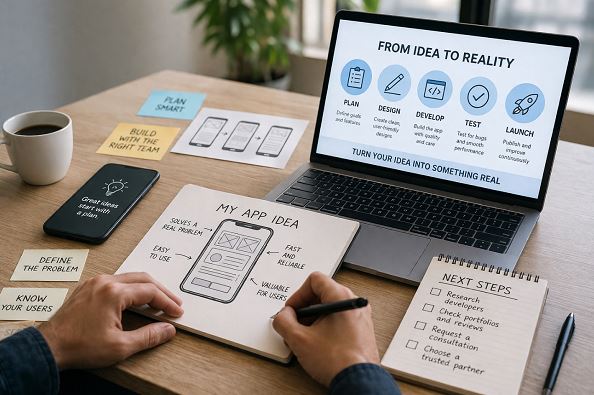
This guide will walk you through a clear, practical path to move from idea to execution—and help you understand when and how to hire an app developer in Houston or partner with a trusted app development company.
Step 1: Define the Problem Your App solves
The biggest mistake people make is focusing too much on the idea itself and not enough on the problem behind it.
Every successful app solves a real problem.
Before doing anything else, ask yourself:
What issue does my app solve?
Who experiences this problem?
Why would someone choose my app over existing solutions?
For example, if your idea is a food delivery app, what makes it different? Faster delivery? Lower fees? Better local options?
Clarity at this stage will save you time, money, and frustration later.
Step 2: Identify Your Target Audience
Not every app is for everyone.
Understanding your users is critical. Think about:
Age group
Location (e.g., Houston or nationwide)
Behavior and habits
Pain points
If you’re planning to launch locally, understanding the Houston market can be a big advantage. Businesses that tailor their apps to specific audiences often see higher engagement and better results.
Step 3: Outline Core Features (Start Small)
You didn’t need perfect app in day one.
In fact, trying to build everything at once is one of the biggest reasons projects fail.
Instead, focus on an MVP (Minimum Viable Product).
Ask:
⦁ What are the must-have features?
⦁ What can be added later?
⦁ For example:
⦁ Login system
⦁ Basic functionality
⦁ Core user interaction
Keep it simple. You can always improve and expand later.
Step 4: Validate Your Idea Before Investing
Before spending money on development, test your idea.
You can:
⦁ Talk to potential users
⦁ Share your concept on forums or social media
⦁ Create a simple landing page
⦁ Collect feedback
Validation helps you understand whether people actually want your app.
It’s better to adjust your idea early than after investing thousands of dollars.
Step 5: Choose the Right App Development Approach
This is where things start getting technical—but don’t worry, you don’t need to be app developer to understand the basics.
You generally have three options:
⦁ iOS app (Apple devices)
⦁ Android app
⦁ Cross-platform app (both with one codebase)
Each option has pros and cons depending on your goals, budget, and timeline.
A trusted app development company will guide you in choosing the right approach based on your needs.
Step 6: Hire the Right App Development Company
This is one of the most important decisions you can make.
If you’re serious about your app, you’ll eventually need to hire an app developer in Houston or work with a professional development team.
But not all developers are the same.
What to Look For:
⦁ Proven experience
⦁ Strong portfolio
⦁ Clear communication
⦁ Transparent pricing
⦁ Positive client reviews
A trusted app development company will not just build your app—they will help you refine your idea, suggest improvements, and guide you through the process.
Why Hiring App Developers in Houston Can Be Beneficial
If your business is based in Texas, working with local developers has advantages.
When you hire an app developer in Houston, you get:
⦁ Better communication (same time zone)
⦁ Easier collaboration
⦁ Understanding of local market needs
⦁ Opportunity for in-person meetings
For many businesses, this creates a smoother and more productive development experience.
Step 7: Understand the Cost of App Development
One of the most common concerns is cost.
The truth is, app development pricing varies widely depending on:
⦁ Features
⦁ Complexity
⦁ Design requirements
⦁ Development approach
A trusted app development company will provide a detailed estimate and explain where your investment is going.
Step 8: Focus on User Experience
Even a great idea can fail if the app is hard to use.
Your app should be:
Simple, Fast, Intuitive
Users should understand how to use it without confusion.
Good design is not just about appearance—it directly affects user retention and success.
Step 9: Plan for Testing and Launch
Before launching your app, it needs to be tested thoroughly.
Testing ensures:
Bugs are fixed, Performance is smooth, Features work correctly
Once everything is ready, your app can be launched on platforms like:
Apple App Store, Google Play Store
A professional development team will guide you through this process.
Step 10: Think Beyond Launch
Launching your app is just the beginning.
After launch, you’ll need:
Updates, Bug fixes, New features, Performance improvements, Apps evolve over time.
That’s why working with a trusted app development company is important—they can support you long-term.
Common Mistakes to Avoid
Many first-time founders make these mistakes:
⦁ Jumping into development without planning
⦁ Choosing developers based only on price
⦁ Ignoring user feedback
⦁ Trying to build too many features at once
These common pitfalls can significantly delay your progress and increase costs, making proper planning and strategic decision-making essential from the start.
How Modern Technology Is Changing App Development
Today’s apps are smarter than ever.
⦁ Businesses are integrating:
⦁ AI features
⦁ Chatbots
⦁ Automation
⦁ Personalized
⦁ Experiences
Users expect more than basic functionality.
Working with experienced developers ensures your app stays competitive in a fast-changing digital world.
Common Questions About App Development
⦁ I have an idea but no technical knowledge. Can I still build an app?
Yes. You don’t need to be technical. A professional team will guide you through every step.
⦁ When should I hire an app developer in Houston?
Once you have a clear idea, defined features, and some validation, it’s the right time to bring in a developer.
⦁ How do I choose a trusted app development company?
Look at their portfolio, reviews, communication style, and experience with similar projects.
⦁ How long does it take to build an app?
It depends on complexity, but most apps take a few months to develop.
⦁ Do I need to build both iOS and Android apps?
Not always. It depends on your audience. Cross-platform development can be a good starting point.
Conclusion
Having an app idea is the first step—but turning it into a successful product requires planning, validation, and the right development partner.
If you take the time to understand your idea, define your goals, and work with the right team, you can build something that truly makes an impact.
When you’re ready, choosing to hire an app developer in Houston or partner with a trusted app development company can turn your vision into a real, working product.
Start small, stay focused, and build something meaningful.


Cruise ships have come a long way in the past two decades. They were once thought of as little more than floating hotels – places to eat, swim, and catch a show – but today’s vessels are genuinely complex technological environments. Automation, digital connectivity, and immersive entertainment now shape the passenger experience in ways that would have seemed far-fetched not long ago. Robotics, artificial intelligence, and virtual reality have all found a home at sea.
If you’re researching an upcoming trip, comparison platforms list options such as P&O cruise deals alongside details about routes and onboard facilities. Price and itinerary still matter most to many travellers, of course, but the technology angle is becoming harder to ignore when choosing between ships.
Robotics entering the hospitality space
Perhaps the most eye-catching development is the arrival of robotics in guest-facing roles. Robotic bartenders have appeared on several ships in recent years – mechanical arms that mix cocktails, measure ingredients with impressive accuracy, and deliver drinks to waiting passengers. It’s a novelty, certainly, but it’s also a sign of where things are heading.
Cruise ships are actually rather well-suited to trialling this kind of technology. The layout is predictable, the footfall is high, and the environment is controlled in a way that a city-centre bar simply isn’t. That makes them useful testing grounds.
Behind the scenes, automation is doing useful work too. Galley equipment can hold precise temperatures and timings across enormous quantities of food, which matters enormously when you’re feeding several thousand people a day. Robotic cleaning systems are also increasingly common in both passenger cabins and public spaces.
None of this is about replacing the crew. In most cases, these systems handle the repetitive, time-consuming tasks so that staff can spend more energy on the things that actually require a human touch – proper conversation, problem-solving, genuine hospitality.
Virtual reality expanding onboard entertainment
VR has also made its way aboard, giving passengers experiences that would be completely impossible to offer through conventional means on a ship. Simulated skydiving, underwater exploration, virtual sporting activities – these aren’t things you can easily accommodate with a theatre and a games deck.
What’s particularly interesting is that VR doesn’t require the same physical footprint as traditional entertainment venues. A relatively small installation can offer a huge variety of experiences, which suits the spatial constraints of even the largest ships.
Some cruise lines have taken a more educational approach. Virtual tours of historical sites or natural environments tied to the ship’s destinations have been trialled, letting passengers get a feel for an upcoming port of call before they step ashore. It’s an imaginative use of the technology, and one that genuinely adds something to the journey rather than just filling time.
The hardware itself keeps improving – lighter headsets, more responsive systems, smoother integration with entertainment programmes.
Digital companions and AI assistance
Artificial intelligence is quietly influencing things at a less flashy level, too. Most major cruise lines now offer apps that let passengers handle a surprising amount from their phones. Dining reservations, excursion bookings, activity schedules, onboard messaging – it can all be managed from a single platform.
Recommendation systems that learn your preferences and suggest relevant events or dining options are becoming more common, though they’re still a work in progress on most ships. The concept is familiar enough from streaming services and online shopping; applying it to a holiday is a logical next step.
Voice-controlled cabin features are appearing as well. Adjusting the lighting, changing the temperature, pulling up entertainment – all via simple voice commands, much like a smart speaker at home. Small thing, but it does make the cabin feel noticeably more modern.
Smart infrastructure behind the scenes
A great deal of what keeps a modern cruise ship running smoothly is entirely invisible to passengers. Networks of sensors monitor everything from engine performance to energy usage in real time, flagging potential maintenance issues before they become actual problems.
IoT systems allow different parts of the ship to communicate with each other continuously, which helps engineers keep everything running efficiently. It’s unglamorous, but it’s genuinely important.
Anonymised passenger movement data is also used to manage crowds and plan staffing. If a particular venue is filling up faster than expected, or a certain time slot is drawing unusually large numbers, operators can respond accordingly – shifting entertainment schedules, redistributing staff, easing congestion. Passengers rarely notice this happening, which is rather the point.
Connectivity at sea
Getting decent internet in the middle of the Atlantic has historically been a frustrating experience. That’s changed considerably. New satellite networks and improved antenna systems mean that many ships now offer connectivity that’s genuinely usable – fast enough for streaming, video calls, and cloud applications.
This matters practically for passengers who need to stay in touch with work or family. It also enables the expansion of digital services across the ship, since more of those services depend on stable connectivity to function properly.
For crew members on long contracts, better connectivity also makes a real difference to their quality of life – staying in touch with home is considerably easier than it was even five years ago.
The broader technological ecosystem
Put all of this together and you have something that genuinely resembles a floating technology hub. A large cruise ship is essentially a small city that never stops moving – it has to sustain thousands of people around the clock while crossing open ocean, maintaining safety standards, managing energy consumption, and running a full entertainment and hospitality operation simultaneously. That’s a remarkable logistical challenge, and technology is deeply embedded in how it’s met.
Future developments will likely include advances in energy systems, broader automation, and more sophisticated immersive entertainment. Different cruise lines will move at different speeds, but the direction of travel seems fairly clear.
Technology shaping the future of cruising
Cruising has always appealed to people who want multiple destinations without the hassle of constant packing and repacking. That core appeal hasn’t changed. What has changed is the layer of technology woven through the experience – from the moment you book to the last night onboard.
Robotics, AI, VR, smart infrastructure – these aren’t gimmicks bolted onto a traditional product. They’re becoming genuinely integral to how modern ships operate and how passengers experience life at sea. The destinations, the food, the relaxation – those things remain central. But technology is now part of the fabric of cruising in a way it simply wasn’t before, and that’s only going to become more pronounced.

Rise Above Competitors with Influencer and SMM Marketing

Increase Social Capital with Proven SMM Promotion Strategies

Safe and Effective Ways to Buy Growth for Marketing Success

How Influencer Collaboration Shapes the Future of Growth

Targeted Social Media Boosts That Drive Real Growth

Build Brand Authority by Promoting with Confidence

Enclomimed 25 (Enclomiphene) – Effective PCT Protocol

Nancy Hallam: The Inspiring Life, Career, and Success Story Behind Ian Wright’s Wife

Who Is Maisie Mae Roffey? The Private Life, Family Story, and Quiet Success of Julie Walters’ Daughter

Roy Hodges: Biography, Lifestyle, Net Worth, Family & Success Story (2025)

Johnny Carell: Inside the Life, Family, and Rising Success of Steve Carell’s Son

Meet Nancy Strang: The Inspiring Life, Success Story, and Legacy of Louis Theroux’s Wife
Enclomimed 25 (Enclomiphene) – Effective PCT Protocol
Nancy Hallam: The Inspiring Life, Career, and Success Story Behind Ian Wright’s Wife
Who Is Maisie Mae Roffey? The Private Life, Family Story, and Quiet Success of Julie Walters’ Daughter
Roy Hodges: Biography, Lifestyle, Net Worth, Family & Success Story (2025)
Johnny Carell: Inside the Life, Family, and Rising Success of Steve Carell’s Son
Meet Nancy Strang: The Inspiring Life, Success Story, and Legacy of Louis Theroux’s Wife
-
 Health3 months ago
Enclomimed 25 (Enclomiphene) – Effective PCT Protocol
-
Celebrity5 months ago
Nancy Hallam: The Inspiring Life, Career, and Success Story Behind Ian Wright’s Wife
-
Celebrity5 months ago
Who Is Maisie Mae Roffey? The Private Life, Family Story, and Quiet Success of Julie Walters’ Daughter
-
Celebrity4 months ago
Roy Hodges: Biography, Lifestyle, Net Worth, Family & Success Story (2025)
-
Celebrity6 months ago
Johnny Carell: Inside the Life, Family, and Rising Success of Steve Carell’s Son
-
Celebrity4 months ago
Meet Nancy Strang: The Inspiring Life, Success Story, and Legacy of Louis Theroux’s Wife
-
 Celebrity3 months ago
Who Is Daniel Clifton Pratt? Inside the Life, Family Values, and Legacy Behind Chris Pratt’s Father
-
 Celebrity6 months ago
Charlotte Edwardes: The Inspiring Journey of a British Journalist and Robert Peston’s Partner